
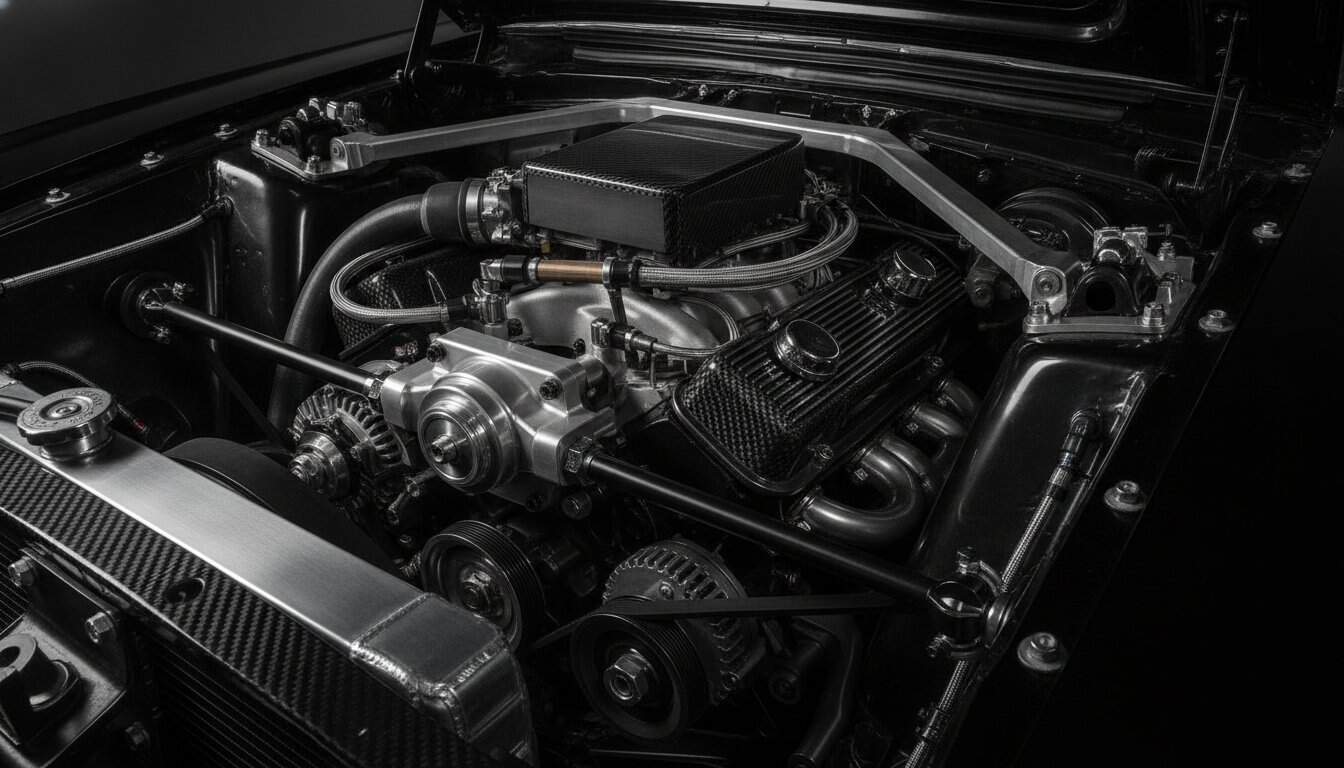
Your classic Mustang should feel like a performance machine, not a wandering boat with a steering wheel that treats your inputs as mere suggestions. That frustrating two-inch dead spot in the center isn’t a charming vintage quirk; it’s a mechanical limitation that drains your confidence at highway speeds. A rack and pinion steering conversion for classic mustang is the most effective way to bridge the gap between 1960s soul and 2026 precision. You deserve a car that tracks straight and responds instantly to every flick of the wrist.
I know the anxiety that comes with modifying a legend, especially when you’re worried about header clearance or steering geometry. This guide will walk you through the technical nuances of modern kits, from affordable AJE Suspension options to premium Flaming River setups. You’ll learn how to select a system that fits your specific engine and header combination without the headache of trial and error. We’ll explore the logistics of eliminating bump steer and achieving that modern, razor-sharp handling that makes every drive an adventure rather than a chore.
Key Takeaways
- Identify the mechanical flaws of the original recirculating ball system to understand why a rack and pinion steering conversion for classic mustang is the definitive solution for modern handling.
- Master the complexities of steering geometry to eliminate bump steer and ensure your Mustang tracks true through every corner.
- Evaluate the critical differences between manual and power rack options to match your steering ratio with your specific driving goals.
- Navigate common installation hurdles like header clearance and steering column modifications with a meticulous pre-installation checklist.
- Discover how to integrate your new steering system with modern suspension and braking components for a cohesive, high-performance driving experience.
Why Your Classic Mustang Steering Feels Vague and How Rack and Pinion Fixes It
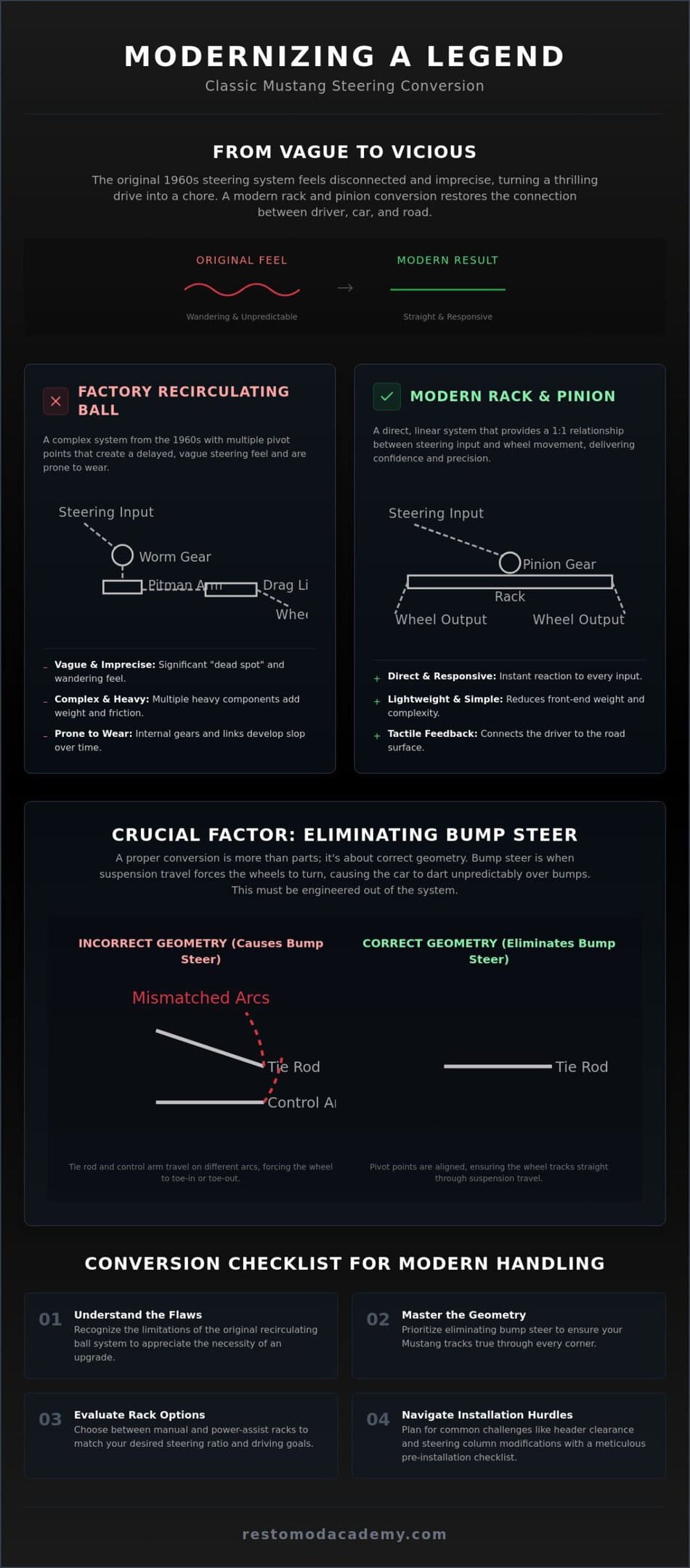
Driving a vintage Mustang through a winding canyon road should be a joy, but the original steering often turns it into a stressful workout. The factory recirculating ball system was designed for the bias-ply tires of the 1960s, not the high-grip radials we use today. This system relies on a complex chain of command: the steering shaft turns a worm gear, which moves ball bearings, which push a sector shaft, which finally moves the pitman arm and a series of drag links. By the time that motion reaches your tires, the message has been diluted by every pivot point in the assembly.
Over time, the internal tolerances in the steering box widen as the gears wear down. This creates a vague, wandering sensation where the car seems to have a mind of its own on straightaways. You find yourself constantly sawing at the wheel just to stay in your lane. Implementing a rack and pinion steering conversion for classic mustang solves this by installing a precise rack and pinion steering mechanism that offers a linear, predictable response. It is a transition from mechanical guesswork to engineering certainty, providing the stability required for 2026 road conditions.
To better understand this concept, watch this helpful video:
Recirculating Ball vs. Rack and Pinion
The traditional steering box is a heavy, high-friction unit that lacks the finesse of modern hardware. When you swap it for a rack, you’re choosing a 1:1 relationship between your hands and the asphalt. This directness is impossible to achieve with a 60-year-old box, no matter how many times you rebuild it. You’ll also notice the weight difference immediately. The original Bendix-style power steering systems used a separate control valve and a massive hydraulic ram that sat low in the chassis. Tossing those components in favor of an integrated rack lightens the front end and removes several common leak points from your garage floor.
The Impact on Driver Confidence
Real confidence comes from predictability. When you dive into a turn, you shouldn’t have to guess where the front wheels are pointing. A modern rack provides tactile feedback, vibrating with the texture of the road and loading up naturally as cornering forces build. This connection is the heartbeat of a successful restomod project. It allows you to push the car harder, knowing that every input will result in a crisp, immediate change in direction. It is the difference between driving a piece of history and driving a performance car that happens to look like one.
Understanding Steering Geometry: Eliminating Slop and Bump Steer
You cannot simply bolt a modern rack into a 1960s chassis and expect immediate perfection. The soul of a successful rack and pinion steering conversion for classic mustang lives in the geometry, not just the hardware. If your pivot points are misaligned, you will introduce a phenomenon known as bump steer. This occurs when the car steers itself as the suspension travels through its vertical range. Imagine hitting a bridge expansion joint and feeling the car dart toward the next lane. It is a jarring experience that undermines the very confidence we are trying to build.
The Mechanics of Bump Steer
Bump steer happens because the tie rods and the lower control arms travel in different arcs. If the tie rod’s inner pivot point doesn’t sit on the same plane as the control arm’s pivot, the distance between the rack and the spindle changes during compression. This forces the wheel to toe-in or toe-out without any input from you. When modifying these critical safety systems, I always recommend reviewing the NHTSA regulations for vehicle alterers. While these standards are often aimed at professional shops, the underlying engineering principles are essential for any serious DIY builder who values safety as much as speed.
Center Take-Off vs. End Take-Off Racks
For the 1964.5 to 1970 Mustang, the engine bay is notoriously tight. Most modern cars use end take-off racks, but these often require tie rods that are far too long for a vintage Ford front end. Center take-off racks are the logical solution for this platform. They utilize a central bracket to attach the tie rods, which effectively mimics the original drag link geometry. This design keeps the tie rod lengths nearly identical to what the Ford engineers originally intended, making it much easier to keep your alignment specs stable.
The vertical and horizontal mounting position of the rack also determines your turning radius and Ackermann angle. Ackermann is the geometry that allows the inside wheel to turn at a sharper angle than the outside wheel during a corner. If the rack is positioned incorrectly, you might find that your car handles beautifully at 60 mph but struggles to turn into a driveway. Precise mounting ensures you maintain a tight turning circle while enjoying modern precision.
If you are still weighing your options between different manufacturers, take a moment to browse our detailed product reviews. Seeing how these kits fit in real engine bays can save you hours of frustration later.
Choosing the Right Conversion Kit for Your Specific Build
Selecting the right rack and pinion steering conversion for classic mustang is a pivotal moment in your build. It is where your vision for the car meets the reality of the workshop. You aren’t just buying a box of parts; you are choosing the interface through which you will experience every mile. Don’t be tempted by junkyard “budget” swaps using parts from old subcompacts or light trucks. While those might seem cost-effective initially, they often introduce dangerous geometry flaws that compromise the safety and handling of your Ford chassis.
Manual vs. Power Steering Racks
Your first major decision is between manual and power assist. A manual rack is a superb choice for a dedicated drag car or a lightweight small-block Mustang focused on simplicity. It offers the purest feedback and saves several pounds off the nose of the car. However, if you plan to drive your Mustang on the street or navigate tight parking lots, the effort required can be taxing. Modern power racks provide a refined hydraulic assist that feels firm at speed but effortless at low speeds. Integrating these with a vintage engine is straightforward, provided you select a kit with the correct bracketry for your specific pump and pulley setup.
Think about your steering ratio as well. A standard 16:1 ratio feels familiar, but many enthusiasts prefer a quicker 12:1 ratio for that modern, “point-and-shoot” sports car feel. Before you commit, check our category of product reviews to see how different ratios perform in real-world testing. This helps you understand how a kit behaves before it ever touches your frame rails.
Evaluating Kit Quality and Engineering
Engineering matters more than shiny finishes. A high-quality kit should include a robust, thick-gauge mounting bracket. Cheap brackets can flex under load, which introduces a spongy feel that defeats the purpose of the conversion. You should also look for kits that include high-strength u-joints and collapsible steering shafts to ensure safety in the event of a collision. A truly complete kit arrives with every nut, bolt, and fitting required for the job, sparing you from multiple trips to the hardware store.
Decide whether you want a bolt-in crossmember or a weld-in solution. Bolt-in kits are excellent for the home builder because they are reversible and require no specialized welding equipment. If you are aiming for maximum rigidity in a high-horsepower build, a weld-in crossmember might be the right path, though it demands a higher skill level to install correctly. For a list of the tools you’ll need for either approach, visit our recommended gear page to ensure your workshop is ready for the task.
Navigating the Installation: Header Clearance and Column Connection
Your rack and pinion steering conversion for classic mustang is more than just a component swap; it is a surgical procedure for your Ford’s chassis. Precision during the installation phase is what separates a car that feels modern from one that feels compromised. Before you even lift a wrench, you must perform a meticulous measurement of your engine bay. The clearance between your exhaust headers and the steering shaft is often measured in fractions of an inch, and failing to account for this early will lead to significant frustration later in the project.
The Header Clearance Challenge
Header interference is the most common hurdle in this conversion. Long-tube headers, while excellent for horsepower, often occupy the exact space where your new steering shaft needs to pass. I have found that Tri-Y headers are frequently the best choice for rack conversions because their compact design tucks closer to the engine block. If you are committed to your current exhaust setup, you may need to utilize offset u-joints or even a three-joint steering shaft with a support bearing to navigate around the primary tubes. Never “clearance” a header tube with a hammer unless it is absolutely necessary; it’s better to adjust the shaft’s path than to sacrifice exhaust flow.
Modifying the Steering Column
Safety is our primary concern when dealing with the steering column. Most 1964.5 to 1967 Mustangs used a solid, one-piece “spear” steering shaft that can be dangerous in a front-end collision. As part of your installation, you’ll need to cut this original shaft and install a lower column bearing. This allows the shaft to interface safely with the new u-joints while providing a smooth, rattle-free rotation. It is a rewarding piece of workshop labor that transforms a dated safety hazard into a modern, collapsible assembly. To avoid common pitfalls and see which tools I use for these precise modifications, explore our recommended gear guide.
Once the hardware is in place, you must focus on phasing your u-joints. This means aligning the yokes of the u-joints so they operate in sync. If they are out of phase, you will experience a rhythmic binding or “lumpy” feel as you turn the wheel. Finally, remember that your alignment specs must change. A rack and pinion system typically thrives with more positive caster than the factory manual ever called for. Aiming for 3 to 4 degrees of positive caster will provide the self-centering feel and high-speed stability that makes a modern steering system so satisfying to use.
Completing Your Mustang Restomod with Modern Handling
Steering is the most intimate connection you have with your car. While a high-horsepower engine provides the thrill of acceleration, it is the steering that defines the character of your drive. Integrating a rack and pinion steering conversion for classic mustang is the catalyst that turns a collection of parts into a cohesive performance machine. It provides the feedback necessary to exploit every other modification you have made, ensuring that your inputs are translated into immediate action on the asphalt.
The Holistic Handling Package
A precision rack works best when paired with a modern suspension system. If you are still running factory-style leaf springs and stamped control arms, the new steering might actually highlight the weaknesses in your chassis. I recommend linking your steering precision with modern coilover suspension systems to manage the increased cornering loads that a rack allows you to achieve. When you can point the car with such accuracy, you’ll naturally carry more speed through the apex, which puts additional stress on your frame rails and shock towers. Ensure your chassis is reinforced to handle these new capabilities.
This is the essence of what is a restomod: the pursuit of balance. Your steering should talk to your suspension, and both should work in harmony with a high-performance brake system. Precise steering allows for better weight transfer management during heavy braking, keeping the car stable as you load the front tires. It is a virtuous cycle of performance where each upgrade amplifies the others, creating a driving experience that feels modern, safe, and exhilarating.
Your Mentor in the Workshop
Embarking on a project of this scale can feel daunting, but you don’t have to navigate it alone. At Restomod Academy, we focus on helping you avoid the expensive trial and error that plagues so many first-time builders. Our Premium Project Blueprints and Restomod Consulting Services are designed to provide the mechanical clarity you need to succeed. If you have already mastered your steering and are looking for the next challenge, perhaps a modern drivetrain is in your future. You might find our definitive guide to an ls engine swap useful if you are planning to bring modern power and reliability to your engine bay.
Use The Ultimate Restomod Guide as your roadmap to ensure every component you choose fits your overarching vision. Whether you are building a weekend cruiser or a track-day weapon, the satisfaction of completing a rack and pinion steering conversion for classic mustang with your own hands is a feeling that stays with you. Take the leap, pick up your tools, and transform your Mustang into the precision machine it was always meant to be. The workshop is waiting, and the road is calling.
Take the Wheel of Your Mustang’s Future
Modernizing your Ford’s steering is the single most effective way to bridge the gap between vintage style and contemporary performance. By understanding the nuances of steering geometry and overcoming the common hurdles of header clearance, you’ve moved from a passive owner to an informed creator. A rack and pinion steering conversion for classic mustang is more than a mechanical upgrade; it is an investment in the safety and joy of every mile you spend behind the wheel. You now have the knowledge to eliminate bump steer and achieve the razor-sharp handling your car deserves.
Every successful build requires a meticulous roadmap to avoid the pitfalls of trial and error. Authored by seasoned restomod expert Brook Walsh, our resources offer a step-by-step instructional methodology and comprehensive project blueprints to ensure your success. Download The Ultimate Restomod Guide to master your Mustang build and join a community of enthusiasts dedicated to mechanical excellence. Your workshop journey is just beginning, and the rewards of a perfectly tuned machine are well worth the labor. Grab your tools and make it happen.
Frequently Asked Questions
Does a rack and pinion conversion require cutting my Mustang chassis?
Most high quality kits for the 1964.5 to 1970 Mustang are designed as bolt-in solutions that use existing factory mounting points. You won’t need to cut your frame rails or modify the structural integrity of the chassis if you select a reputable brand. However, some racing-oriented crossmembers require welding for maximum rigidity. Always verify the installation requirements of your specific rack and pinion steering conversion for classic mustang before starting the teardown.
Will a rack and pinion kit work with my original 289 or 302 exhaust manifolds?
Yes, most conversion kits are engineered to clear original cast-iron manifolds on small-block engines. The primary clearance issues arise with aftermarket long-tube headers rather than factory parts. If you’re running a stock 289 or 302, the installation is typically straightforward. If you plan to upgrade to headers later, consider a Tri-Y design to maintain the necessary space for the steering shaft and u-joints.
How do I know if a rack and pinion kit will cause bump steer?
You can identify potential bump steer by observing the angle of your tie rods relative to the lower control arms. They should travel in parallel arcs as the suspension moves. If a kit uses a rack that is too narrow or wide for the Mustang’s track width, it will force the wheels to toe-in or toe-out during compression. Reputable manufacturers provide geometry data to prove their pivot points align with factory suspension specifications.
Can I keep my original steering wheel and column with a rack conversion?
You can absolutely retain your vintage steering wheel and column, though it requires some mechanical labor. Most kits require you to cut the original steering shaft and install a lower bearing to create a safe connection point for the new u-joints. Some premium options even offer a complete replacement column if you prefer a tilt function. Maintaining the heritage look of your interior while enjoying modern precision is a hallmark of a great build.
What is the difference between a center take-off and an end take-off rack?
A center take-off rack attaches the tie rods to a central bracket, which closely mimics the original Ford drag link geometry. This is generally preferred for classic Mustangs because it maintains proper tie rod length. End take-off racks attach the rods to the ends of the rack housing. While common in modern cars, end take-off designs can sometimes lead to geometry issues in the narrow engine bays of 1965 to 1970 models.
Is a power rack and pinion worth the extra cost over a manual rack?
Choosing power assist is worth the investment if you plan to use your Mustang as a frequent driver or navigate tight urban environments. Modern power racks provide a firm, communicative feel at speed without the heavy low-speed effort of a manual system. If your car is a dedicated lightweight track machine, a manual rack saves weight and simplifies the engine bay. Consider your primary driving environment before making the final call.
How much faster is the steering ratio on a modern rack compared to the original box?
Modern racks typically offer a 16:1 or a quick-ratio 12:1 setup, which is significantly faster than the original factory boxes. Vintage manual steering often had a slow 19:1 or 22:1 ratio, requiring many turns from lock to lock. Upgrading your rack and pinion steering conversion for classic mustang reduces the steering effort and input required, making the car feel much more responsive and agile during spirited driving sessions.
What u-joint phasing is required for a safe steering shaft installation?
Phasing requires you to align the yokes of the u-joints so they are in the same plane. If the joints are out of phase, the steering will feel lumpy or bind as you rotate the wheel through its travel. This is a critical safety step that ensures smooth torque transfer from the column to the rack. Take your time during this part of the assembly to ensure the shaft rotates freely without any mechanical interference.
Your classic Mustang should feel like a performance machine, not a wandering boat with a steering wheel that treats your inputs as mere suggestions. That frustrating two-inch dead spot in the center isn’t a charming vintage quirk; it’s a mechanical limitation that drains your confidence at highway speeds. A rack and pinion steering conversion for classic mustang is the most effective way to bridge the gap between 1960s soul and 2026 precision. You deserve a car that tracks straight and responds instantly to every flick of the wrist.
I know the anxiety that comes with modifying a legend, especially when you’re worried about header clearance or steering geometry. This guide will walk you through the technical nuances of modern kits, from affordable AJE Suspension options to premium Flaming River setups. You’ll learn how to select a system that fits your specific engine and header combination without the headache of trial and error. We’ll explore the logistics of eliminating bump steer and achieving that modern, razor-sharp handling that makes every drive an adventure rather than a chore.
Key Takeaways
- Identify the mechanical flaws of the original recirculating ball system to understand why a rack and pinion steering conversion for classic mustang is the definitive solution for modern handling.
- Master the complexities of steering geometry to eliminate bump steer and ensure your Mustang tracks true through every corner.
- Evaluate the critical differences between manual and power rack options to match your steering ratio with your specific driving goals.
- Navigate common installation hurdles like header clearance and steering column modifications with a meticulous pre-installation checklist.
- Discover how to integrate your new steering system with modern suspension and braking components for a cohesive, high-performance driving experience.
Why Your Classic Mustang Steering Feels Vague and How Rack and Pinion Fixes It
Driving a vintage Mustang through a winding canyon road should be a joy, but the original steering often turns it into a stressful workout. The factory recirculating ball system was designed for the bias-ply tires of the 1960s, not the high-grip radials we use today. This system relies on a complex chain of command: the steering shaft turns a worm gear, which moves ball bearings, which push a sector shaft, which finally moves the pitman arm and a series of drag links. By the time that motion reaches your tires, the message has been diluted by every pivot point in the assembly.
Over time, the internal tolerances in the steering box widen as the gears wear down. This creates a vague, wandering sensation where the car seems to have a mind of its own on straightaways. You find yourself constantly sawing at the wheel just to stay in your lane. Implementing a rack and pinion steering conversion for classic mustang solves this by installing a precise rack and pinion steering mechanism that offers a linear, predictable response. It is a transition from mechanical guesswork to engineering certainty, providing the stability required for 2026 road conditions.
To better understand this concept, watch this helpful video:
Recirculating Ball vs. Rack and Pinion
The traditional steering box is a heavy, high-friction unit that lacks the finesse of modern hardware. When you swap it for a rack, you’re choosing a 1:1 relationship between your hands and the asphalt. This directness is impossible to achieve with a 60-year-old box, no matter how many times you rebuild it. You’ll also notice the weight difference immediately. The original Bendix-style power steering systems used a separate control valve and a massive hydraulic ram that sat low in the chassis. Tossing those components in favor of an integrated rack lightens the front end and removes several common leak points from your garage floor.
The Impact on Driver Confidence
Real confidence comes from predictability. When you dive into a turn, you shouldn’t have to guess where the front wheels are pointing. A modern rack provides tactile feedback, vibrating with the texture of the road and loading up naturally as cornering forces build. This connection is the heartbeat of a successful restomod project. It allows you to push the car harder, knowing that every input will result in a crisp, immediate change in direction. It is the difference between driving a piece of history and driving a performance car that happens to look like one.
Understanding Steering Geometry: Eliminating Slop and Bump Steer
You cannot simply bolt a modern rack into a 1960s chassis and expect immediate perfection. The soul of a successful rack and pinion steering conversion for classic mustang lives in the geometry, not just the hardware. If your pivot points are misaligned, you will introduce a phenomenon known as bump steer. This occurs when the car steers itself as the suspension travels through its vertical range. Imagine hitting a bridge expansion joint and feeling the car dart toward the next lane. It is a jarring experience that undermines the very confidence we are trying to build.
The Mechanics of Bump Steer
Bump steer happens because the tie rods and the lower control arms travel in different arcs. If the tie rod’s inner pivot point doesn’t sit on the same plane as the control arm’s pivot, the distance between the rack and the spindle changes during compression. This forces the wheel to toe-in or toe-out without any input from you. When modifying these critical safety systems, I always recommend reviewing the NHTSA regulations for vehicle alterers. While these standards are often aimed at professional shops, the underlying engineering principles are essential for any serious DIY builder who values safety as much as speed.
Center Take-Off vs. End Take-Off Racks
For the 1964.5 to 1970 Mustang, the engine bay is notoriously tight. Most modern cars use end take-off racks, but these often require tie rods that are far too long for a vintage Ford front end. Center take-off racks are the logical solution for this platform. They utilize a central bracket to attach the tie rods, which effectively mimics the original drag link geometry. This design keeps the tie rod lengths nearly identical to what the Ford engineers originally intended, making it much easier to keep your alignment specs stable.
The vertical and horizontal mounting position of the rack also determines your turning radius and Ackermann angle. Ackermann is the geometry that allows the inside wheel to turn at a sharper angle than the outside wheel during a corner. If the rack is positioned incorrectly, you might find that your car handles beautifully at 60 mph but struggles to turn into a driveway. Precise mounting ensures you maintain a tight turning circle while enjoying modern precision.
If you are still weighing your options between different manufacturers, take a moment to browse our detailed product reviews. Seeing how these kits fit in real engine bays can save you hours of frustration later.
Choosing the Right Conversion Kit for Your Specific Build
Selecting the right rack and pinion steering conversion for classic mustang is a pivotal moment in your build. It is where your vision for the car meets the reality of the workshop. You aren’t just buying a box of parts; you are choosing the interface through which you will experience every mile. Don’t be tempted by junkyard “budget” swaps using parts from old subcompacts or light trucks. While those might seem cost-effective initially, they often introduce dangerous geometry flaws that compromise the safety and handling of your Ford chassis.
Manual vs. Power Steering Racks
Your first major decision is between manual and power assist. A manual rack is a superb choice for a dedicated drag car or a lightweight small-block Mustang focused on simplicity. It offers the purest feedback and saves several pounds off the nose of the car. However, if you plan to drive your Mustang on the street or navigate tight parking lots, the effort required can be taxing. Modern power racks provide a refined hydraulic assist that feels firm at speed but effortless at low speeds. Integrating these with a vintage engine is straightforward, provided you select a kit with the correct bracketry for your specific pump and pulley setup.
Think about your steering ratio as well. A standard 16:1 ratio feels familiar, but many enthusiasts prefer a quicker 12:1 ratio for that modern, “point-and-shoot” sports car feel. Before you commit, check our category of product reviews to see how different ratios perform in real-world testing. This helps you understand how a kit behaves before it ever touches your frame rails.
Evaluating Kit Quality and Engineering
Engineering matters more than shiny finishes. A high-quality kit should include a robust, thick-gauge mounting bracket. Cheap brackets can flex under load, which introduces a spongy feel that defeats the purpose of the conversion. You should also look for kits that include high-strength u-joints and collapsible steering shafts to ensure safety in the event of a collision. A truly complete kit arrives with every nut, bolt, and fitting required for the job, sparing you from multiple trips to the hardware store.
Decide whether you want a bolt-in crossmember or a weld-in solution. Bolt-in kits are excellent for the home builder because they are reversible and require no specialized welding equipment. If you are aiming for maximum rigidity in a high-horsepower build, a weld-in crossmember might be the right path, though it demands a higher skill level to install correctly. For a list of the tools you’ll need for either approach, visit our recommended gear page to ensure your workshop is ready for the task.
Navigating the Installation: Header Clearance and Column Connection
Your rack and pinion steering conversion for classic mustang is more than just a component swap; it is a surgical procedure for your Ford’s chassis. Precision during the installation phase is what separates a car that feels modern from one that feels compromised. Before you even lift a wrench, you must perform a meticulous measurement of your engine bay. The clearance between your exhaust headers and the steering shaft is often measured in fractions of an inch, and failing to account for this early will lead to significant frustration later in the project.
The Header Clearance Challenge
Header interference is the most common hurdle in this conversion. Long-tube headers, while excellent for horsepower, often occupy the exact space where your new steering shaft needs to pass. I have found that Tri-Y headers are frequently the best choice for rack conversions because their compact design tucks closer to the engine block. If you are committed to your current exhaust setup, you may need to utilize offset u-joints or even a three-joint steering shaft with a support bearing to navigate around the primary tubes. Never “clearance” a header tube with a hammer unless it is absolutely necessary; it’s better to adjust the shaft’s path than to sacrifice exhaust flow.
Modifying the Steering Column
Safety is our primary concern when dealing with the steering column. Most 1964.5 to 1967 Mustangs used a solid, one-piece “spear” steering shaft that can be dangerous in a front-end collision. As part of your installation, you’ll need to cut this original shaft and install a lower column bearing. This allows the shaft to interface safely with the new u-joints while providing a smooth, rattle-free rotation. It is a rewarding piece of workshop labor that transforms a dated safety hazard into a modern, collapsible assembly. To avoid common pitfalls and see which tools I use for these precise modifications, explore our recommended gear guide.
Once the hardware is in place, you must focus on phasing your u-joints. This means aligning the yokes of the u-joints so they operate in sync. If they are out of phase, you will experience a rhythmic binding or “lumpy” feel as you turn the wheel. Finally, remember that your alignment specs must change. A rack and pinion system typically thrives with more positive caster than the factory manual ever called for. Aiming for 3 to 4 degrees of positive caster will provide the self-centering feel and high-speed stability that makes a modern steering system so satisfying to use.
Completing Your Mustang Restomod with Modern Handling
Steering is the most intimate connection you have with your car. While a high-horsepower engine provides the thrill of acceleration, it is the steering that defines the character of your drive. Integrating a rack and pinion steering conversion for classic mustang is the catalyst that turns a collection of parts into a cohesive performance machine. It provides the feedback necessary to exploit every other modification you have made, ensuring that your inputs are translated into immediate action on the asphalt.
The Holistic Handling Package
A precision rack works best when paired with a modern suspension system. If you are still running factory-style leaf springs and stamped control arms, the new steering might actually highlight the weaknesses in your chassis. I recommend linking your steering precision with modern coilover suspension systems to manage the increased cornering loads that a rack allows you to achieve. When you can point the car with such accuracy, you’ll naturally carry more speed through the apex, which puts additional stress on your frame rails and shock towers. Ensure your chassis is reinforced to handle these new capabilities.
This is the essence of what is a restomod: the pursuit of balance. Your steering should talk to your suspension, and both should work in harmony with a high-performance brake system. Precise steering allows for better weight transfer management during heavy braking, keeping the car stable as you load the front tires. It is a virtuous cycle of performance where each upgrade amplifies the others, creating a driving experience that feels modern, safe, and exhilarating.
Your Mentor in the Workshop
Embarking on a project of this scale can feel daunting, but you don’t have to navigate it alone. At Restomod Academy, we focus on helping you avoid the expensive trial and error that plagues so many first-time builders. Our Premium Project Blueprints and Restomod Consulting Services are designed to provide the mechanical clarity you need to succeed. If you have already mastered your steering and are looking for the next challenge, perhaps a modern drivetrain is in your future. You might find our definitive guide to an ls engine swap useful if you are planning to bring modern power and reliability to your engine bay.
Use The Ultimate Restomod Guide as your roadmap to ensure every component you choose fits your overarching vision. Whether you are building a weekend cruiser or a track-day weapon, the satisfaction of completing a rack and pinion steering conversion for classic mustang with your own hands is a feeling that stays with you. Take the leap, pick up your tools, and transform your Mustang into the precision machine it was always meant to be. The workshop is waiting, and the road is calling.
Take the Wheel of Your Mustang’s Future
Modernizing your Ford’s steering is the single most effective way to bridge the gap between vintage style and contemporary performance. By understanding the nuances of steering geometry and overcoming the common hurdles of header clearance, you’ve moved from a passive owner to an informed creator. A rack and pinion steering conversion for classic mustang is more than a mechanical upgrade; it is an investment in the safety and joy of every mile you spend behind the wheel. You now have the knowledge to eliminate bump steer and achieve the razor-sharp handling your car deserves.
Every successful build requires a meticulous roadmap to avoid the pitfalls of trial and error. Authored by seasoned restomod expert Brook Walsh, our resources offer a step-by-step instructional methodology and comprehensive project blueprints to ensure your success. Download The Ultimate Restomod Guide to master your Mustang build and join a community of enthusiasts dedicated to mechanical excellence. Your workshop journey is just beginning, and the rewards of a perfectly tuned machine are well worth the labor. Grab your tools and make it happen.
Frequently Asked Questions
Does a rack and pinion conversion require cutting my Mustang chassis?
Most high quality kits for the 1964.5 to 1970 Mustang are designed as bolt-in solutions that use existing factory mounting points. You won’t need to cut your frame rails or modify the structural integrity of the chassis if you select a reputable brand. However, some racing-oriented crossmembers require welding for maximum rigidity. Always verify the installation requirements of your specific rack and pinion steering conversion for classic mustang before starting the teardown.
Will a rack and pinion kit work with my original 289 or 302 exhaust manifolds?
Yes, most conversion kits are engineered to clear original cast-iron manifolds on small-block engines. The primary clearance issues arise with aftermarket long-tube headers rather than factory parts. If you’re running a stock 289 or 302, the installation is typically straightforward. If you plan to upgrade to headers later, consider a Tri-Y design to maintain the necessary space for the steering shaft and u-joints.
How do I know if a rack and pinion kit will cause bump steer?
You can identify potential bump steer by observing the angle of your tie rods relative to the lower control arms. They should travel in parallel arcs as the suspension moves. If a kit uses a rack that is too narrow or wide for the Mustang’s track width, it will force the wheels to toe-in or toe-out during compression. Reputable manufacturers provide geometry data to prove their pivot points align with factory suspension specifications.
Can I keep my original steering wheel and column with a rack conversion?
You can absolutely retain your vintage steering wheel and column, though it requires some mechanical labor. Most kits require you to cut the original steering shaft and install a lower bearing to create a safe connection point for the new u-joints. Some premium options even offer a complete replacement column if you prefer a tilt function. Maintaining the heritage look of your interior while enjoying modern precision is a hallmark of a great build.
What is the difference between a center take-off and an end take-off rack?
A center take-off rack attaches the tie rods to a central bracket, which closely mimics the original Ford drag link geometry. This is generally preferred for classic Mustangs because it maintains proper tie rod length. End take-off racks attach the rods to the ends of the rack housing. While common in modern cars, end take-off designs can sometimes lead to geometry issues in the narrow engine bays of 1965 to 1970 models.
Is a power rack and pinion worth the extra cost over a manual rack?
Choosing power assist is worth the investment if you plan to use your Mustang as a frequent driver or navigate tight urban environments. Modern power racks provide a firm, communicative feel at speed without the heavy low-speed effort of a manual system. If your car is a dedicated lightweight track machine, a manual rack saves weight and simplifies the engine bay. Consider your primary driving environment before making the final call.
How much faster is the steering ratio on a modern rack compared to the original box?
Modern racks typically offer a 16:1 or a quick-ratio 12:1 setup, which is significantly faster than the original factory boxes. Vintage manual steering often had a slow 19:1 or 22:1 ratio, requiring many turns from lock to lock. Upgrading your rack and pinion steering conversion for classic mustang reduces the steering effort and input required, making the car feel much more responsive and agile during spirited driving sessions.
What u-joint phasing is required for a safe steering shaft installation?
Phasing requires you to align the yokes of the u-joints so they are in the same plane. If the joints are out of phase, the steering will feel lumpy or bind as you rotate the wheel through its travel. This is a critical safety step that ensures smooth torque transfer from the column to the rack. Take your time during this part of the assembly to ensure the shaft rotates freely without any mechanical interference.