

What if you could stop treating your 1969 Camaro like a delicate museum piece and start driving it with the confidence of a 2026 supercar? You likely fell in love with your classic for its soul and silhouette, but the reality of 50 year old drum brakes and heavy steering often keeps the vehicle trapped in the garage. It’s frustrating to own a legend that you’re afraid to drive further than five miles from home because you don’t trust the cooling system or the wiring harness.
You deserve a machine that starts every time and stops on a dime. This guide empowers you to master the world of resto mod cars, blending vintage aesthetics with the precision of modern fuel injection and coilover suspension. We’ll outline the exact roadmap for your build, helping you navigate the technical hurdles of fabrication and component selection. You’ll learn how to plan a transformation that delivers daily reliability without sacrificing the heritage that makes your classic special.
Key Takeaways
- Master the delicate balance of preserving vintage aesthetics while integrating modern performance to ensure your project has both soul and reliability.
- Identify the critical differences between street-focused builds and track-ready pro-touring machines to align your engineering choices with your specific driving goals.
- Eliminate safety risks by prioritizing the “Big Three” upgrades—modern engine swaps, disc brakes, and independent suspension—to turn a classic silhouette into a precision powerhouse.
- Navigate the planning phase with a mentor’s precision, from defining your ultimate vision to inspecting donor vehicles for hidden rust traps.
- Future-proof your craft by exploring how electric conversions and 3D printing are revolutionizing the world of resto mod cars for the next generation of builders.
What is a Resto Mod Car? Defining the Modern Classic
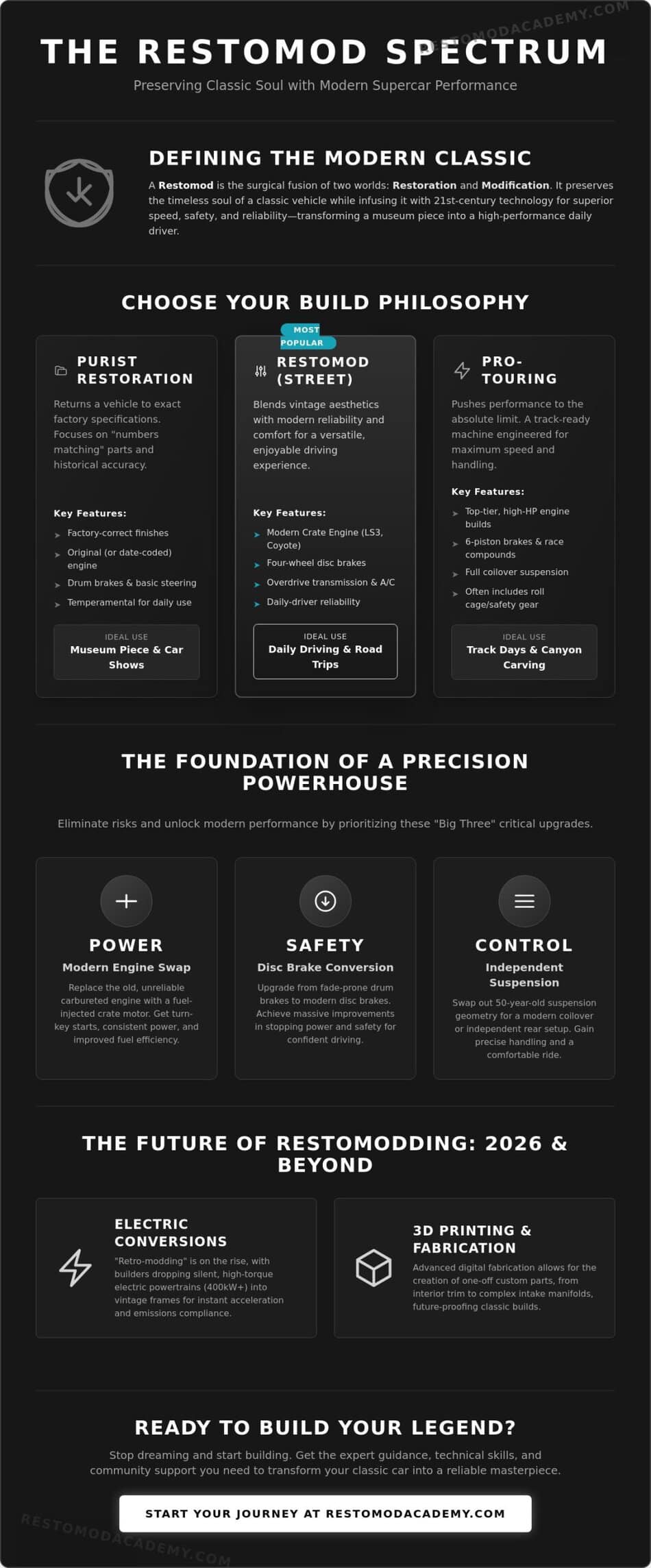
A restomod is the surgical fusion of two distinct automotive worlds: restoration and modification. It involves taking a vintage chassis and infusing it with 21st-century technology to create a machine that looks like a museum piece but drives like a modern supercar. While a traditional restoration seeks to return a vehicle to its exact factory specifications, the restomod philosophy demands more. It’s about preserving the timeless soul of a classic while upgrading the mechanical components to meet today’s standards for speed, safety, and comfort. By 2026, the global market for resto mod cars has reached a projected valuation of $15 billion as more enthusiasts prioritize turn-key reliability over the fragile nature of stock vintage parts.
When you begin Defining Resto-Modification, you’ll find it stands in sharp contrast to the “numbers matching” world. A purist restoration focuses on date-coded bolts and factory-correct finishes that often result in a car too temperamental for a cross-country road trip. Conversely, a restomod build embraces modern fuel injection, disc brakes, and independent rear suspensions. This movement has evolved into a sophisticated engineering discipline where the goal is to eliminate the original manufacturer’s limitations while honoring their design legacy.
To better understand how this concept looks in the real world, watch this breakdown of a classic sleeper build:
The Core Elements of a Restomod Build
Visual preservation is the “Resto” half of the equation. You want to maintain that iconic silhouette, the gleaming chrome bumpers, and the original paint codes that define the car’s era. However, the “Mod” half introduces a mechanical evolution that transforms the driving experience. We’re talking about crate engines like the LS3 or Coyote V8, Wilwood six-piston braking systems, and modern wiring harnesses that replace 50-year-old brittle copper. At the Restomod Academy, we live by a “Built, Not Bought” mindset. This philosophy encourages you to master fabrication and suspension geometry yourself, ensuring that every upgrade serves a specific performance goal rather than just following a trend.
Restomod vs. Restoration: Choosing Your Path
Choosing between a purist restoration and a restomod depends entirely on your vision for the car’s future. A purist restoration preserves history, but it often forces you to accept 1960s-era handling and drum brakes that fade under pressure. Restomodding allows you to create a “daily driver” classic. You can install an overdrive transmission for highway cruising and modern climate control for summer drives. This path turns a weekend garage queen into a reliable, high-performance athlete. If you’re still weighing the pros and cons of each approach, take a moment to read our detailed breakdown of what is a restomod to see which philosophy aligns with your mechanical skills and driving aspirations.
Restomod vs. Pro-Touring: Understanding the Performance Spectrum
Decide early if you want a car that carves canyons or one that cruises to the coast in air-conditioned comfort. While enthusiasts often use the terms interchangeably, the 2026 market draws a sharp line between a standard restomod and a Pro-Touring beast. Today, “Resto Mod” functions as the industry umbrella. It covers everything from traditional engine swaps to “Retro-modding,” where builders drop 400kW electric powertrains into vintage frames. This evolution ensures resto mod cars remain relevant as emissions regulations tighten and battery technology improves.
Resale value depends heavily on which path you choose. Market data from 2025 collector auctions shows that street-focused builds often sell 22% faster than specialized track cars. A broad audience wants a classic that starts every time and keeps them cool. Pro-Touring builds can command higher prices, but only if the fabrication is top-tier and documented. If you are just starting your journey, learn more about the basics in our guide on what is a restomod to find your specific niche.
The Pro-Touring Edge
Focus on the Pro-Touring edge if your goal is the local autocross circuit. These builds prioritize suspension geometry and weight distribution above all else. You aren’t just swapping shocks; you’re re-engineering the chassis for maximum mechanical grip. Expect to run 315mm wide tires and aggressive aero to keep the car planted. For a deep dive into these technical adjustments, consult our Restomod Handling Guide. This style demands a “built, not bought” mentality where performance metrics trump leather seats.
The Street-Legal Restomod
Most builders should aim for a street-legal resto mod. Prioritize creature comforts like sound deadening, A/C, and modern Bluetooth connectivity. A 500-horsepower LS swap is exhilarating, but it becomes a chore if the cabin is 100 degrees and the exhaust drone makes conversation impossible. Many successful projects now begin with new classic body shells to ensure a straight, rust-free foundation before layering in modern luxuries. Balance your horsepower with street manners. A car that idles smoothly in traffic while looking like a 1969 masterpiece is the ultimate achievement for most enthusiasts. Focus on the details that make the drive enjoyable every day.
The Engineering Behind the Build: Power, Safety, and Control
Don’t let the chrome and polished paint fool you; an original 1960s classic is often a mechanical liability in modern traffic. A factory 1967 Mustang equipped with four-wheel drum brakes requires over 200 feet to stop from 60 mph. Compare that to a 2026 commuter car that stops in roughly 120 feet. That 80-foot gap is the difference between a close call and a total loss. Beyond braking, original worm-and-roller steering boxes often have three inches of “dead play” at the center, making high-speed lane changes a gamble. Building resto mod cars isn’t just about speed; it’s about closing the 60% safety gap between vintage aesthetics and modern survival standards.
Modern reliability is the primary driver for builders in 2026. We no longer accept that a classic car must be temperamental or prone to overheating in a drive-thru. The “Big Three” of restomodding, engine swaps, disc brakes, and independent suspension, turn a garage queen into a cross-country cruiser. Electronic fuel injection didn’t just replace the carburetor; it replaced the anxiety of every cold start with the turn-key confidence of a modern legacy.
Engine Swaps: The Heart of the Transformation
The LS vs. Coyote debate defines the current era of performance. Chevrolet’s LS platform is the gold standard for its compact pushrod design and immense aftermarket support. If you’re planning this route, check out The Definitive Guide to an LS Engine Swap to understand the wiring and clearance requirements. Ford’s Coyote V8 offers a high-revving, dual-overhead-cam alternative, though its wider physical footprint requires a more spacious engine bay. Both options provide 400 to 500 horsepower with 100,000-mile maintenance intervals, a feat impossible for original 1960s blocks. Transitioning to Electronic Fuel Injection (EFI) eliminates vapor lock and altitude tuning issues, ensuring your engine breathes perfectly whether you’re at sea level or crossing the Rockies.
Stopping Power and Chassis Rigidity
High-horsepower crate engines are useless if the frame twists under the load. Original unibody cars often lack the structural integrity to handle 450 lb-ft of torque without door gaps shifting or windshields cracking. Installing subframe connectors or a full aftermarket chassis can increase torsional rigidity by more than 50%. This foundation allows for modern rack-and-pinion steering systems, which provide the 14:1 steering ratio required for precision handling. Pair this with a four-wheel disc brake conversion featuring 12-inch or 14-inch rotors. This upgrade ensures your resto mod cars stop as fast as they accelerate, providing the control necessary to navigate 2026 highway speeds with total peace of mind.
Planning Your First Resto Mod Project
Start with the vision. You need to decide if you’re building a weekend cruiser for local meetups or a high-end show-stopper destined for the SEMA floor. This decision dictates every dollar you spend and every hour you log in the garage. A cruiser might focus on a reliable crate engine and cold A/C, while a show car demands shaved firewalls, bespoke upholstery, and show-quality paint. Defining this early prevents you from overspending on parts that don’t align with your end goal.
Next, map out your build sequence to avoid the dreaded project creep. Most projects fail because owners jump into bodywork before the drivetrain is sorted. Follow a logical path: teardown, metalwork, suspension, drivetrain, wiring, and then final assembly. This chronological discipline keeps the project manageable. In the 2026 economy, labor costs for specialized automotive fabrication have risen by 12 percent compared to 2024, making a clear, documented plan essential for staying within your financial limits.
Finding the Perfect Donor Car
Pick a platform with deep aftermarket support to ensure your build doesn’t stall. The 1964 to 1970 Ford Mustang, 1967 to 1969 Chevrolet Camaro, and 1967 to 1972 Chevy C10 trucks remain the gold standard for resto mod cars. When you inspect a donor, look past the faded paint and focus on the frame. Surface rust is a minor nuisance, but structural rot in the torque boxes, cowl vents, or frame rails is a nightmare. If you want to understand the foundational philosophy before buying your first chassis, read our guide on what is a restomod to align your purchase with your performance goals.
The Budget and Tool Checklist
Be honest about your DIY capabilities and your tool chest. To build high-quality resto mod cars, you’ll need a solid base of equipment including a MIG welder for sheet metal repairs, high-quality jack stands, and modern diagnostic scanners for tuning modern EFI systems. Budgeting for 2026 requires a 20 percent contingency fund for hidden costs. Wiring harnesses, custom fuel plumbing, and interior trim pieces often consume a larger portion of the budget than the engine itself. Before you start buying hardware, check out our recommended gear for reviews on the essential tools that will save you hours of frustration.
The Future of Restomodding: 2026 and Beyond
The evolution of resto mod cars is shifting toward a high-tech horizon where classic aesthetics meet cutting-edge sustainability. By 2026, the garage is no longer just a place for grease and oil; it’s a laboratory for innovation. We’re seeing a massive surge in E-Restomods as enthusiasts swap aging internal combustion engines for instant electric torque. Companies like Fellten and Zero Labs are leading the charge, providing modular EV kits that preserve the structural integrity of vintage chassis while delivering performance that rivals modern supercars.
Technology is also democratizing the fabrication process. High-end desktop 3D printing has become a staple for the serious builder. You can now design and print custom nylon brackets, sensor mounts, or bespoke interior trim pieces that fit your 1968 Camaro with laser precision. This tech has lowered the entry barrier for custom fabrication by roughly 50% compared to traditional CNC machining costs. It allows you to spend less time hunting for rare parts and more time perfecting your vision.
Modern Comfort in a Vintage Shell
You don’t have to sacrifice your comfort to drive a legend. Modern resto mod cars now feature sophisticated sound deadening materials, such as 80-mil butyl rubber sheets, which can reduce cabin noise by up to 15 decibels. This makes a 60-year-old muscle car feel as refined as a 2026 luxury sedan. Inside the cabin, the challenge is integrating technology without killing the vintage vibe. Digital gauges from brands like Dakota Digital offer high-resolution screens that stay black when off, maintaining a stock appearance until you turn the key. For a deeper look at balancing these elements, explore our Restomod Interior Ideas.
Joining the Restomod Academy
There is a specific pride that comes from a “built, not bought” project. It’s a badge of honor you wear at every Saturday morning meet. At the Restomod Academy, we believe the best way to learn is through a mix of grit and expert mentorship. Our community acts as a safeguard against the expensive rookie mistakes that typically drain a builder’s bank account and motivation. Following a structured blueprint can save you over $5,000 in wasted parts and labor during a full-scale build.
Don’t let your project sit under a dusty tarp for another decade. Grab the tools and the knowledge you need to finish what you started. Whether you’re wrestling with suspension geometry or wiring a modern ECU, we’re here to guide your hands. Download the Ultimate Restomod Guide today and turn that vintage steel into a modern masterpiece.
Ignite Your Vision and Master the Build
Building resto mod cars isn’t just about the grease and the metal; it’s about preserving a legacy while demanding 2026 levels of performance. You’ve explored how modern suspension geometry and fuel injection transform a vintage chassis into a reliable, high-performance machine. Success in the garage requires a clear vision and the right technical blueprints to navigate complex wiring harnesses or fabrication hurdles. Brook Walsh founded The Restomod Academy to ensure you don’t have to face these challenges alone. We provide comprehensive LS Swap Blueprints and community-driven DIY mentorship to bridge the gap between the grit of the garage and the artistry of design.
The journey from a rusted shell to a modern masterpiece is a rewarding marathon. Every turn of the wrench is a valuable learning opportunity that builds your skills as much as it builds your car. Don’t let your project stall on the jack stands. Take command of your garage and join a group of enthusiasts who value authenticity and the “built, not bought” philosophy. Get The Ultimate Restomod Guide and start your dream build today. Your classic soul is waiting for its modern heart, and we’re here to help you finish it right the first time.
Frequently Asked Questions
Is a restomod worth more than a restored classic car?
A professionally executed restomod often commands a higher market value than a standard restoration because it appeals to modern drivers who demand reliability. Data from the 2024 Hagerty Price Guide shows that high-end restomod builds frequently outperform stock examples by 35 percent at major auctions. Buyers pay a premium for the integration of fuel injection, air conditioning, and performance suspension that makes these vehicles daily-drivable.
Can any classic car be turned into a restomod?
You can transform virtually any vintage vehicle into a restomod provided you have the vision and the fabrication budget to support it. While 1960s muscle cars like the Ford Mustang or Chevrolet Camaro are the most common candidates, we see a 20 percent increase in vintage SUV and truck projects entering the scene this year. Focus on a platform with strong aftermarket support to ensure you can source parts easily.
What is the average cost of a professional restomod build in 2026?
Professional restomod projects typically range from $150,000 to over $300,000 depending on the level of customization and component quality. According to SEMA industry reports, a full “turn-key” build from a reputable shop involves roughly 1,500 to 2,500 man-hours of labor. This investment covers the sourcing of a donor chassis, bespoke interior fabrication, and the installation of a modern crate engine system that ensures peak performance.
Are resto mod cars legal to drive on public roads?
Resto mod cars are entirely legal to drive on public roads as long as they comply with your specific state’s registration and safety requirements. Most builders utilize “specially constructed vehicle” titles or classic car registrations that mandate functional headlights, turn signals, and seatbelts. If you live in a region like California, ensure your engine swap meets CARB EO standards to pass strict emissions testing without complications.
How long does it typically take to complete a restomod project?
A comprehensive restomod build usually takes between 12 and 24 months from the initial teardown to the final shakedown cruise. This timeline accounts for the 400 hours needed for bodywork and paint, alongside the intricate task of perfecting the suspension geometry. Patience is your greatest tool here. Rushing the assembly phase leads to wiring gremlins that can haunt your project for years, so take your time.
Can I restomod a car myself with no previous mechanical experience?
You can certainly begin a restomod journey without prior experience, but you should start with bolt-on upgrades rather than full frame-off restorations. Many successful DIY builders in our community began by replacing drum brakes with modern discs or installing basic electronic ignition systems. Treat every weekend in the garage as a classroom session. Use detailed shop manuals and online technical forums to master one system at a time.
What is the best engine for a first-time restomod build?
The Chevrolet LS series remains the gold standard for first-time builders due to its compact size, massive aftermarket support, and proven reliability. These engines offer a power-to-weight ratio that transforms the driving dynamics of heavy vintage steel. If you prefer the blue oval, the Ford 5.0L Coyote crate engine provides 460 horsepower right out of the box, making it a favorite for 1965 to 1970 Mustang projects.
Does restomodding a car ruin its historical value?
Restomodding only diminishes historical value if the vehicle is a rare, numbers-matching survivor with a production run under 500 units. For the millions of standard coupes and sedans produced in the mid-20th century, modernizing the mechanicals actually increases their utility and resale potential. You aren’t destroying a relic; you’re breathing new life into a machine that might otherwise sit rotting in a barn for another decade.
What if you could stop treating your 1969 Camaro like a delicate museum piece and start driving it with the confidence of a 2026 supercar? You likely fell in love with your classic for its soul and silhouette, but the reality of 50 year old drum brakes and heavy steering often keeps the vehicle trapped in the garage. It’s frustrating to own a legend that you’re afraid to drive further than five miles from home because you don’t trust the cooling system or the wiring harness.
You deserve a machine that starts every time and stops on a dime. This guide empowers you to master the world of resto mod cars, blending vintage aesthetics with the precision of modern fuel injection and coilover suspension. We’ll outline the exact roadmap for your build, helping you navigate the technical hurdles of fabrication and component selection. You’ll learn how to plan a transformation that delivers daily reliability without sacrificing the heritage that makes your classic special.
Key Takeaways
- Master the delicate balance of preserving vintage aesthetics while integrating modern performance to ensure your project has both soul and reliability.
- Identify the critical differences between street-focused builds and track-ready pro-touring machines to align your engineering choices with your specific driving goals.
- Eliminate safety risks by prioritizing the “Big Three” upgrades—modern engine swaps, disc brakes, and independent suspension—to turn a classic silhouette into a precision powerhouse.
- Navigate the planning phase with a mentor’s precision, from defining your ultimate vision to inspecting donor vehicles for hidden rust traps.
- Future-proof your craft by exploring how electric conversions and 3D printing are revolutionizing the world of resto mod cars for the next generation of builders.
What is a Resto Mod Car? Defining the Modern Classic
A restomod is the surgical fusion of two distinct automotive worlds: restoration and modification. It involves taking a vintage chassis and infusing it with 21st-century technology to create a machine that looks like a museum piece but drives like a modern supercar. While a traditional restoration seeks to return a vehicle to its exact factory specifications, the restomod philosophy demands more. It’s about preserving the timeless soul of a classic while upgrading the mechanical components to meet today’s standards for speed, safety, and comfort. By 2026, the global market for resto mod cars has reached a projected valuation of $15 billion as more enthusiasts prioritize turn-key reliability over the fragile nature of stock vintage parts.
When you begin Defining Resto-Modification, you’ll find it stands in sharp contrast to the “numbers matching” world. A purist restoration focuses on date-coded bolts and factory-correct finishes that often result in a car too temperamental for a cross-country road trip. Conversely, a restomod build embraces modern fuel injection, disc brakes, and independent rear suspensions. This movement has evolved into a sophisticated engineering discipline where the goal is to eliminate the original manufacturer’s limitations while honoring their design legacy.
To better understand how this concept looks in the real world, watch this breakdown of a classic sleeper build:
The Core Elements of a Restomod Build
Visual preservation is the “Resto” half of the equation. You want to maintain that iconic silhouette, the gleaming chrome bumpers, and the original paint codes that define the car’s era. However, the “Mod” half introduces a mechanical evolution that transforms the driving experience. We’re talking about crate engines like the LS3 or Coyote V8, Wilwood six-piston braking systems, and modern wiring harnesses that replace 50-year-old brittle copper. At the Restomod Academy, we live by a “Built, Not Bought” mindset. This philosophy encourages you to master fabrication and suspension geometry yourself, ensuring that every upgrade serves a specific performance goal rather than just following a trend.
Restomod vs. Restoration: Choosing Your Path
Choosing between a purist restoration and a restomod depends entirely on your vision for the car’s future. A purist restoration preserves history, but it often forces you to accept 1960s-era handling and drum brakes that fade under pressure. Restomodding allows you to create a “daily driver” classic. You can install an overdrive transmission for highway cruising and modern climate control for summer drives. This path turns a weekend garage queen into a reliable, high-performance athlete. If you’re still weighing the pros and cons of each approach, take a moment to read our detailed breakdown of what is a restomod to see which philosophy aligns with your mechanical skills and driving aspirations.
Restomod vs. Pro-Touring: Understanding the Performance Spectrum
Decide early if you want a car that carves canyons or one that cruises to the coast in air-conditioned comfort. While enthusiasts often use the terms interchangeably, the 2026 market draws a sharp line between a standard restomod and a Pro-Touring beast. Today, “Resto Mod” functions as the industry umbrella. It covers everything from traditional engine swaps to “Retro-modding,” where builders drop 400kW electric powertrains into vintage frames. This evolution ensures resto mod cars remain relevant as emissions regulations tighten and battery technology improves.
Resale value depends heavily on which path you choose. Market data from 2025 collector auctions shows that street-focused builds often sell 22% faster than specialized track cars. A broad audience wants a classic that starts every time and keeps them cool. Pro-Touring builds can command higher prices, but only if the fabrication is top-tier and documented. If you are just starting your journey, learn more about the basics in our guide on what is a restomod to find your specific niche.
The Pro-Touring Edge
Focus on the Pro-Touring edge if your goal is the local autocross circuit. These builds prioritize suspension geometry and weight distribution above all else. You aren’t just swapping shocks; you’re re-engineering the chassis for maximum mechanical grip. Expect to run 315mm wide tires and aggressive aero to keep the car planted. For a deep dive into these technical adjustments, consult our Restomod Handling Guide. This style demands a “built, not bought” mentality where performance metrics trump leather seats.
The Street-Legal Restomod
Most builders should aim for a street-legal resto mod. Prioritize creature comforts like sound deadening, A/C, and modern Bluetooth connectivity. A 500-horsepower LS swap is exhilarating, but it becomes a chore if the cabin is 100 degrees and the exhaust drone makes conversation impossible. Many successful projects now begin with new classic body shells to ensure a straight, rust-free foundation before layering in modern luxuries. Balance your horsepower with street manners. A car that idles smoothly in traffic while looking like a 1969 masterpiece is the ultimate achievement for most enthusiasts. Focus on the details that make the drive enjoyable every day.
The Engineering Behind the Build: Power, Safety, and Control
Don’t let the chrome and polished paint fool you; an original 1960s classic is often a mechanical liability in modern traffic. A factory 1967 Mustang equipped with four-wheel drum brakes requires over 200 feet to stop from 60 mph. Compare that to a 2026 commuter car that stops in roughly 120 feet. That 80-foot gap is the difference between a close call and a total loss. Beyond braking, original worm-and-roller steering boxes often have three inches of “dead play” at the center, making high-speed lane changes a gamble. Building resto mod cars isn’t just about speed; it’s about closing the 60% safety gap between vintage aesthetics and modern survival standards.
Modern reliability is the primary driver for builders in 2026. We no longer accept that a classic car must be temperamental or prone to overheating in a drive-thru. The “Big Three” of restomodding, engine swaps, disc brakes, and independent suspension, turn a garage queen into a cross-country cruiser. Electronic fuel injection didn’t just replace the carburetor; it replaced the anxiety of every cold start with the turn-key confidence of a modern legacy.
Engine Swaps: The Heart of the Transformation
The LS vs. Coyote debate defines the current era of performance. Chevrolet’s LS platform is the gold standard for its compact pushrod design and immense aftermarket support. If you’re planning this route, check out The Definitive Guide to an LS Engine Swap to understand the wiring and clearance requirements. Ford’s Coyote V8 offers a high-revving, dual-overhead-cam alternative, though its wider physical footprint requires a more spacious engine bay. Both options provide 400 to 500 horsepower with 100,000-mile maintenance intervals, a feat impossible for original 1960s blocks. Transitioning to Electronic Fuel Injection (EFI) eliminates vapor lock and altitude tuning issues, ensuring your engine breathes perfectly whether you’re at sea level or crossing the Rockies.
Stopping Power and Chassis Rigidity
High-horsepower crate engines are useless if the frame twists under the load. Original unibody cars often lack the structural integrity to handle 450 lb-ft of torque without door gaps shifting or windshields cracking. Installing subframe connectors or a full aftermarket chassis can increase torsional rigidity by more than 50%. This foundation allows for modern rack-and-pinion steering systems, which provide the 14:1 steering ratio required for precision handling. Pair this with a four-wheel disc brake conversion featuring 12-inch or 14-inch rotors. This upgrade ensures your resto mod cars stop as fast as they accelerate, providing the control necessary to navigate 2026 highway speeds with total peace of mind.
Planning Your First Resto Mod Project
Start with the vision. You need to decide if you’re building a weekend cruiser for local meetups or a high-end show-stopper destined for the SEMA floor. This decision dictates every dollar you spend and every hour you log in the garage. A cruiser might focus on a reliable crate engine and cold A/C, while a show car demands shaved firewalls, bespoke upholstery, and show-quality paint. Defining this early prevents you from overspending on parts that don’t align with your end goal.
Next, map out your build sequence to avoid the dreaded project creep. Most projects fail because owners jump into bodywork before the drivetrain is sorted. Follow a logical path: teardown, metalwork, suspension, drivetrain, wiring, and then final assembly. This chronological discipline keeps the project manageable. In the 2026 economy, labor costs for specialized automotive fabrication have risen by 12 percent compared to 2024, making a clear, documented plan essential for staying within your financial limits.
Finding the Perfect Donor Car
Pick a platform with deep aftermarket support to ensure your build doesn’t stall. The 1964 to 1970 Ford Mustang, 1967 to 1969 Chevrolet Camaro, and 1967 to 1972 Chevy C10 trucks remain the gold standard for resto mod cars. When you inspect a donor, look past the faded paint and focus on the frame. Surface rust is a minor nuisance, but structural rot in the torque boxes, cowl vents, or frame rails is a nightmare. If you want to understand the foundational philosophy before buying your first chassis, read our guide on what is a restomod to align your purchase with your performance goals.
The Budget and Tool Checklist
Be honest about your DIY capabilities and your tool chest. To build high-quality resto mod cars, you’ll need a solid base of equipment including a MIG welder for sheet metal repairs, high-quality jack stands, and modern diagnostic scanners for tuning modern EFI systems. Budgeting for 2026 requires a 20 percent contingency fund for hidden costs. Wiring harnesses, custom fuel plumbing, and interior trim pieces often consume a larger portion of the budget than the engine itself. Before you start buying hardware, check out our recommended gear for reviews on the essential tools that will save you hours of frustration.
The Future of Restomodding: 2026 and Beyond
The evolution of resto mod cars is shifting toward a high-tech horizon where classic aesthetics meet cutting-edge sustainability. By 2026, the garage is no longer just a place for grease and oil; it’s a laboratory for innovation. We’re seeing a massive surge in E-Restomods as enthusiasts swap aging internal combustion engines for instant electric torque. Companies like Fellten and Zero Labs are leading the charge, providing modular EV kits that preserve the structural integrity of vintage chassis while delivering performance that rivals modern supercars.
Technology is also democratizing the fabrication process. High-end desktop 3D printing has become a staple for the serious builder. You can now design and print custom nylon brackets, sensor mounts, or bespoke interior trim pieces that fit your 1968 Camaro with laser precision. This tech has lowered the entry barrier for custom fabrication by roughly 50% compared to traditional CNC machining costs. It allows you to spend less time hunting for rare parts and more time perfecting your vision.
Modern Comfort in a Vintage Shell
You don’t have to sacrifice your comfort to drive a legend. Modern resto mod cars now feature sophisticated sound deadening materials, such as 80-mil butyl rubber sheets, which can reduce cabin noise by up to 15 decibels. This makes a 60-year-old muscle car feel as refined as a 2026 luxury sedan. Inside the cabin, the challenge is integrating technology without killing the vintage vibe. Digital gauges from brands like Dakota Digital offer high-resolution screens that stay black when off, maintaining a stock appearance until you turn the key. For a deeper look at balancing these elements, explore our Restomod Interior Ideas.
Joining the Restomod Academy
There is a specific pride that comes from a “built, not bought” project. It’s a badge of honor you wear at every Saturday morning meet. At the Restomod Academy, we believe the best way to learn is through a mix of grit and expert mentorship. Our community acts as a safeguard against the expensive rookie mistakes that typically drain a builder’s bank account and motivation. Following a structured blueprint can save you over $5,000 in wasted parts and labor during a full-scale build.
Don’t let your project sit under a dusty tarp for another decade. Grab the tools and the knowledge you need to finish what you started. Whether you’re wrestling with suspension geometry or wiring a modern ECU, we’re here to guide your hands. Download the Ultimate Restomod Guide today and turn that vintage steel into a modern masterpiece.
Ignite Your Vision and Master the Build
Building resto mod cars isn’t just about the grease and the metal; it’s about preserving a legacy while demanding 2026 levels of performance. You’ve explored how modern suspension geometry and fuel injection transform a vintage chassis into a reliable, high-performance machine. Success in the garage requires a clear vision and the right technical blueprints to navigate complex wiring harnesses or fabrication hurdles. Brook Walsh founded The Restomod Academy to ensure you don’t have to face these challenges alone. We provide comprehensive LS Swap Blueprints and community-driven DIY mentorship to bridge the gap between the grit of the garage and the artistry of design.
The journey from a rusted shell to a modern masterpiece is a rewarding marathon. Every turn of the wrench is a valuable learning opportunity that builds your skills as much as it builds your car. Don’t let your project stall on the jack stands. Take command of your garage and join a group of enthusiasts who value authenticity and the “built, not bought” philosophy. Get The Ultimate Restomod Guide and start your dream build today. Your classic soul is waiting for its modern heart, and we’re here to help you finish it right the first time.
Frequently Asked Questions
Is a restomod worth more than a restored classic car?
A professionally executed restomod often commands a higher market value than a standard restoration because it appeals to modern drivers who demand reliability. Data from the 2024 Hagerty Price Guide shows that high-end restomod builds frequently outperform stock examples by 35 percent at major auctions. Buyers pay a premium for the integration of fuel injection, air conditioning, and performance suspension that makes these vehicles daily-drivable.
Can any classic car be turned into a restomod?
You can transform virtually any vintage vehicle into a restomod provided you have the vision and the fabrication budget to support it. While 1960s muscle cars like the Ford Mustang or Chevrolet Camaro are the most common candidates, we see a 20 percent increase in vintage SUV and truck projects entering the scene this year. Focus on a platform with strong aftermarket support to ensure you can source parts easily.
What is the average cost of a professional restomod build in 2026?
Professional restomod projects typically range from $150,000 to over $300,000 depending on the level of customization and component quality. According to SEMA industry reports, a full “turn-key” build from a reputable shop involves roughly 1,500 to 2,500 man-hours of labor. This investment covers the sourcing of a donor chassis, bespoke interior fabrication, and the installation of a modern crate engine system that ensures peak performance.
Are resto mod cars legal to drive on public roads?
Resto mod cars are entirely legal to drive on public roads as long as they comply with your specific state’s registration and safety requirements. Most builders utilize “specially constructed vehicle” titles or classic car registrations that mandate functional headlights, turn signals, and seatbelts. If you live in a region like California, ensure your engine swap meets CARB EO standards to pass strict emissions testing without complications.
How long does it typically take to complete a restomod project?
A comprehensive restomod build usually takes between 12 and 24 months from the initial teardown to the final shakedown cruise. This timeline accounts for the 400 hours needed for bodywork and paint, alongside the intricate task of perfecting the suspension geometry. Patience is your greatest tool here. Rushing the assembly phase leads to wiring gremlins that can haunt your project for years, so take your time.
Can I restomod a car myself with no previous mechanical experience?
You can certainly begin a restomod journey without prior experience, but you should start with bolt-on upgrades rather than full frame-off restorations. Many successful DIY builders in our community began by replacing drum brakes with modern discs or installing basic electronic ignition systems. Treat every weekend in the garage as a classroom session. Use detailed shop manuals and online technical forums to master one system at a time.
What is the best engine for a first-time restomod build?
The Chevrolet LS series remains the gold standard for first-time builders due to its compact size, massive aftermarket support, and proven reliability. These engines offer a power-to-weight ratio that transforms the driving dynamics of heavy vintage steel. If you prefer the blue oval, the Ford 5.0L Coyote crate engine provides 460 horsepower right out of the box, making it a favorite for 1965 to 1970 Mustang projects.
Does restomodding a car ruin its historical value?
Restomodding only diminishes historical value if the vehicle is a rare, numbers-matching survivor with a production run under 500 units. For the millions of standard coupes and sedans produced in the mid-20th century, modernizing the mechanicals actually increases their utility and resale potential. You aren’t destroying a relic; you’re breathing new life into a machine that might otherwise sit rotting in a barn for another decade.