
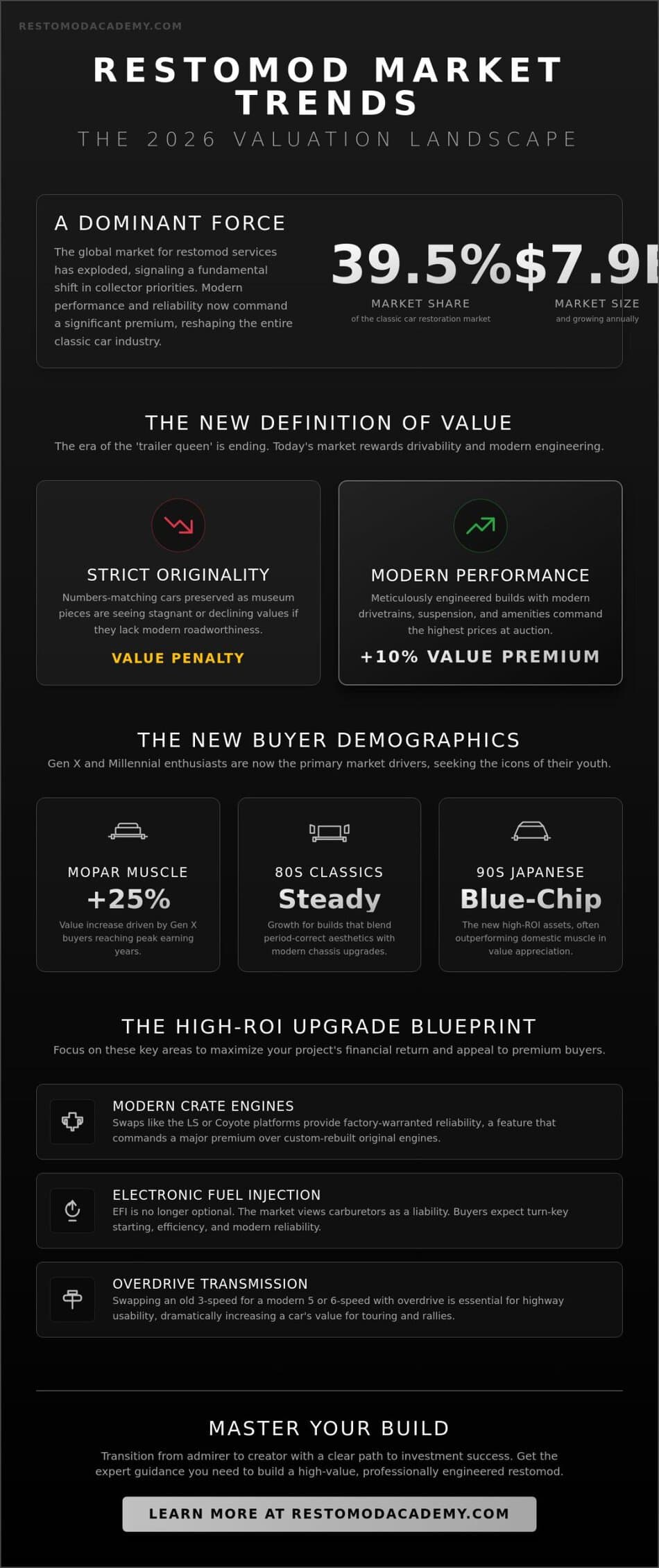
Did you know that restomod builds now command a massive 39.5 percent share of the entire classic car restoration market? As we move through 2026, the rigid rules of “originality at all costs” are fading into the rearview mirror. You’ve likely felt the tension between preserving a piece of history and wanting a machine that actually performs with precision when you turn the key. Understanding restomod resale value trends 2026 is essential if you want to avoid over-capitalizing on a project that the market won’t eventually reward.
The global market for these specialized services has reached 7.9 billion dollars this year, fueled by a new generation of collectors who prioritize modern reliability alongside heritage aesthetics. This guide will show you how shifting demographics are redefining the financial landscape of classic car modification. We will break down high-ROI modifications, explain how to document your meticulous labor for a professional appraisal, and identify which 80s and 90s donor cars are ready for a high-value transformation. It’s time to transition from a passive admirer to an active creator with a clear path to investment success.
Key Takeaways
- Learn why the 2026 market rewards mechanical precision and modern drivability over strict factory originality.
- Identify the high-ROI engine and suspension swaps that provide the best performance while boosting your restomod resale value trends 2026.
- Discover why 1990s Japanese performance legends are becoming the new blue-chip assets for strategic builders and investors.
- Master the art of selecting a donor car with a high appreciation ceiling and maintaining a cohesive build theme to attract premium buyers.
- Explore how to future-proof your investment against evolving fuel regulations through strategic technology integration and high-quality electric conversions.
Understanding the Restomod Valuation Landscape in 2026
The global market for classic car restoration and restomod services has hit a staggering 7.9 billion dollars this year. This growth isn’t just about volume; it’s about a fundamental shift in how we define value. For decades, the “numbers-matching” purist sat at the top of the financial mountain. Today, the landscape is different. We are seeing a historic convergence where a meticulously engineered restomod often commands a higher price than a factory-original survivor. To truly master the financial side of your build, you need a firm understanding of restomod principles versus traditional preservation. The restomod resale value trends 2026 show that collectors now view vintage steel as a canvas for modern performance rather than a static museum piece.
Before you commit to a donor car, revisit our guide on what is a restomod to align your vision with these shifting market expectations. The premium at auction now follows cars that offer a seamless blend of heritage aesthetics and contemporary utility. It’s a rewarding era for builders who prioritize precision over period-correct limitations.
The Shift from Trailer Queens to Daily Drivers
The days of the non-functional show car are ending. Buyers in 2026 demand machines they can actually use in modern traffic without the fear of overheating or brake fade. This “utility premium” has caused a decline in the value of trailer queens that lack roadworthiness. High-performance builds with integrated technology like electronic fuel injection and modern climate control are seeing a 10 percent increase in auction values compared to last year. If your car can’t handle a cross-country sprint, the market will likely penalize your ROI. Focus on reliability to capture the highest returns.
Generational Demographics and Purchasing Power
Gen X and Millennial enthusiasts are now the primary drivers of the market. Their nostalgia isn’t tied to the lead sleds of the 1950s. Instead, they are hunting for high-tech icons from the 1970s, 80s, and 90s. Consider these shifts in restomod resale value trends 2026:
- Mopar muscle restomods have seen a 25 percent value increase as younger Gen Xers reach peak earnings.
- The RADindex shows steady growth for 80s classics, rewarding builds that keep the period-correct look but add modern chassis stiffness.
- Japanese performance legends from the 1990s are the new blue-chip candidates, often outperforming traditional domestic muscle in terms of percentage-based ROI.
Every decision you make in the shop should reflect this generational shift. These buyers value the character of a vintage machine but refuse to compromise on the thrill of contemporary technology. Build for the driver, and the investment will follow.
Performance Upgrades and Their Impact on Market Retained Value
The engine is the heart of your build, and in 2026, it’s also the primary driver of your financial return. Modern crate engines have overtaken rebuilt originals in terms of market desirability. A factory-warranted power plant provides a level of certainty that a custom rebuild simply cannot match. When analyzing Classic Car Market Size, Growth, Trends, it’s clear that the premium for reliability is at an all-time high. Buyers want the soul of a classic with the turn-key confidence of a modern showroom vehicle. Confidently tracking restomod resale value trends 2026 requires looking at this shift toward predictable performance.
Integrating modern fuel injection and electronic management is no longer optional if you’re chasing top-tier results. A carburetor might look nostalgic, but the market now views it as a liability for cold-start reliability and fuel efficiency. Similarly, the addition of an overdrive gear is essential. Swapping an old three-speed for a modern five or six-speed unit allows the car to breathe at highway speeds. This single mechanical change significantly influences restomod resale value trends 2026 by making the vehicle a viable option for long-distance events and rallies.
Engine Swaps: LS and Coyote Dominance
The LS platform remains the gold standard for resale liquidity due to its immense aftermarket support and compact footprint. If you’re considering this path, you should consult the definitive guide to an ls engine swap to master the technical nuances that separate a pro-build from an amateur effort. For those in the Ford camp, the Coyote 5.0L has seen a massive surge in value. These swaps are currently commanding a significant premium in the 2026 market because they offer a sophisticated, high-revving character that appeals to younger, tech-savvy collectors.
Handling and Braking: The Safety Premium
Power is useless if you can’t control it, and the 2026 market reflects this reality with a high ROI on chassis and braking upgrades. High-quality bolt-on suspension kits often hold more value than one-off custom fabrication because they’re recognizable and easier for future owners to service. Upgrading to a modern rack-and-pinion steering system and six-piston big brake kits provides a tactile precision that justifies a higher appraisal. To ensure your build maintains a cohesive balance between speed and safety, consider using our Premium Project Blueprints to guide your component selection. This methodical approach ensures every dollar spent on the chassis translates directly into retained value.
The Rise of the 1980s and 1990s Restomod Market
The definition of a classic car has expanded far beyond the chrome bumpers of the 1960s. At the start of 2025, the RADindex, which tracks the value of vehicles from the 1980s and 1990s, grew by 1 percent year-over-year. This steady climb indicates a permanent shift in collector priorities. As we move through 2026, the market for these “Radwood-era” machines is maturing into a blue-chip sector. To capitalize on restomod resale value trends 2026, you must understand that these buyers value a specific blend of analog soul and modern precision. They want the tactile feel of a 90s cockpit paired with the unwavering reliability of a modern engine management system.
Vintage SUVs and classic 4×4 trucks are also seeing an explosion in value. Models like the Ford Bronco and Dodge Ramcharger have gained significant traction, but the real growth is in the engineering beneath the skin. A successful project in this category doesn’t just look the part; it behaves like a modern luxury vehicle on the road. Balancing digital upgrades with the period-correct aesthetics of the 80s and 90s is the key to maintaining long-term value. If you’re just starting, our product reviews can help you identify the specific components that preserve this era’s unique character while adding modern performance.
Japanese Classics: The New Frontier
The high-end JDM market has become a powerhouse for restomodding. Legends like the Toyota Supra, Nissan Skyline, and Mazda RX-7 are commanding premium prices at auction when modified with restraint. The most successful builds utilize reversible modifications that allow the car to return to stock if necessary, yet offer modern performance. Integrating a modern ECU is essential for proper tuning, but you should keep the hardware hidden. Preserve the period-correct interior plastics and switchgear to maintain the nostalgic charm while enjoying contemporary power delivery. This precision ensures your build stands out in a competitive market.
The Square Body and OBS Truck Trend
General Motors trucks from 1988 to 1998, known as the OBS or Original Body Style, are currently experiencing massive resale gains. Unlocking the equity in these trucks requires more than just a lowering kit. The market rewards full chassis swaps that provide modern geometry and a refined ride quality. When you pair a stiff, modern frame with a luxury interior conversion, you transform a utility vehicle into a high-value collectible. This methodical approach to the build ensures that your labor is reflected in the final appraisal. It turns a common workhorse into a precision machine that collectors are eager to acquire.
Strategic Planning to Maximize Your Project’s Financial Return
Select your foundation with the end in mind. Choosing a donor car with a high ceiling for appreciation is the first step in ensuring your project doesn’t become a financial sinkhole. While you might be tempted by a bargain-bin frame, the market in 2026 favors recognized platforms with established enthusiast bases. To master the complexities of restomod resale value trends 2026, you must prioritize a cohesive build theme. High-end buyers look for a singular vision. They want a car that feels like it was designed by a single hand, not a collection of parts ordered during late-night browsing sessions. Avoid the common trap of overly personalized paint colors or niche interior trim. While that neon green leather might reflect your personality, it will likely alienate the majority of high-net-worth collectors. Stick to timeless palettes that emphasize the vehicle’s lines while hinting at its modern capabilities.
Creating a structured roadmap is the only way to stay on budget and on schedule. You can begin this journey by reading our foundational guide on what is a restomod to refine your project’s scope and investment goals. This preparation ensures that every task is executed with the precision that professional buyers expect.
Documentation: The Key to Provenance
Build a thorough build book from day one. This isn’t just a folder of papers; it is the mechanical provenance of your machine. Every hour of labor and every specialty bolt should be accounted for. Professional photography and video documentation of the assembly process provide undeniable proof of the quality hidden beneath the paint. When you show a buyer the meticulous wiring or the precision of the fuel system installation, you justify a premium asking price. Keep every receipt for major components like the engine and transmission. In the eyes of an appraiser, a high-performance power plant without a paper trail is just another used motor. This level of detail transforms a custom car into a documented asset.
Appraisal and Insurance: Protecting Your Equity
Protect your equity with the right coverage. There is a massive difference between standard market value and agreed value. Standard insurance will treat your modified classic like a depreciated used car. You need an agreed value policy that recognizes the true cost of your high-performance enhancements. Seek out a specialty appraiser who specifically understands the custom market and can quantify the value of modern performance enhancements. Update your coverage as you hit major milestones in the build. To ensure your build meets the high standards of today’s collectors and maximizes its future worth, secure your copy of The Ultimate Restomod Guide.
Navigating the Future of High-Value Custom Builds
The horizon of custom building is shifting. While we cherish the visceral roar of a V8, the electric vehicle aftermarket is growing at a rate of 18.7 percent annually. This isn’t a fad; it’s a fundamental evolution of the craft. To stay ahead of restomod resale value trends 2026, you must decide where your project sits on the spectrum of innovation. Future-proofing your build involves more than just selecting a fuel source. It requires an awareness of tightening fuel regulations and a commitment to engineering excellence that transcends the power plant. Whether you choose the silence of a motor or the soul of an engine, the market rewards precision and foresight.
Don’t assume the internal combustion experience is dead. There’s a growing demographic of collectors who value the mechanical symphony of a well-tuned engine specifically because it feels rare in a digital world. The character of a vintage machine is its greatest asset. By maintaining that analog connection while upgrading the weak points, you ensure your car remains desirable regardless of shifting energy trends.
The EV Conversion Debate
Resale data for Tesla-swapped classics is beginning to stabilize, though V8-swapped counterparts still hold the majority of the market share. For utility vehicles like vintage Land Rovers or suburban cruisers, electrification can drive a higher premium due to the increased drivability. The key to long-term equity in an EV build is the battery packaging. Amateur builds with exposed wiring and poorly secured cells will face steep depreciation. A professional-grade installation that respects the vehicle’s original design while housing modern energy density is what high-end investors are hunting for.
Investing in Education and Quality
Your greatest tool isn’t in your chest; it’s the knowledge you apply to the metal. Professional-level DIY skills consistently lead to higher resale values than amateur work. A buyer can see the difference between a project that was rushed and one that followed a methodical, instructional flow. To avoid the costly mistakes that plague many first-time builders, you need a structured roadmap. Leverage our recommended gear lists and professional insights to elevate your craftsmanship.
Mastering the art of the build is a journey that pays dividends. If you’re ready to transition from a dreamer to a creator, our Restomod Consulting Services provide the expert guidance needed to ensure your investment remains a blue-chip asset. By focusing on quality and following a proven framework, you can build with the confidence that your machine will stand the test of time and market fluctuations.
Master Your Build and Secure Your Investment
We’ve explored how the current market has shifted toward a future where drivability and mechanical precision are the ultimate currencies. You’ve seen why the 80s and 90s are the new blue-chip eras and how documenting your meticulous labor can transform a hobby into a high-value asset. Staying ahead of restomod resale value trends 2026 means moving beyond guesswork and embracing a disciplined, documented approach to every modification you make in the shop. It’s about respecting the heritage of the machine while demanding the reliability of contemporary technology.
Don’t let the complexity of a project stall your progress. You can access premium project blueprints and receive expert mentorship from Brook Walsh to ensure every nut and bolt adds to your bottom line. Start your journey with The Ultimate Restomod Guide and join a community of professional-level builders who value craftsmanship over shortcuts. Your vision for the perfect vintage machine is within reach. Pick up your tools and start building a legacy that will stand the test of time and the scrutiny of the auction block.
Frequently Asked Questions
Do restomods hold their value better than original classic cars in 2026?
Yes, restomods currently represent the largest segment of the classic car restoration market with a 39.5 percent share. While rare survivors still hold a place in museums, the 2026 market rewards vehicles that offer a seamless mix of heritage and modern utility. Collectors are increasingly willing to pay a premium for cars that can handle modern traffic without failure. This shift ensures that well-executed builds remain competitive against stock counterparts.
How much does an LS engine swap typically add to the resale value of a classic car?
An LS engine swap typically increases auction values by approximately 10 percent compared to vehicles with aged, factory power plants. This platform remains the gold standard for resale because it offers unmatched aftermarket support and reliability. Buyers in 2026 look for liquidity, and a car with a modern crate engine is far easier to sell than one with a finicky, original setup. Focus on a clean, professional installation to maximize this return.
What is the most profitable car model to restomod for a beginner right now?
The most profitable entry point for a beginner is currently the 1988 to 1998 GM truck platform. These OBS trucks are seeing massive resale gains because they are relatively simple to work on and have a massive enthusiast following. By following restomod resale value trends 2026, you can see that utility vehicles and classic 4x4s are outpacing many traditional coupes. Start with a solid frame and focus on mechanical precision to build equity quickly.
Does converting a classic car to an electric vehicle increase its market value?
Converting a classic to an electric vehicle can increase its market value, especially for urban cruisers and vintage SUVs. The EV aftermarket is growing at a rate of 18.7 percent annually, reflecting a broader trend of modernization. However, the value is strictly tied to the quality of the battery packaging and integration. A sloppy conversion will face skepticism, while a professional-grade setup that preserves the car’s character will attract a high-end niche buyer.
How do I find a certified appraiser for a high-end restomod project?
To find a certified appraiser, you should look for professionals who specialize in the custom and restomod market rather than general classic car experts. Look for specialists who understand the specific costs associated with high-performance modern components. A standard valuation often misses the value of modern chassis engineering or bespoke electronic systems. Choose someone who understands the technical labor involved to ensure your equity is properly documented.
What are the most common modifications that actually decrease a classic car’s value?
Over-personalized aesthetics and non-reversible structural modifications are the most common value killers. While a custom neon paint job might suit your taste, it often alienates the majority of potential buyers. Similarly, cutting into the original metal of a rare donor car for a modern component can decrease its appeal to high-end collectors. Stick to a cohesive theme and prioritize reversible upgrades whenever you are working on a vehicle with significant historical value.
Is it better to buy a finished restomod or build one myself from an investment standpoint?
Building a restomod yourself is generally better for maximizing your financial return because it allows you to capture sweat equity. When you perform the labor correctly, you aren’t paying the retail markup for a finished project. However, this only works if you maintain professional standards throughout the build. Buying a finished car saves time but often means you are paying for someone else’s vision and labor at a premium without knowing the secrets hidden under the paint.
How has the Radwood movement affected the resale value of 1980s restomods?
The Radwood movement has stabilized the market for 1980s icons, with the RADindex showing a 1 percent growth at the start of 2025. This cultural shift has made it socially and financially acceptable to modify cars that were previously ignored. Collectors who grew up in that era now have the purchasing power to drive up demand for restomodded 80s machines. These vehicles offer a unique blend of digital nostalgia and analog driving that fits perfectly with restomod resale value trends 2026.
Did you know that restomod builds now command a massive 39.5 percent share of the entire classic car restoration market? As we move through 2026, the rigid rules of “originality at all costs” are fading into the rearview mirror. You’ve likely felt the tension between preserving a piece of history and wanting a machine that actually performs with precision when you turn the key. Understanding restomod resale value trends 2026 is essential if you want to avoid over-capitalizing on a project that the market won’t eventually reward.
The global market for these specialized services has reached 7.9 billion dollars this year, fueled by a new generation of collectors who prioritize modern reliability alongside heritage aesthetics. This guide will show you how shifting demographics are redefining the financial landscape of classic car modification. We will break down high-ROI modifications, explain how to document your meticulous labor for a professional appraisal, and identify which 80s and 90s donor cars are ready for a high-value transformation. It’s time to transition from a passive admirer to an active creator with a clear path to investment success.
Key Takeaways
- Learn why the 2026 market rewards mechanical precision and modern drivability over strict factory originality.
- Identify the high-ROI engine and suspension swaps that provide the best performance while boosting your restomod resale value trends 2026.
- Discover why 1990s Japanese performance legends are becoming the new blue-chip assets for strategic builders and investors.
- Master the art of selecting a donor car with a high appreciation ceiling and maintaining a cohesive build theme to attract premium buyers.
- Explore how to future-proof your investment against evolving fuel regulations through strategic technology integration and high-quality electric conversions.
Understanding the Restomod Valuation Landscape in 2026
The global market for classic car restoration and restomod services has hit a staggering 7.9 billion dollars this year. This growth isn’t just about volume; it’s about a fundamental shift in how we define value. For decades, the “numbers-matching” purist sat at the top of the financial mountain. Today, the landscape is different. We are seeing a historic convergence where a meticulously engineered restomod often commands a higher price than a factory-original survivor. To truly master the financial side of your build, you need a firm understanding of restomod principles versus traditional preservation. The restomod resale value trends 2026 show that collectors now view vintage steel as a canvas for modern performance rather than a static museum piece.
Before you commit to a donor car, revisit our guide on what is a restomod to align your vision with these shifting market expectations. The premium at auction now follows cars that offer a seamless blend of heritage aesthetics and contemporary utility. It’s a rewarding era for builders who prioritize precision over period-correct limitations.
The Shift from Trailer Queens to Daily Drivers
The days of the non-functional show car are ending. Buyers in 2026 demand machines they can actually use in modern traffic without the fear of overheating or brake fade. This “utility premium” has caused a decline in the value of trailer queens that lack roadworthiness. High-performance builds with integrated technology like electronic fuel injection and modern climate control are seeing a 10 percent increase in auction values compared to last year. If your car can’t handle a cross-country sprint, the market will likely penalize your ROI. Focus on reliability to capture the highest returns.
Generational Demographics and Purchasing Power
Gen X and Millennial enthusiasts are now the primary drivers of the market. Their nostalgia isn’t tied to the lead sleds of the 1950s. Instead, they are hunting for high-tech icons from the 1970s, 80s, and 90s. Consider these shifts in restomod resale value trends 2026:
- Mopar muscle restomods have seen a 25 percent value increase as younger Gen Xers reach peak earnings.
- The RADindex shows steady growth for 80s classics, rewarding builds that keep the period-correct look but add modern chassis stiffness.
- Japanese performance legends from the 1990s are the new blue-chip candidates, often outperforming traditional domestic muscle in terms of percentage-based ROI.
Every decision you make in the shop should reflect this generational shift. These buyers value the character of a vintage machine but refuse to compromise on the thrill of contemporary technology. Build for the driver, and the investment will follow.
Performance Upgrades and Their Impact on Market Retained Value
The engine is the heart of your build, and in 2026, it’s also the primary driver of your financial return. Modern crate engines have overtaken rebuilt originals in terms of market desirability. A factory-warranted power plant provides a level of certainty that a custom rebuild simply cannot match. When analyzing Classic Car Market Size, Growth, Trends, it’s clear that the premium for reliability is at an all-time high. Buyers want the soul of a classic with the turn-key confidence of a modern showroom vehicle. Confidently tracking restomod resale value trends 2026 requires looking at this shift toward predictable performance.
Integrating modern fuel injection and electronic management is no longer optional if you’re chasing top-tier results. A carburetor might look nostalgic, but the market now views it as a liability for cold-start reliability and fuel efficiency. Similarly, the addition of an overdrive gear is essential. Swapping an old three-speed for a modern five or six-speed unit allows the car to breathe at highway speeds. This single mechanical change significantly influences restomod resale value trends 2026 by making the vehicle a viable option for long-distance events and rallies.
Engine Swaps: LS and Coyote Dominance
The LS platform remains the gold standard for resale liquidity due to its immense aftermarket support and compact footprint. If you’re considering this path, you should consult the definitive guide to an ls engine swap to master the technical nuances that separate a pro-build from an amateur effort. For those in the Ford camp, the Coyote 5.0L has seen a massive surge in value. These swaps are currently commanding a significant premium in the 2026 market because they offer a sophisticated, high-revving character that appeals to younger, tech-savvy collectors.
Handling and Braking: The Safety Premium
Power is useless if you can’t control it, and the 2026 market reflects this reality with a high ROI on chassis and braking upgrades. High-quality bolt-on suspension kits often hold more value than one-off custom fabrication because they’re recognizable and easier for future owners to service. Upgrading to a modern rack-and-pinion steering system and six-piston big brake kits provides a tactile precision that justifies a higher appraisal. To ensure your build maintains a cohesive balance between speed and safety, consider using our Premium Project Blueprints to guide your component selection. This methodical approach ensures every dollar spent on the chassis translates directly into retained value.
The Rise of the 1980s and 1990s Restomod Market
The definition of a classic car has expanded far beyond the chrome bumpers of the 1960s. At the start of 2025, the RADindex, which tracks the value of vehicles from the 1980s and 1990s, grew by 1 percent year-over-year. This steady climb indicates a permanent shift in collector priorities. As we move through 2026, the market for these “Radwood-era” machines is maturing into a blue-chip sector. To capitalize on restomod resale value trends 2026, you must understand that these buyers value a specific blend of analog soul and modern precision. They want the tactile feel of a 90s cockpit paired with the unwavering reliability of a modern engine management system.
Vintage SUVs and classic 4×4 trucks are also seeing an explosion in value. Models like the Ford Bronco and Dodge Ramcharger have gained significant traction, but the real growth is in the engineering beneath the skin. A successful project in this category doesn’t just look the part; it behaves like a modern luxury vehicle on the road. Balancing digital upgrades with the period-correct aesthetics of the 80s and 90s is the key to maintaining long-term value. If you’re just starting, our product reviews can help you identify the specific components that preserve this era’s unique character while adding modern performance.
Japanese Classics: The New Frontier
The high-end JDM market has become a powerhouse for restomodding. Legends like the Toyota Supra, Nissan Skyline, and Mazda RX-7 are commanding premium prices at auction when modified with restraint. The most successful builds utilize reversible modifications that allow the car to return to stock if necessary, yet offer modern performance. Integrating a modern ECU is essential for proper tuning, but you should keep the hardware hidden. Preserve the period-correct interior plastics and switchgear to maintain the nostalgic charm while enjoying contemporary power delivery. This precision ensures your build stands out in a competitive market.
The Square Body and OBS Truck Trend
General Motors trucks from 1988 to 1998, known as the OBS or Original Body Style, are currently experiencing massive resale gains. Unlocking the equity in these trucks requires more than just a lowering kit. The market rewards full chassis swaps that provide modern geometry and a refined ride quality. When you pair a stiff, modern frame with a luxury interior conversion, you transform a utility vehicle into a high-value collectible. This methodical approach to the build ensures that your labor is reflected in the final appraisal. It turns a common workhorse into a precision machine that collectors are eager to acquire.
Strategic Planning to Maximize Your Project’s Financial Return
Select your foundation with the end in mind. Choosing a donor car with a high ceiling for appreciation is the first step in ensuring your project doesn’t become a financial sinkhole. While you might be tempted by a bargain-bin frame, the market in 2026 favors recognized platforms with established enthusiast bases. To master the complexities of restomod resale value trends 2026, you must prioritize a cohesive build theme. High-end buyers look for a singular vision. They want a car that feels like it was designed by a single hand, not a collection of parts ordered during late-night browsing sessions. Avoid the common trap of overly personalized paint colors or niche interior trim. While that neon green leather might reflect your personality, it will likely alienate the majority of high-net-worth collectors. Stick to timeless palettes that emphasize the vehicle’s lines while hinting at its modern capabilities.
Creating a structured roadmap is the only way to stay on budget and on schedule. You can begin this journey by reading our foundational guide on what is a restomod to refine your project’s scope and investment goals. This preparation ensures that every task is executed with the precision that professional buyers expect.
Documentation: The Key to Provenance
Build a thorough build book from day one. This isn’t just a folder of papers; it is the mechanical provenance of your machine. Every hour of labor and every specialty bolt should be accounted for. Professional photography and video documentation of the assembly process provide undeniable proof of the quality hidden beneath the paint. When you show a buyer the meticulous wiring or the precision of the fuel system installation, you justify a premium asking price. Keep every receipt for major components like the engine and transmission. In the eyes of an appraiser, a high-performance power plant without a paper trail is just another used motor. This level of detail transforms a custom car into a documented asset.
Appraisal and Insurance: Protecting Your Equity
Protect your equity with the right coverage. There is a massive difference between standard market value and agreed value. Standard insurance will treat your modified classic like a depreciated used car. You need an agreed value policy that recognizes the true cost of your high-performance enhancements. Seek out a specialty appraiser who specifically understands the custom market and can quantify the value of modern performance enhancements. Update your coverage as you hit major milestones in the build. To ensure your build meets the high standards of today’s collectors and maximizes its future worth, secure your copy of The Ultimate Restomod Guide.
Navigating the Future of High-Value Custom Builds
The horizon of custom building is shifting. While we cherish the visceral roar of a V8, the electric vehicle aftermarket is growing at a rate of 18.7 percent annually. This isn’t a fad; it’s a fundamental evolution of the craft. To stay ahead of restomod resale value trends 2026, you must decide where your project sits on the spectrum of innovation. Future-proofing your build involves more than just selecting a fuel source. It requires an awareness of tightening fuel regulations and a commitment to engineering excellence that transcends the power plant. Whether you choose the silence of a motor or the soul of an engine, the market rewards precision and foresight.
Don’t assume the internal combustion experience is dead. There’s a growing demographic of collectors who value the mechanical symphony of a well-tuned engine specifically because it feels rare in a digital world. The character of a vintage machine is its greatest asset. By maintaining that analog connection while upgrading the weak points, you ensure your car remains desirable regardless of shifting energy trends.
The EV Conversion Debate
Resale data for Tesla-swapped classics is beginning to stabilize, though V8-swapped counterparts still hold the majority of the market share. For utility vehicles like vintage Land Rovers or suburban cruisers, electrification can drive a higher premium due to the increased drivability. The key to long-term equity in an EV build is the battery packaging. Amateur builds with exposed wiring and poorly secured cells will face steep depreciation. A professional-grade installation that respects the vehicle’s original design while housing modern energy density is what high-end investors are hunting for.
Investing in Education and Quality
Your greatest tool isn’t in your chest; it’s the knowledge you apply to the metal. Professional-level DIY skills consistently lead to higher resale values than amateur work. A buyer can see the difference between a project that was rushed and one that followed a methodical, instructional flow. To avoid the costly mistakes that plague many first-time builders, you need a structured roadmap. Leverage our recommended gear lists and professional insights to elevate your craftsmanship.
Mastering the art of the build is a journey that pays dividends. If you’re ready to transition from a dreamer to a creator, our Restomod Consulting Services provide the expert guidance needed to ensure your investment remains a blue-chip asset. By focusing on quality and following a proven framework, you can build with the confidence that your machine will stand the test of time and market fluctuations.
Master Your Build and Secure Your Investment
We’ve explored how the current market has shifted toward a future where drivability and mechanical precision are the ultimate currencies. You’ve seen why the 80s and 90s are the new blue-chip eras and how documenting your meticulous labor can transform a hobby into a high-value asset. Staying ahead of restomod resale value trends 2026 means moving beyond guesswork and embracing a disciplined, documented approach to every modification you make in the shop. It’s about respecting the heritage of the machine while demanding the reliability of contemporary technology.
Don’t let the complexity of a project stall your progress. You can access premium project blueprints and receive expert mentorship from Brook Walsh to ensure every nut and bolt adds to your bottom line. Start your journey with The Ultimate Restomod Guide and join a community of professional-level builders who value craftsmanship over shortcuts. Your vision for the perfect vintage machine is within reach. Pick up your tools and start building a legacy that will stand the test of time and the scrutiny of the auction block.
Frequently Asked Questions
Do restomods hold their value better than original classic cars in 2026?
Yes, restomods currently represent the largest segment of the classic car restoration market with a 39.5 percent share. While rare survivors still hold a place in museums, the 2026 market rewards vehicles that offer a seamless mix of heritage and modern utility. Collectors are increasingly willing to pay a premium for cars that can handle modern traffic without failure. This shift ensures that well-executed builds remain competitive against stock counterparts.
How much does an LS engine swap typically add to the resale value of a classic car?
An LS engine swap typically increases auction values by approximately 10 percent compared to vehicles with aged, factory power plants. This platform remains the gold standard for resale because it offers unmatched aftermarket support and reliability. Buyers in 2026 look for liquidity, and a car with a modern crate engine is far easier to sell than one with a finicky, original setup. Focus on a clean, professional installation to maximize this return.
What is the most profitable car model to restomod for a beginner right now?
The most profitable entry point for a beginner is currently the 1988 to 1998 GM truck platform. These OBS trucks are seeing massive resale gains because they are relatively simple to work on and have a massive enthusiast following. By following restomod resale value trends 2026, you can see that utility vehicles and classic 4x4s are outpacing many traditional coupes. Start with a solid frame and focus on mechanical precision to build equity quickly.
Does converting a classic car to an electric vehicle increase its market value?
Converting a classic to an electric vehicle can increase its market value, especially for urban cruisers and vintage SUVs. The EV aftermarket is growing at a rate of 18.7 percent annually, reflecting a broader trend of modernization. However, the value is strictly tied to the quality of the battery packaging and integration. A sloppy conversion will face skepticism, while a professional-grade setup that preserves the car’s character will attract a high-end niche buyer.
How do I find a certified appraiser for a high-end restomod project?
To find a certified appraiser, you should look for professionals who specialize in the custom and restomod market rather than general classic car experts. Look for specialists who understand the specific costs associated with high-performance modern components. A standard valuation often misses the value of modern chassis engineering or bespoke electronic systems. Choose someone who understands the technical labor involved to ensure your equity is properly documented.
What are the most common modifications that actually decrease a classic car’s value?
Over-personalized aesthetics and non-reversible structural modifications are the most common value killers. While a custom neon paint job might suit your taste, it often alienates the majority of potential buyers. Similarly, cutting into the original metal of a rare donor car for a modern component can decrease its appeal to high-end collectors. Stick to a cohesive theme and prioritize reversible upgrades whenever you are working on a vehicle with significant historical value.
Is it better to buy a finished restomod or build one myself from an investment standpoint?
Building a restomod yourself is generally better for maximizing your financial return because it allows you to capture sweat equity. When you perform the labor correctly, you aren’t paying the retail markup for a finished project. However, this only works if you maintain professional standards throughout the build. Buying a finished car saves time but often means you are paying for someone else’s vision and labor at a premium without knowing the secrets hidden under the paint.
How has the Radwood movement affected the resale value of 1980s restomods?
The Radwood movement has stabilized the market for 1980s icons, with the RADindex showing a 1 percent growth at the start of 2025. This cultural shift has made it socially and financially acceptable to modify cars that were previously ignored. Collectors who grew up in that era now have the purchasing power to drive up demand for restomodded 80s machines. These vehicles offer a unique blend of digital nostalgia and analog driving that fits perfectly with restomod resale value trends 2026.