
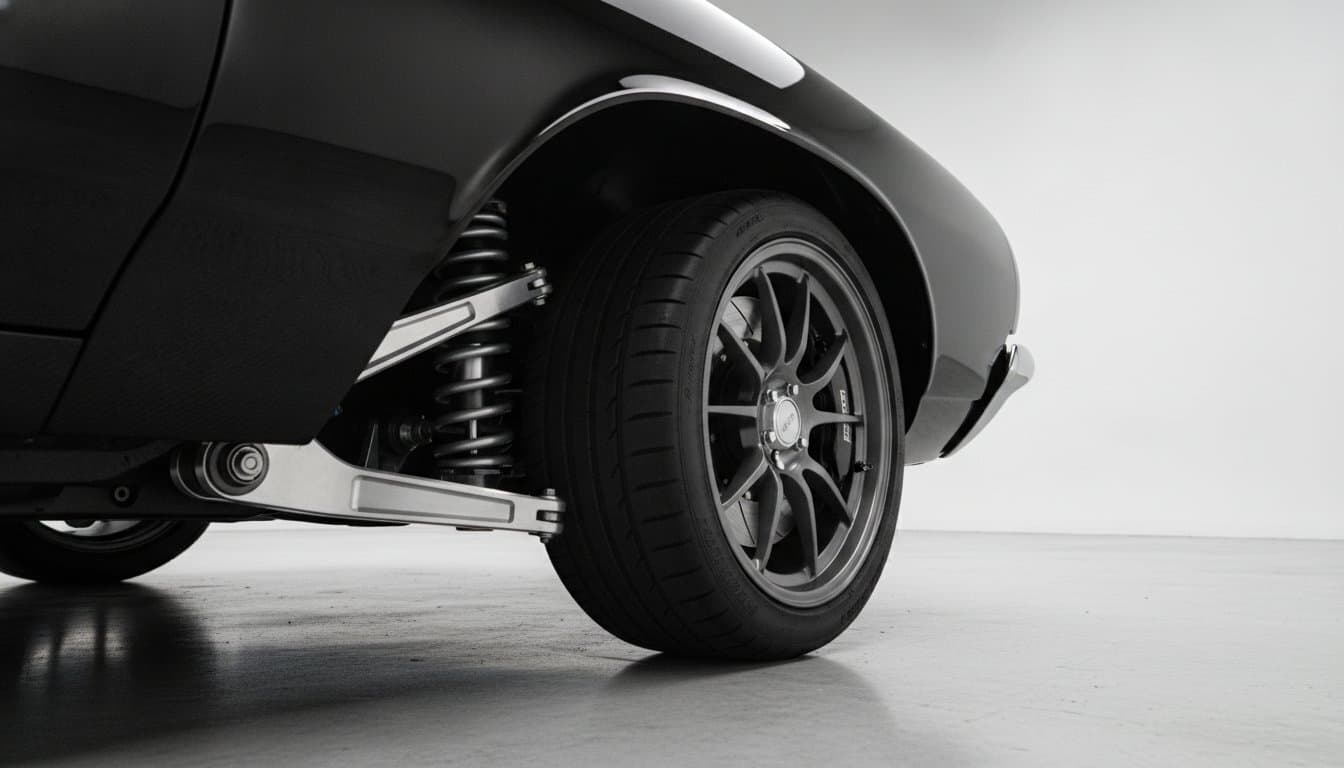
Stiffening your springs until the ride becomes unbearable isn’t performance tuning; it’s a recipe for a car you’ll eventually hate to drive. You’ve likely felt that white-knuckle dread when your classic wanders at highway speeds or felt the frustration of a harsh ride caused by poorly matched components. Mastering a restomod suspension tuning guide is about more than just buying parts. It’s about understanding how to manage the relationship between modern grip and vintage chassis flex so your car feels planted rather than punishing.
This article will show you how to transform your vintage ride into a precision machine by balancing modern suspension technology with classic automotive soul. We’re moving beyond the confusion of technical terms like scrub radius and roll center to focus on actionable, professional results. You’ll get a clear look at how to select coilovers, integrate rack-and-pinion systems, and dial in the geometry that defines a world-class build. By the time we’re finished, you’ll have the roadmap to create a chassis that honors its heritage while delivering 2026 levels of confidence and control.
Key Takeaways
- Learn why original geometry fails when paired with modern tires and how to recalibrate your vintage frame for contemporary grip.
- Compare the tuning potential of coilovers and air ride systems to find the perfect balance between performance and comfort.
- Master the three primary alignment angles to eliminate wander and give your classic car the self-centering steering feel it deserves.
- Follow a logical, step-by-step restomod suspension tuning guide that teaches you to adjust one variable at a time for professional results.
- Shift your perspective from simply bolting on parts to creating an integrated system that prioritizes safety and precision in every corner.
The Foundation: Why Restomod Suspension Tuning is the Soul of Your Build
Restomod suspension tuning is the deliberate calibration of modern high-performance components within the structural constraints of a vintage frame. It’s the moment you stop being a passive admirer and start being an active creator, an architect of your own driving experience. While many enthusiasts focus on horsepower, the soul of a build lives in how it communicates through the steering wheel. This restomod suspension tuning guide serves as your blueprint for that communication, ensuring your project feels as good as it looks.
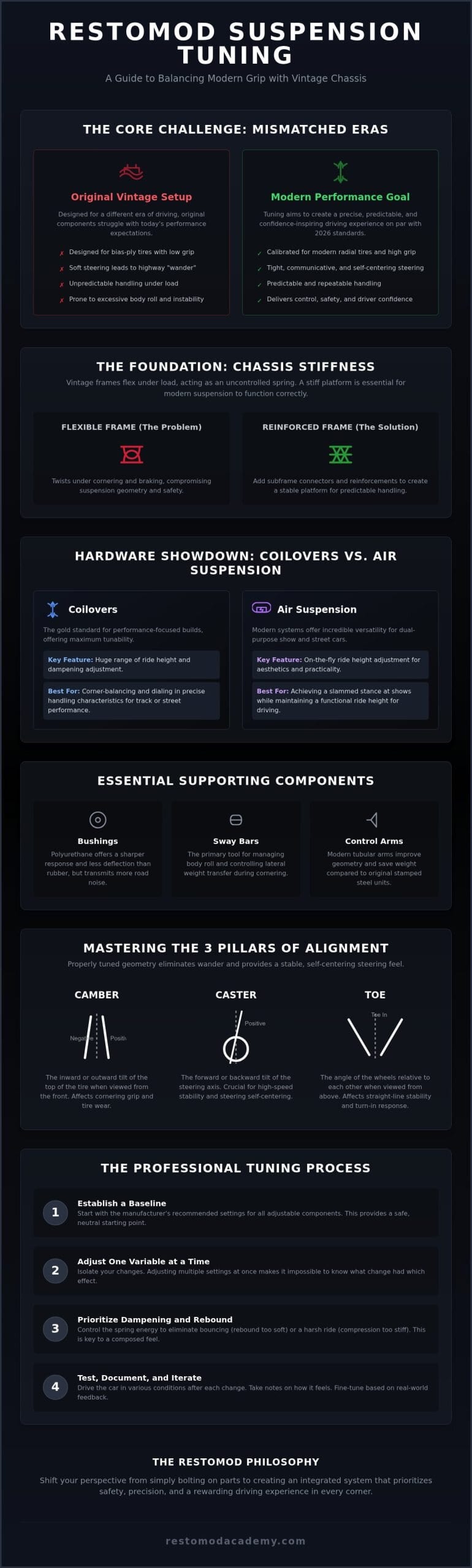
Original suspension geometry was designed for the era of bias-ply tires and drum brakes. Those components were never meant to handle the lateral G-forces generated by modern radial tires. When you add 2026 levels of grip to a 1960s chassis without proper tuning, the geometry often fails, leading to unpredictable camber changes and unstable handling. Balancing the aesthetic nostalgia of your car with contemporary safety standards requires a deep dive into the mechanical systems that keep you on the road. Precision is your best friend here.
The Evolution of the Restomod Handling Philosophy
Driving a stock muscle car often feels like navigating a boat through a storm; the steering is soft, and the car wanders across the lane. By contrast, 2026 precision demands a tight, communicative interface between the driver and the asphalt. The primary goal of modern tuning is to create a predictable and repeatable driving experience. If you’re still defining your project’s direction, it helps to understand exactly what is a restomod before you start tearing into the subframe. We want a car that responds the same way every time you turn the wheel, regardless of the speed.
Understanding Chassis Flex in Vintage Vehicles
Old steel frames are notoriously flexible. Under hard cornering or heavy braking, that frame twists and bends, essentially acting as a secondary, uncontrolled spring. No amount of expensive shock valving can fix a chassis that’s moving beneath you. Tuning must account for these structural limitations of the donor car. Using a comprehensive restomod suspension tuning guide helps you identify these weak points before they compromise your build’s safety. Ensure you have a stiff platform by adding subframe connectors or reinforcing factory welds. A stable chassis allows your modern components to do their job, ensuring that every adjustment you make to the suspension is actually felt on the road.
Selecting the Right Hardware: Coilovers, Air Ride, and Modern Components
Selecting the right hardware is where your vision takes physical shape. Traditional spring and shock setups are often limited by fixed spring rates and generic valving. In contrast, this restomod suspension tuning guide advocates for components that offer high levels of adjustability. This flexibility allows you to dial in the car for specific driving conditions rather than settling for a factory compromise. Consider these primary hardware choices for your baseline:
- Bushings: Polyurethane offers a much sharper response than rubber by reducing deflection, though it transmits more road noise into the cabin.
- Sway Bars: These are your primary tools for managing lateral weight transfer and reducing body roll during hard cornering.
- Control Arms: Modern tubular arms often provide improved geometry and weight savings over original stamped steel units.
Coilovers vs Air Suspension: Choosing Your Path
Coilovers are the gold standard for drivers seeking 2026 performance levels. They provide a massive range of adjustment for both ride height and dampening, allowing you to corner-balance the car for perfect weight distribution. Air suspension has also evolved significantly. Modern air ride systems offer incredible versatility for cruisers that need a specific slammed aesthetic at shows but still require a functional ride height for the drive home. If you’re searching for vetted hardware that pairs well with vintage frames, explore our recommended gear for a solid starting point.
The Critical Role of Dampening and Rebound
Understanding how your shocks behave is vital for a composed ride. Compression is the force that resists the shock closing when you hit a bump. Rebound is the force that controls how fast the shock extends back to its original position. Dampening is the control of spring energy. If your rebound is too soft, you’ll experience that floaty, classic car bounce that feels unsettled over crests. If it’s too stiff, the tire won’t stay in contact with the pavement. Dialing this in is a core part of any successful restomod suspension tuning guide.
Tires: The Only Part of the Suspension That Touches the Road
While these principles are applied here to vintage cars, the fundamentals of spring management are universal. If you are also interested in optimizing the handling of two-wheeled machines, you can learn more about Suspension Store and their specialized guides for motorcycle shock adjustment.
Your suspension tuning is essentially useless without considering the tires. Modern low-profile tires have much stiffer sidewalls than vintage rubber, which means they transmit more force directly into your springs and shocks. You’ll often need to run slightly softer spring rates than you might expect to maintain a civilized ride. Always match your tire’s grip levels to the structural integrity of your suspension. High-traction compounds can easily overwhelm stock components or weak ball joints, leading to safety concerns. Choosing the right tires and hardware is a significant step, and our consulting services can help you build a cohesive system that prioritizes both precision and safety.
Mastering Suspension Geometry: Camber, Caster, and Toe
Geometry is the invisible architecture of your handling. It’s the set of mathematical relationships that determines how your tires interact with the road during every transition, brake, and acceleration. Even the most expensive components won’t save a car with poor alignment. Mastering a restomod suspension tuning guide requires looking past the shiny parts to understand that these angles aren’t just numbers on a printout; they’re the difference between a car that tracks straight at 80 mph and one that’s a chore to drive. We’re aiming for a setup that provides modern confidence without erasing the car’s vintage character.
Caster: The Secret to Modern Steering Feel
Most classic cars were designed with very little positive caster to make manual steering easier for the driver. However, modern radial tires require much more caster to provide that stable, self-centering feel we expect in 2026. Positive caster occurs when the upper ball joint is positioned behind the lower ball joint. This creates a mechanical trail that pulls the wheels back to center after a turn. For a typical street-driven restomod, a baseline of 3 to 5 degrees of positive caster is usually the sweet spot. It improves high-speed stability and gives you that weighted, communicative steering feel that’s often missing in vintage builds.
Camber and Toe: Balancing Grip and Longevity
Camber is the vertical tilt of the wheel. We generally aim for a small amount of negative camber, where the tops of the tires tilt slightly toward each other. This ensures that when the car leans into a corner, the outside tire flattens out to maximize the contact patch. While aggressive negative camber looks great and helps in the twisties, it’ll eat through your tires if you spend most of your time on the highway. Toe settings are equally critical. Toe-in, where the front of the tires point slightly toward the center of the car, is the standard for street use. It provides straight-line stability and prevents the car from darting every time you hit a small bump in the road.
Advanced Concepts: Scrub Radius and Roll Center
As you dive deeper into your restomod suspension tuning guide, you’ll encounter scrub radius and roll center. Scrub radius is determined by your wheel offset and the pivot point of your steering. If you choose wheels with the wrong offset, you can drastically increase steering effort and kickback. Similarly, lowering your car too much can ruin the roll center geometry. If the roll center drops too far below the center of gravity, the car will actually lean more in corners despite having stiffer springs. Always prioritize geometry over a slammed aesthetic to ensure your car remains a precision machine on the road.
The Step-by-Step Tuning Process: From Baseline to Precision
Precision in handling isn’t something you buy; it’s something you earn through a disciplined, methodical approach. This restomod suspension tuning guide emphasizes a logical sequence to ensure you aren’t chasing your tail with conflicting adjustments. The golden rule of the garage is simple: change only one variable at a time. If you adjust the tire pressure, the shock valving, and the ride height all at once, you’ll never know which change actually improved the car. Establish a dedicated test loop near your workshop that includes a mix of smooth highway, off-camber turns, and slightly uneven pavement to get a full picture of the chassis behavior.
Setting Your Baseline: Ride Height and Corner Weighting
Before you ever touch an alignment rack, you must set a repeatable ride height. Use a tape measure to record the distance from the wheel arch to the ground at all four corners, ensuring the car is on level ground with a half tank of fuel. Corner weighting is the next level of precision. By using a set of portable scales, you can adjust your coilover perches to balance the weight distribution. This ensures that the car reacts identically during left and right-hand turns and provides stable, predictable braking. You don’t need a professional race shop for this; a set of scales and a flat garage floor are the primary tools for a professional baseline setup at home.
The Iterative Tuning Loop: Drive, Adjust, Repeat
Tuning is rarely finished in a single afternoon. You need to develop a checklist for evaluating how the car handles transitions. Does it push wide at the entrance of a corner (understeer), or does the rear end feel light and ready to rotate (oversteer)? Use your shock adjustments to fix specific ride quality issues; for example, increasing rebound can settle a car that feels floaty over crests. The tuning loop is a cycle of objective testing and subjective feel. Document every click of the shock dial and every degree of change in a logbook. This allows you to return to a known baseline if a new adjustment makes the car worse.
Diagnosing Common Handling Issues
If the car feels skittish and bounces over small bumps, your spring rates might be too high for the structural integrity of your vintage chassis. It’s easy to confuse a stiff ride with a high-performance ride, but a car that can’t absorb road imperfections will ultimately have less mechanical grip. Unlike modern race cars, most restomods rely entirely on mechanical grip rather than aerodynamic downforce, so keeping the tires in contact with the asphalt is your top priority. If you’re struggling to find the right balance, our recommended gear page lists the essential tools for diagnosing these issues. To ensure every part of your build meets these professional standards, access our premium project blueprints for a structured path to success.
Final Calibration: Aligning Your Build with the Restomod Academy Philosophy
Completing a restomod suspension tuning guide is about more than just checking off a list of mechanical tasks. It represents a fundamental mental shift from viewing a car as a collection of bolt-on parts to understanding it as a singular, integrated system. The long-term rewards for the DIY builder go beyond a smoother ride; they manifest in the deep satisfaction of knowing exactly how your machine will react to every input. You’ve transitioned from a passive admirer of vintage aesthetics to an active creator of modern performance. This commitment to precision is what separates a backyard project from a professional-grade build in 2026.
Safety and Maintenance of Tuned Systems
High-performance suspensions operate under higher stresses than their factory counterparts. Because your new components provide more grip and faster response times, they require more frequent inspections of joints, rod ends, and bushings. Always perform a comprehensive nut-and-bolt check after your first 500 miles of driving. Components can settle, and torque specs can shift as the chassis adjusts to its new geometry. Don’t overlook this step. A safe car is a fun car, and maintaining the integrity of your hard work ensures that your project remains a source of pride rather than a liability. Keep a dedicated log of your inspections to track the wear of specialized mechanical parts over time.
Continuing Your Education with Restomod Academy
Once your chassis is dialed in and your handling is precise, you’ll likely find yourself looking for the next challenge. A well-tuned suspension provides the perfect foundation for increased power. If you’re ready to match your car’s cornering ability with modern acceleration, explore our definitive guide to an ls engine swap for your next major upgrade. Mastering the art of the modernized classic is a journey that doesn’t end with a single system. It’s a continuous process of learning and refinement.
We encourage every builder to share their project blueprints and engage with the community to refine their skills further. Every hurdle you overcome in the workshop is a valuable learning opportunity that builds your confidence as a creator. Whether you’re fine-tuning a daily driver or building a show-stopping machine, the principles of quality and safety remain the same. Stay methodical, stay curious, and keep pushing the boundaries of what your vintage machine can achieve. The road ahead is yours to master.
Build Your Legacy on a Precision Foundation
Transforming a vintage chassis into a modern performer requires more than just high-end parts; it demands a deep understanding of geometry and a disciplined tuning process. You’ve learned how to balance nostalgia with 2026 safety standards, ensuring your project is as reliable as it is thrilling. By mastering the hardware and the math behind the movement, you’ve taken the first step toward true automotive artistry.
This restomod suspension tuning guide is your roadmap to a car that handles with contemporary confidence while retaining its classic soul. Every turn of the wrench is an opportunity to learn, and every test drive is a reward for your meticulous labor. Brook Walsh and the Restomod Academy provide the authoritative guides and instructional content you need to move from a passive admirer to a creator. Don’t let the complexity of modernization hold you back from achieving professional results in your own garage.
Your vision deserves a chassis that can keep up with your ambition. Start your journey with The Ultimate Restomod Guide and join a community dedicated to DIY empowerment and mechanical excellence. Pick up your tools. Trust the process. Prepare to experience your classic ride like never before.
Frequently Asked Questions
How do I know if my restomod needs suspension tuning?
Your car needs tuning if it exhibits unpredictable behavior like wandering at speed or excessive body roll. If you’ve upgraded to modern radial tires but kept the original geometry, the mismatched grip levels will cause the car to feel unsettled. Tuning ensures that your high-performance parts actually work together rather than fighting each other. This process is the key to achieving the precision promised in this restomod suspension tuning guide.
Can I tune my suspension without professional alignment racks?
You can perform a significant amount of tuning in your own garage using basic tools like string, jack stands, and digital inclinometers. While a professional rack offers high-precision digital readouts, manual methods for setting toe and camber are time-tested and reliable for establishing a baseline. You’ll need patience and a flat surface to get accurate results. Mastering these manual techniques is a core part of transitioning from a passive admirer to an active creator.
What is the best spring rate for a classic Mustang restomod?
The ideal spring rate depends on your engine weight and intended use, but a common starting point for a street-driven small-block Mustang is 500 to 600 lbs/in for the front. If you’ve performed an LS swap or added a heavy big-block, you’ll need to adjust accordingly to maintain ride height. Always consider the total vehicle weight and distribution. Choosing the wrong rate leads to a harsh ride, which ruins the driving experience.
Will a modern suspension kit make my vintage car ride too rough?
Modern kits actually improve ride quality by using better valving and materials, provided you don’t choose excessively stiff spring rates. High-quality shocks, like those mentioned in our restomod suspension tuning guide, manage energy more efficiently than original equipment. They allow the car to absorb road imperfections without the bouncy, uncontrolled feeling typical of old leaf springs. The result is a firm but composed ride that feels much more like a 2026 sports car.
How often should I re-tune my suspension after the initial build?
Plan to re-check your alignment and torque specs after the first 500 miles, then perform a seasonal inspection every year. New bushings and springs will settle over time, which can slightly alter your ride height and geometry. If you change your tire compound or wheel offset, you’ll need to revisit your settings to maintain optimal grip. Regular maintenance ensures your precision machine remains safe and predictable on the road for the long term.
What is the difference between pro-touring and standard restomod suspension?
Pro-touring focuses heavily on track-capable performance and lateral grip, while a standard restomod suspension prioritizes a balance of modern reliability and street comfort. A pro-touring build might utilize extreme negative camber and very high spring rates that could be tiring for daily use. Standard restomods aim for a civilized experience that handles well but doesn’t punish the driver on long cruises. Both styles benefit from the structured approach found in our instructional materials.
Is air suspension better than coilovers for a daily driver?
Air suspension offers superior versatility for a daily driver because you can adjust ride height and stiffness on the fly to handle speed bumps or driveways. Coilovers are generally more robust and provide a more consistent mechanical feel for spirited driving. If your priority is a specific aesthetic at car shows combined with functional ground clearance, air is excellent. If you value simplicity and raw handling precision, stick with a high-quality coilover setup.
Do I need to stiffen my chassis before upgrading the suspension?
Stiffening the chassis is a critical prerequisite because a flexible frame acts like a secondary, uncontrolled spring that compromises your tuning efforts. Adding subframe connectors or a roll cage ensures that the forces from the road are managed by your shocks and springs rather than the body of the car. Without a rigid foundation, even the most expensive suspension components won’t reach their full potential. Always prioritize structural integrity to ensure a safe and predictable build.
Stiffening your springs until the ride becomes unbearable isn’t performance tuning; it’s a recipe for a car you’ll eventually hate to drive. You’ve likely felt that white-knuckle dread when your classic wanders at highway speeds or felt the frustration of a harsh ride caused by poorly matched components. Mastering a restomod suspension tuning guide is about more than just buying parts. It’s about understanding how to manage the relationship between modern grip and vintage chassis flex so your car feels planted rather than punishing.
This article will show you how to transform your vintage ride into a precision machine by balancing modern suspension technology with classic automotive soul. We’re moving beyond the confusion of technical terms like scrub radius and roll center to focus on actionable, professional results. You’ll get a clear look at how to select coilovers, integrate rack-and-pinion systems, and dial in the geometry that defines a world-class build. By the time we’re finished, you’ll have the roadmap to create a chassis that honors its heritage while delivering 2026 levels of confidence and control.
Key Takeaways
- Learn why original geometry fails when paired with modern tires and how to recalibrate your vintage frame for contemporary grip.
- Compare the tuning potential of coilovers and air ride systems to find the perfect balance between performance and comfort.
- Master the three primary alignment angles to eliminate wander and give your classic car the self-centering steering feel it deserves.
- Follow a logical, step-by-step restomod suspension tuning guide that teaches you to adjust one variable at a time for professional results.
- Shift your perspective from simply bolting on parts to creating an integrated system that prioritizes safety and precision in every corner.
The Foundation: Why Restomod Suspension Tuning is the Soul of Your Build
Restomod suspension tuning is the deliberate calibration of modern high-performance components within the structural constraints of a vintage frame. It’s the moment you stop being a passive admirer and start being an active creator, an architect of your own driving experience. While many enthusiasts focus on horsepower, the soul of a build lives in how it communicates through the steering wheel. This restomod suspension tuning guide serves as your blueprint for that communication, ensuring your project feels as good as it looks.
Original suspension geometry was designed for the era of bias-ply tires and drum brakes. Those components were never meant to handle the lateral G-forces generated by modern radial tires. When you add 2026 levels of grip to a 1960s chassis without proper tuning, the geometry often fails, leading to unpredictable camber changes and unstable handling. Balancing the aesthetic nostalgia of your car with contemporary safety standards requires a deep dive into the mechanical systems that keep you on the road. Precision is your best friend here.
The Evolution of the Restomod Handling Philosophy
Driving a stock muscle car often feels like navigating a boat through a storm; the steering is soft, and the car wanders across the lane. By contrast, 2026 precision demands a tight, communicative interface between the driver and the asphalt. The primary goal of modern tuning is to create a predictable and repeatable driving experience. If you’re still defining your project’s direction, it helps to understand exactly what is a restomod before you start tearing into the subframe. We want a car that responds the same way every time you turn the wheel, regardless of the speed.
Understanding Chassis Flex in Vintage Vehicles
Old steel frames are notoriously flexible. Under hard cornering or heavy braking, that frame twists and bends, essentially acting as a secondary, uncontrolled spring. No amount of expensive shock valving can fix a chassis that’s moving beneath you. Tuning must account for these structural limitations of the donor car. Using a comprehensive restomod suspension tuning guide helps you identify these weak points before they compromise your build’s safety. Ensure you have a stiff platform by adding subframe connectors or reinforcing factory welds. A stable chassis allows your modern components to do their job, ensuring that every adjustment you make to the suspension is actually felt on the road.
Selecting the Right Hardware: Coilovers, Air Ride, and Modern Components
Selecting the right hardware is where your vision takes physical shape. Traditional spring and shock setups are often limited by fixed spring rates and generic valving. In contrast, this restomod suspension tuning guide advocates for components that offer high levels of adjustability. This flexibility allows you to dial in the car for specific driving conditions rather than settling for a factory compromise. Consider these primary hardware choices for your baseline:
- Bushings: Polyurethane offers a much sharper response than rubber by reducing deflection, though it transmits more road noise into the cabin.
- Sway Bars: These are your primary tools for managing lateral weight transfer and reducing body roll during hard cornering.
- Control Arms: Modern tubular arms often provide improved geometry and weight savings over original stamped steel units.
Coilovers vs Air Suspension: Choosing Your Path
Coilovers are the gold standard for drivers seeking 2026 performance levels. They provide a massive range of adjustment for both ride height and dampening, allowing you to corner-balance the car for perfect weight distribution. Air suspension has also evolved significantly. Modern air ride systems offer incredible versatility for cruisers that need a specific slammed aesthetic at shows but still require a functional ride height for the drive home. If you’re searching for vetted hardware that pairs well with vintage frames, explore our recommended gear for a solid starting point.
The Critical Role of Dampening and Rebound
Understanding how your shocks behave is vital for a composed ride. Compression is the force that resists the shock closing when you hit a bump. Rebound is the force that controls how fast the shock extends back to its original position. Dampening is the control of spring energy. If your rebound is too soft, you’ll experience that floaty, classic car bounce that feels unsettled over crests. If it’s too stiff, the tire won’t stay in contact with the pavement. Dialing this in is a core part of any successful restomod suspension tuning guide.
Tires: The Only Part of the Suspension That Touches the Road
Your suspension tuning is essentially useless without considering the tires. Modern low-profile tires have much stiffer sidewalls than vintage rubber, which means they transmit more force directly into your springs and shocks. You’ll often need to run slightly softer spring rates than you might expect to maintain a civilized ride. Always match your tire’s grip levels to the structural integrity of your suspension. High-traction compounds can easily overwhelm stock components or weak ball joints, leading to safety concerns. Choosing the right tires and hardware is a significant step, and our consulting services can help you build a cohesive system that prioritizes both precision and safety.
Mastering Suspension Geometry: Camber, Caster, and Toe
Geometry is the invisible architecture of your handling. It’s the set of mathematical relationships that determines how your tires interact with the road during every transition, brake, and acceleration. Even the most expensive components won’t save a car with poor alignment. Mastering a restomod suspension tuning guide requires looking past the shiny parts to understand that these angles aren’t just numbers on a printout; they’re the difference between a car that tracks straight at 80 mph and one that’s a chore to drive. We’re aiming for a setup that provides modern confidence without erasing the car’s vintage character.
Caster: The Secret to Modern Steering Feel
Most classic cars were designed with very little positive caster to make manual steering easier for the driver. However, modern radial tires require much more caster to provide that stable, self-centering feel we expect in 2026. Positive caster occurs when the upper ball joint is positioned behind the lower ball joint. This creates a mechanical trail that pulls the wheels back to center after a turn. For a typical street-driven restomod, a baseline of 3 to 5 degrees of positive caster is usually the sweet spot. It improves high-speed stability and gives you that weighted, communicative steering feel that’s often missing in vintage builds.
Camber and Toe: Balancing Grip and Longevity
Camber is the vertical tilt of the wheel. We generally aim for a small amount of negative camber, where the tops of the tires tilt slightly toward each other. This ensures that when the car leans into a corner, the outside tire flattens out to maximize the contact patch. While aggressive negative camber looks great and helps in the twisties, it’ll eat through your tires if you spend most of your time on the highway. Toe settings are equally critical. Toe-in, where the front of the tires point slightly toward the center of the car, is the standard for street use. It provides straight-line stability and prevents the car from darting every time you hit a small bump in the road.
Advanced Concepts: Scrub Radius and Roll Center
As you dive deeper into your restomod suspension tuning guide, you’ll encounter scrub radius and roll center. Scrub radius is determined by your wheel offset and the pivot point of your steering. If you choose wheels with the wrong offset, you can drastically increase steering effort and kickback. Similarly, lowering your car too much can ruin the roll center geometry. If the roll center drops too far below the center of gravity, the car will actually lean more in corners despite having stiffer springs. Always prioritize geometry over a slammed aesthetic to ensure your car remains a precision machine on the road.
The Step-by-Step Tuning Process: From Baseline to Precision
Precision in handling isn’t something you buy; it’s something you earn through a disciplined, methodical approach. This restomod suspension tuning guide emphasizes a logical sequence to ensure you aren’t chasing your tail with conflicting adjustments. The golden rule of the garage is simple: change only one variable at a time. If you adjust the tire pressure, the shock valving, and the ride height all at once, you’ll never know which change actually improved the car. Establish a dedicated test loop near your workshop that includes a mix of smooth highway, off-camber turns, and slightly uneven pavement to get a full picture of the chassis behavior.
Setting Your Baseline: Ride Height and Corner Weighting
Before you ever touch an alignment rack, you must set a repeatable ride height. Use a tape measure to record the distance from the wheel arch to the ground at all four corners, ensuring the car is on level ground with a half tank of fuel. Corner weighting is the next level of precision. By using a set of portable scales, you can adjust your coilover perches to balance the weight distribution. This ensures that the car reacts identically during left and right-hand turns and provides stable, predictable braking. You don’t need a professional race shop for this; a set of scales and a flat garage floor are the primary tools for a professional baseline setup at home.
The Iterative Tuning Loop: Drive, Adjust, Repeat
Tuning is rarely finished in a single afternoon. You need to develop a checklist for evaluating how the car handles transitions. Does it push wide at the entrance of a corner (understeer), or does the rear end feel light and ready to rotate (oversteer)? Use your shock adjustments to fix specific ride quality issues; for example, increasing rebound can settle a car that feels floaty over crests. The tuning loop is a cycle of objective testing and subjective feel. Document every click of the shock dial and every degree of change in a logbook. This allows you to return to a known baseline if a new adjustment makes the car worse.
Diagnosing Common Handling Issues
If the car feels skittish and bounces over small bumps, your spring rates might be too high for the structural integrity of your vintage chassis. It’s easy to confuse a stiff ride with a high-performance ride, but a car that can’t absorb road imperfections will ultimately have less mechanical grip. Unlike modern race cars, most restomods rely entirely on mechanical grip rather than aerodynamic downforce, so keeping the tires in contact with the asphalt is your top priority. If you’re struggling to find the right balance, our recommended gear page lists the essential tools for diagnosing these issues. To ensure every part of your build meets these professional standards, access our premium project blueprints for a structured path to success.
Final Calibration: Aligning Your Build with the Restomod Academy Philosophy
Completing a restomod suspension tuning guide is about more than just checking off a list of mechanical tasks. It represents a fundamental mental shift from viewing a car as a collection of bolt-on parts to understanding it as a singular, integrated system. The long-term rewards for the DIY builder go beyond a smoother ride; they manifest in the deep satisfaction of knowing exactly how your machine will react to every input. You’ve transitioned from a passive admirer of vintage aesthetics to an active creator of modern performance. This commitment to precision is what separates a backyard project from a professional-grade build in 2026.
Safety and Maintenance of Tuned Systems
High-performance suspensions operate under higher stresses than their factory counterparts. Because your new components provide more grip and faster response times, they require more frequent inspections of joints, rod ends, and bushings. Always perform a comprehensive nut-and-bolt check after your first 500 miles of driving. Components can settle, and torque specs can shift as the chassis adjusts to its new geometry. Don’t overlook this step. A safe car is a fun car, and maintaining the integrity of your hard work ensures that your project remains a source of pride rather than a liability. Keep a dedicated log of your inspections to track the wear of specialized mechanical parts over time.
Continuing Your Education with Restomod Academy
Once your chassis is dialed in and your handling is precise, you’ll likely find yourself looking for the next challenge. A well-tuned suspension provides the perfect foundation for increased power. If you’re ready to match your car’s cornering ability with modern acceleration, explore our definitive guide to an ls engine swap for your next major upgrade. Mastering the art of the modernized classic is a journey that doesn’t end with a single system. It’s a continuous process of learning and refinement.
We encourage every builder to share their project blueprints and engage with the community to refine their skills further. Every hurdle you overcome in the workshop is a valuable learning opportunity that builds your confidence as a creator. Whether you’re fine-tuning a daily driver or building a show-stopping machine, the principles of quality and safety remain the same. Stay methodical, stay curious, and keep pushing the boundaries of what your vintage machine can achieve. The road ahead is yours to master.
Build Your Legacy on a Precision Foundation
Transforming a vintage chassis into a modern performer requires more than just high-end parts; it demands a deep understanding of geometry and a disciplined tuning process. You’ve learned how to balance nostalgia with 2026 safety standards, ensuring your project is as reliable as it is thrilling. By mastering the hardware and the math behind the movement, you’ve taken the first step toward true automotive artistry.
This restomod suspension tuning guide is your roadmap to a car that handles with contemporary confidence while retaining its classic soul. Every turn of the wrench is an opportunity to learn, and every test drive is a reward for your meticulous labor. Brook Walsh and the Restomod Academy provide the authoritative guides and instructional content you need to move from a passive admirer to a creator. Don’t let the complexity of modernization hold you back from achieving professional results in your own garage.
Your vision deserves a chassis that can keep up with your ambition. Start your journey with The Ultimate Restomod Guide and join a community dedicated to DIY empowerment and mechanical excellence. Pick up your tools. Trust the process. Prepare to experience your classic ride like never before.
Frequently Asked Questions
How do I know if my restomod needs suspension tuning?
Your car needs tuning if it exhibits unpredictable behavior like wandering at speed or excessive body roll. If you’ve upgraded to modern radial tires but kept the original geometry, the mismatched grip levels will cause the car to feel unsettled. Tuning ensures that your high-performance parts actually work together rather than fighting each other. This process is the key to achieving the precision promised in this restomod suspension tuning guide.
Can I tune my suspension without professional alignment racks?
You can perform a significant amount of tuning in your own garage using basic tools like string, jack stands, and digital inclinometers. While a professional rack offers high-precision digital readouts, manual methods for setting toe and camber are time-tested and reliable for establishing a baseline. You’ll need patience and a flat surface to get accurate results. Mastering these manual techniques is a core part of transitioning from a passive admirer to an active creator.
What is the best spring rate for a classic Mustang restomod?
The ideal spring rate depends on your engine weight and intended use, but a common starting point for a street-driven small-block Mustang is 500 to 600 lbs/in for the front. If you’ve performed an LS swap or added a heavy big-block, you’ll need to adjust accordingly to maintain ride height. Always consider the total vehicle weight and distribution. Choosing the wrong rate leads to a harsh ride, which ruins the driving experience.
Will a modern suspension kit make my vintage car ride too rough?
Modern kits actually improve ride quality by using better valving and materials, provided you don’t choose excessively stiff spring rates. High-quality shocks, like those mentioned in our restomod suspension tuning guide, manage energy more efficiently than original equipment. They allow the car to absorb road imperfections without the bouncy, uncontrolled feeling typical of old leaf springs. The result is a firm but composed ride that feels much more like a 2026 sports car.
How often should I re-tune my suspension after the initial build?
Plan to re-check your alignment and torque specs after the first 500 miles, then perform a seasonal inspection every year. New bushings and springs will settle over time, which can slightly alter your ride height and geometry. If you change your tire compound or wheel offset, you’ll need to revisit your settings to maintain optimal grip. Regular maintenance ensures your precision machine remains safe and predictable on the road for the long term.
What is the difference between pro-touring and standard restomod suspension?
Pro-touring focuses heavily on track-capable performance and lateral grip, while a standard restomod suspension prioritizes a balance of modern reliability and street comfort. A pro-touring build might utilize extreme negative camber and very high spring rates that could be tiring for daily use. Standard restomods aim for a civilized experience that handles well but doesn’t punish the driver on long cruises. Both styles benefit from the structured approach found in our instructional materials.
Is air suspension better than coilovers for a daily driver?
Air suspension offers superior versatility for a daily driver because you can adjust ride height and stiffness on the fly to handle speed bumps or driveways. Coilovers are generally more robust and provide a more consistent mechanical feel for spirited driving. If your priority is a specific aesthetic at car shows combined with functional ground clearance, air is excellent. If you value simplicity and raw handling precision, stick with a high-quality coilover setup.
Do I need to stiffen my chassis before upgrading the suspension?
Stiffening the chassis is a critical prerequisite because a flexible frame acts like a secondary, uncontrolled spring that compromises your tuning efforts. Adding subframe connectors or a roll cage ensures that the forces from the road are managed by your shocks and springs rather than the body of the car. Without a rigid foundation, even the most expensive suspension components won’t reach their full potential. Always prioritize structural integrity to ensure a safe and predictable build.