
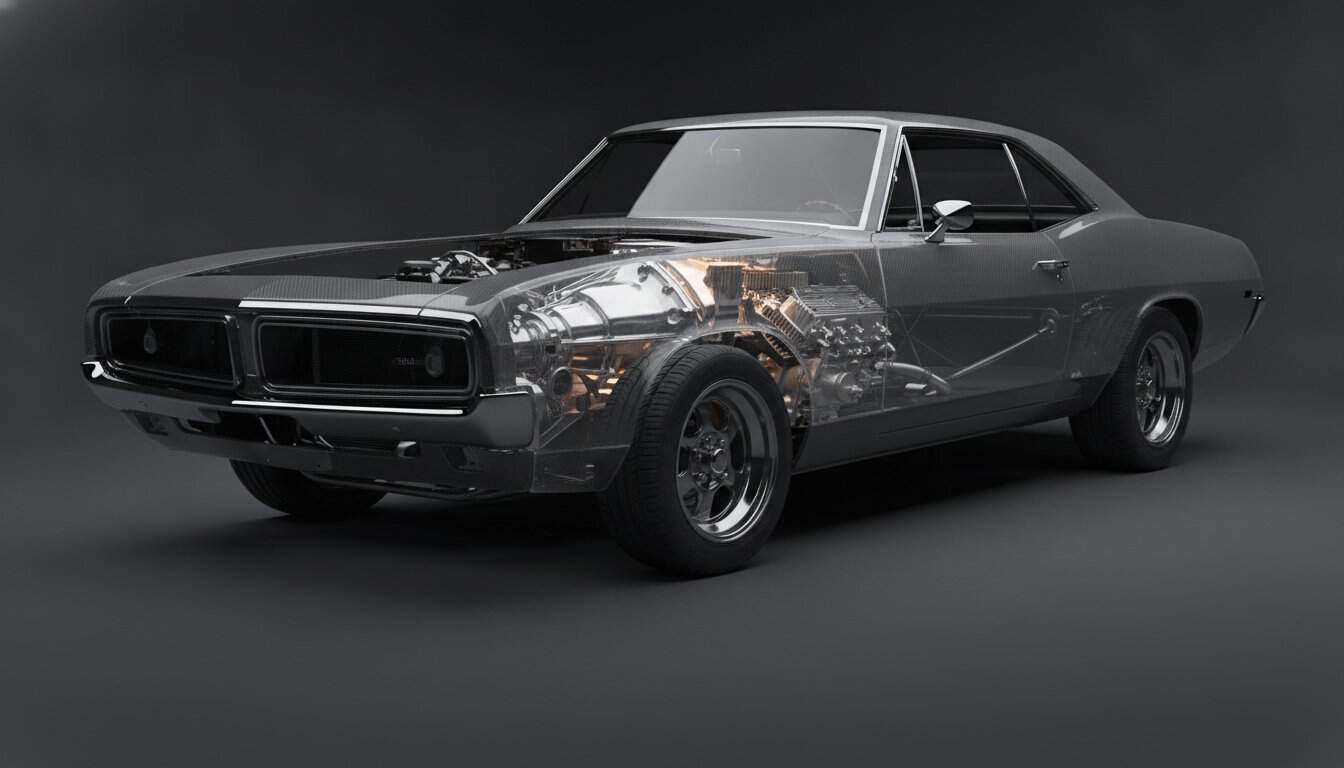
The perfect restomod transmission is not about the number of gears; it is about synchronizing the power band of a modern engine with the mechanical soul of a vintage chassis. As you evaluate different restomod transmission options, you likely want the neck-snapping acceleration of a 2026 crate engine without the screaming RPMs of an old three-speed automatic. It is natural to feel a bit of anxiety when you consider cutting original floorpans for a massive gearbox or wiring up complex electronic controllers. You deserve a drivetrain that feels as precise as it looks.
This guide empowers you to master the technical nuances of modern transmission swaps to ensure your classic car handles modern power with reliability and precision. We will explore the most effective choices on the market today, including the compact Tremec TKX and the high-tech Ford 10R80. You will gain a clear understanding of how to match gear ratios to your rear-end for peak performance. By the end of this article, you will have a complete roadmap for the installation process, giving you the confidence to transition from a dreamer to a creator in your own workshop.
Key Takeaways
- Discover why the Tremec TKX has become the preferred choice for enthusiasts who want modern manual performance without aggressive floorpan modifications.
- Compare the most popular restomod transmission options to find the ideal balance between modern 10-speed efficiency and classic driving engagement.
- Calculate your ideal final drive ratio using tire height and gear data to prevent a sluggish launch or high-revving highway speeds.
- Develop a precise installation roadmap that identifies potential fitment hurdles and electronic controller requirements before you begin the swap.
The Heart of the Drivetrain: Why Transmission Choice Defines Your Build
Your engine provides the raw power, but your transmission provides the personality of the build. A vintage gearbox often feels like a bottleneck, trapping a modern engine’s potential within the limits of three or four gears. To understand what is a restomod, you must view the drivetrain as a cohesive system where modern reliability meets heritage style. Choosing from the available restomod transmission options is perhaps the most critical decision you’ll make for the drivability and character of your project.
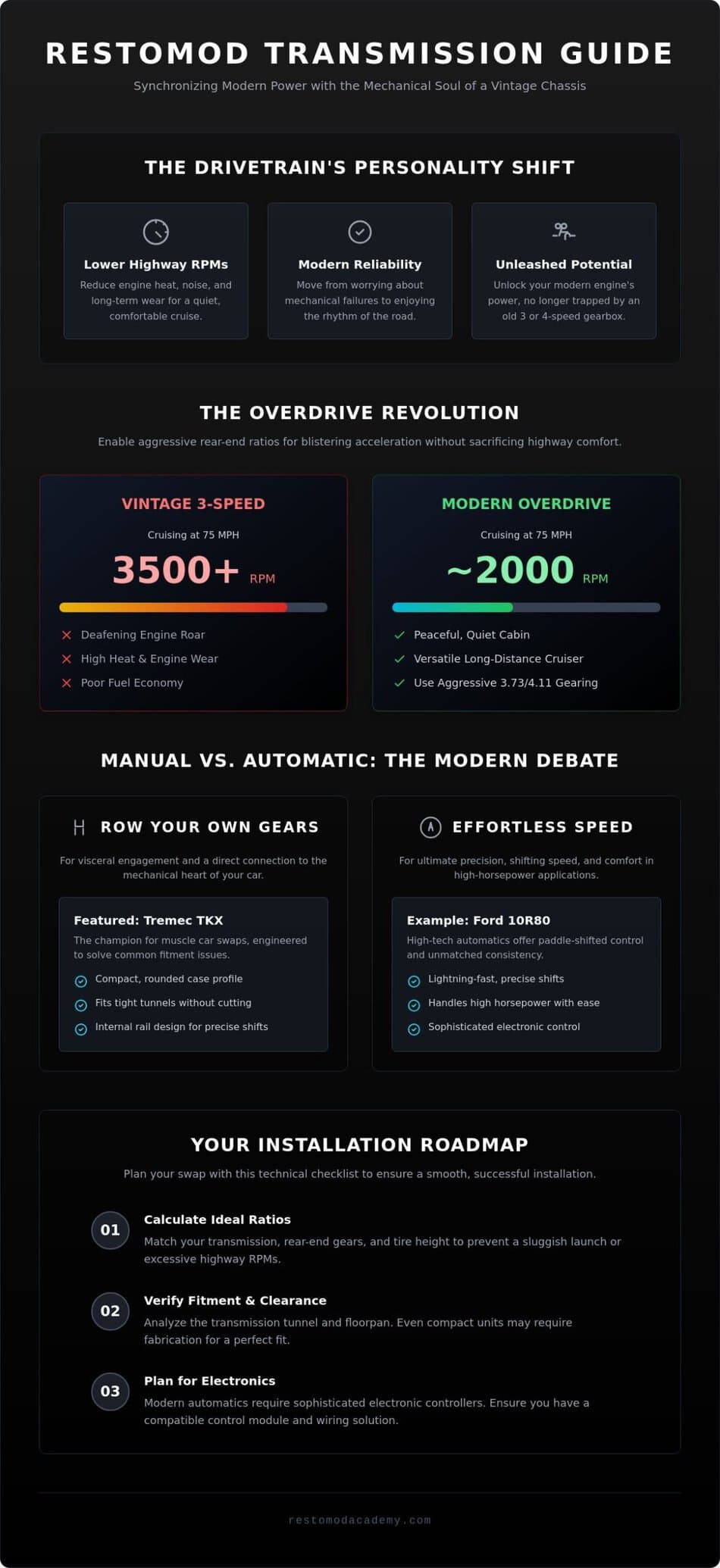
A modern transmission does more than just switch gears; it fundamentally changes your relationship with the car. It preserves your engine by lowering highway RPMs, which reduces heat and long-term wear while significantly quieting the cabin. Imagine cruising at 75 mph without the deafening roar of a high-revving V8 or the vibration of an outdated three-speed. You transform a car that was once a chore to drive into a machine that begs for a cross-country road trip. The psychological shift is massive. You move from worrying about the next mechanical failure to simply enjoying the rhythm of the road.
To see how a high-performance manual swap changes the character of a classic, watch this 1967 Camaro in action:
The Overdrive Revolution
Vintage transmissions were designed for a different era of speed and fuel costs. By stepping up to a modern unit with a 0.60 to 0.70 overdrive ratio, you gain a massive mechanical advantage. This allows you to run aggressive rear-end ratios, like a 3.73 or 4.11, for blistering acceleration off the line without making the car unusable at highway speeds. It’s effectively giving you the best of both worlds. You can have that neck-snapping torque in the city and a peaceful, fuel-efficient cruise on the interstate. It turns a performance-only build into a versatile, long-distance cruiser that you can drive anywhere.
Manual vs Automatic: The Modern Debate
The choice between three pedals and two often comes down to your intended use and personal connection to the machine. A 6-speed manual offers a visceral engagement that few things can match. It requires your full attention and rewards you with a direct link to the mechanical heart of the car. On the other hand, a modern, paddle-shifted automatic provides a level of precision and shifting speed that is hard to ignore, especially in high-horsepower applications. Consider your physical comfort and whether you plan to tackle heavy traffic or the open track. If you’re still refining your project’s identity, explore our guide on what is a restomod to align your transmission choice with your overall vision. Evaluating restomod transmission options requires a balance of logic and emotion, ensuring the final result is a car you actually want to drive every weekend.
Modern Manual Transmission Swaps: Row Your Own Gears
There is a unique satisfaction in the tactile click of a modern shifter. While automatics dominate the drag strip, the manual gearbox remains the soul of many classic builds. When exploring restomod transmission options, the manual market has evolved significantly beyond the fragile four-speeds of the 1960s. Today, you have access to race-bred technology that fits inside a vintage tunnel with minimal surgery. This transition requires a meticulous approach to geometry and component selection, but the reward is a car that feels as precise as a modern sports car.
Modern manual swaps eliminate the vague, sloppy gear changes of the past. By utilizing internal rail designs, manufacturers have moved the shifting mechanism inside the case. This creates a direct, bolt-action feel that inspires confidence during high-RPM driving. Whether you are building a canyon carver or a highway cruiser, the right manual setup defines the rhythm of your drive.
The Tremec Lineup Analyzed
The Tremec TKX is the undisputed champion for most muscle car restorations. It was engineered from a clean sheet to solve the fitment issues of previous five-speeds. Its rounded case profile allows it to slide into tight transmission tunnels without the need for aggressive cutting. Consider these advantages of the TKX platform:
- Compact design that fits almost all 1960s and 1970s floorpans.
- A 600 lb-ft torque capacity that handles most naturally aspirated builds.
- High-RPM shifting capabilities tested up to 8,000 RPM.
If your build involves a forced-induction LS or a high-displacement big block, the T56 Magnum is your heavy-duty solution. It boasts a 700 lb-ft torque rating and provides a double-overdrive configuration. This makes it perfect for pro-touring machines that need a deep first gear for acceleration and a tall sixth gear for high-speed touring. If you are pairing this with a modern powerplant, our definitive guide to an LS engine swap covers the essential drivetrain alignment steps required for these larger units.
Manual Swap Essentials
Precision is the difference between a smooth-shifting masterpiece and a mechanical nightmare. You must prioritize the relationship between the engine block and the input shaft. This starts with selecting a high-quality steel bellhousing and performing a dial indicator alignment to ensure the transmission is perfectly centered. Ditching the old mechanical Z-bar linkage for a hydraulic clutch conversion is a non-negotiable upgrade for modern drivability. It provides a consistent, light pedal feel that won’t fatigue your leg in traffic. You must verify that the pilot bearing is fully seated and provides exactly 0.030 inches of clearance between the input shaft and the bearing face to prevent binding. If you find yourself stuck on the specifics of your drivetrain geometry, our restomod consulting services can provide the expert clarity needed to move your project forward.
Modern Performance Automatics: Speed and Effortless Torque
Forget the era of the slushbox where automatic transmissions were the compromise choice for builders who didn’t want to row their own gears. Modern automatics have redefined performance, offering shifting speeds and torque management that no human foot can replicate. When you evaluate restomod transmission options, the shift from mechanical to electronic control is the most significant leap you can take. It moves your project from a vintage cruiser to a precision instrument capable of handling massive power with refined manners.
The transition typically begins with the 4L60E, a reliable four-speed that served as the entry point for years. However, the current landscape has shifted toward the 6L80 and 8L90 series. These units provide a much tighter gear spread, keeping your engine in its happy place during every acceleration pull. Integrating these requires a standalone Transmission Control Unit (TCU). This brain allows you to customize shift firmness and timing, effectively giving you a gearbox that learns your driving style. You must also pay close attention to torque converter selection. A stall speed that is too high will make the car feel mushy on the street, while one that is too low can cause the engine to stumble at stoplights. Aim for a balance that matches your camshaft’s power band.
Electronic vs Mechanical Automatics
The 4L80E remains a powerhouse favorite for high-boost applications, particularly for those following our definitive guide to an LS engine swap. It is essentially a bulletproof Turbo 400 with an overdrive gear added. While older mechanical units relied on vacuum lines and governor weights, modern electronic units use software to manage heat and line pressure. This programmability is a massive advantage for engine longevity. You can set the TCU to pull timing during a shift to protect the internals. Just remember that these high-performance units generate significant heat. Always install the largest fluid cooler your chassis can accommodate to prevent premature clutch wear.
The 10-Speed Frontier
The 10R80 and 10L90 10-speed transmissions represent the absolute peak of current restomod transmission options. With ten forward speeds, the engine never falls out of its peak power band. While some critics suggest these are too complex for a DIY build, 2026 standalone controllers have made the wiring surprisingly manageable. The primary hurdle is physical size. A 10R80 case is significantly bulkier than a vintage Powerglide, often requiring tunnel modifications or a complete floorpan reshape. If you can clear the floorpan, the performance reward is a car that feels endlessly fast, with a gear for every possible scenario. Be aware that remanufactured 10R80 units currently range from $3,999 to $5,099, so budget accordingly for this top-tier upgrade.
The Technical Checklist: Fitment, Ratios, and Fabrication
Transitioning from selecting your gearbox to actually bolting it into the chassis is where the real labor of restoration begins. You have evaluated your restomod transmission options based on torque and gear counts, but the physical reality of the swap requires a meticulous eye for geometry. A modern six-speed or heavy-duty automatic often demands more real estate than a vintage four-speed. Success in this phase is measured in fractions of an inch. You must approach the transmission tunnel and the driveline as a single, integrated system to ensure the finished car drives as smoothly as it looks.
Before you lift the unit into place, establish a baseline for your measurements. You need to know the distance from the engine block face to the tailshaft housing and the widest point of the case. Compare these to your existing tunnel dimensions. It is also the time to consider your crossmember. While many aftermarket bolt-in solutions exist for popular platforms like the F-body or A-body, you may find that a custom fabricated piece is necessary to achieve the perfect engine tilt. Aim for a three-degree downward angle at the transmission output shaft to set yourself up for success with driveline phasing.
Fitment and Tunnel Modification
Expanding a vintage transmission tunnel for a T56 or 6L80 is a common hurdle that requires the right approach to metalwork. You will likely need a plasma cutter or a high-quality reciprocating saw to remove the restrictive factory bracing. Once you have cleared the path, use a sheet metal brake or a dedicated tunnel patch kit to rebuild the structure. It is vital to maintain structural integrity by tying your new tunnel skin back into the floorpan and firewall with solid welds. If you are refining your drivetrain alignment, our definitive guide to an LS engine swap offers technical insights into managing these tight clearances.
Gear Ratio Optimization
Don’t leave your highway performance to chance. Use a ratio calculator to predict your engine RPM at 70 MPH before you finalize your rear-end choice. You want to match your transmission’s overdrive gear to your ring and pinion to keep the engine in its most efficient cruising range. A 3.73 rear gear pairs with a modern 0.63 overdrive to provide aggressive off-the-line torque while keeping highway cruising RPMs comfortably low. This combination ensures that your car remains responsive in the city without feeling strained on long trips.
The final hardware link is the driveshaft. Changing the length or the slip yoke style is almost always required when moving to modern gearing. You must verify your operating angles at both the transmission and the differential. If these angles are not parallel within a narrow margin, you will experience a persistent driveline vibration that can ruin bearings and seals. To ensure you have the right tools for these precise measurements, review our recommended gear list to outfit your workshop for success.
Executing the Swap: Planning Your Drivetrain Roadmap
The final phase of your drivetrain evolution requires more than just mechanical skill; it demands a strategic mindset. You have studied the various restomod transmission options and measured your clearance, but now you must execute the plan with precision. A successful swap is rarely the result of buying parts in isolation. Instead, it comes from viewing the engine, transmission, and rear-end as a singular, high-performance ecosystem. Before you spend a single dollar on a gearbox, you must document every variable in a comprehensive project blueprint. This document should track everything from your target cruise RPM to the specific wiring pinouts for your standalone controller.
The System Approach
Treating your engine and transmission as a single unit is the only way to avoid the heartbreak of mismatched components. If you select a high-revving small block but pair it with a transmission designed for low-end truck torque, the car will never feel right. Consult with experts early in the process to verify that your stall speeds, gear ratios, and physical dimensions align with your performance goals. To build a solid foundation for these decisions, it helps to revisit the core philosophy of what is a restomod to ensure your drivetrain choices support your ultimate vision for the car. This structured approach turns an intimidating mechanical hurdle into a series of achievable, logical steps.
Next Steps for Your Build
Master Your Drivetrain Evolution
Your journey through the landscape of restomod transmission options is about more than just finding a part that fits. It’s about creating a machine that honors its vintage roots while delivering the precision and reliability of 2026 performance technology. You now understand how a compact Tremec TKX or a high-tech 10-speed automatic can transform your driving experience from a stressful chore into a seamless adventure. By focusing on the system as a whole, from tunnel clearance to final drive ratios, you ensure that every gear change reinforces your connection to the road.
Success in the workshop requires both the right knowledge and a proven roadmap. You don’t have to navigate these complex fabrication and electronic hurdles alone. Take the guesswork out of your build with The Ultimate Restomod Guide. This resource provides access to expert consulting for complex drivetrain swaps, comprehensive blueprints for major vehicle models, and a dedicated community of professional restomod builders. Pick up your tools with confidence. Every measurement you take and every bolt you tighten brings you one step closer to the masterpiece you envisioned. The road is waiting for you.
Frequently Asked Questions
Will a 6-speed transmission fit in my classic car without cutting the floor?
Most 6-speed units, such as the T56 Magnum, won’t fit without significant floorpan surgery. The sheer size of the double-overdrive case usually interferes with the narrow tunnels found in 1960s and 1970s muscle cars. If you want to avoid cutting your original metal, you should look at more compact restomod transmission options like the Tremec TKX. It provides a modern 5-speed feel with a streamlined profile designed specifically for vintage clearances.
What is the best transmission for an LS engine swap in a restomod?
The T56 Magnum is the gold standard for manual LS swaps, while the 6L80 or 10L90 series leads the way for automatics. These units are built to handle the high torque output of modern LS and LT engines without failing under pressure. You’ll need to ensure your bellhousing and input shaft match your specific block. Selecting the right unit early in your project prevents costly alignment issues later in the build.
Do I need a computer to run a modern automatic transmission in an old car?
You absolutely need a standalone Transmission Control Unit (TCU) for any modern electronic automatic. Transmissions like the 4L60E, 6L80, and the newer 10R80 rely on electronic signals to manage shift points and line pressure. Without a controller, the gearbox won’t know when to shift or how to protect its internal clutches from heat. Fortunately, 2026 standalone systems are more user-friendly than ever, allowing for simple plug-and-play integration with most engine harnesses.
Is a 5-speed or 6-speed better for a classic car restomod?
A 5-speed is typically the superior choice for builders who prioritize easy fitment and street driving. The Tremec TKX offers a great balance of strength and size for most applications. However, a 6-speed is better if you plan on pro-touring or high-speed highway travel where a double overdrive keeps RPMs exceptionally low. Evaluate your tunnel space and your rear-end gear ratio before you commit to the extra weight and size of a 6-speed.
How much does a restomod transmission swap typically cost?
You can expect to spend between $4,000 and $10,000 for a complete high-quality swap. A base Tremec TKX unit starts around $2,895, but you must factor in the cost of the bellhousing, clutch, and driveshaft modifications. Remanufactured 10R80 automatic units often fall between $3,999 and $5,099 before you add the necessary electronic controller and cooling system. Doing the labor yourself can save thousands in professional shop fees while ensuring everything is installed to your standards.
Can I use my original speedometer with a modern transmission swap?
You can use your original speedometer, but it requires a specialized conversion kit. Most modern transmissions use an electronic Vehicle Speed Sensor (VSS) instead of a mechanical cable drive. You’ll need an electronic-to-mechanical signal converter box that physically spins your original cable. Alternatively, many builders choose to upgrade to GPS-driven gauges. These eliminate the need for a physical connection to the gearbox entirely and provide much higher accuracy.
What is the difference between a T56 and a T56 Magnum?
The T56 Magnum is a ground-up aftermarket redesign of the original OEM T56 found in production cars. It features significantly stronger gears and a 700 lb-ft torque capacity, whereas the original units were often rated much lower. The Magnum also offers multiple shifter locations and dual speedo pickups, making it far more versatile for custom restomod transmission options. It’s the heavy-duty solution for high-horsepower builds that need long-term reliability on the street or track.
Why is the Tremec TKX so popular for restomod projects?
The Tremec TKX is popular because it solved the biggest headache in the restomod world: floorpan interference. Engineers designed the case with a rounded, slim profile that slides into most vintage tunnels without the need for a plasma cutter. It also handles 600 lb-ft of torque and shifts smoothly at 8,000 RPM. This combination of high-end performance and easy installation makes it the go-to choice for the DIY community looking for modern gearing.
The perfect restomod transmission is not about the number of gears; it is about synchronizing the power band of a modern engine with the mechanical soul of a vintage chassis. As you evaluate different restomod transmission options, you likely want the neck-snapping acceleration of a 2026 crate engine without the screaming RPMs of an old three-speed automatic. It is natural to feel a bit of anxiety when you consider cutting original floorpans for a massive gearbox or wiring up complex electronic controllers. You deserve a drivetrain that feels as precise as it looks.
This guide empowers you to master the technical nuances of modern transmission swaps to ensure your classic car handles modern power with reliability and precision. We will explore the most effective choices on the market today, including the compact Tremec TKX and the high-tech Ford 10R80. You will gain a clear understanding of how to match gear ratios to your rear-end for peak performance. By the end of this article, you will have a complete roadmap for the installation process, giving you the confidence to transition from a dreamer to a creator in your own workshop.
Key Takeaways
- Discover why the Tremec TKX has become the preferred choice for enthusiasts who want modern manual performance without aggressive floorpan modifications.
- Compare the most popular restomod transmission options to find the ideal balance between modern 10-speed efficiency and classic driving engagement.
- Calculate your ideal final drive ratio using tire height and gear data to prevent a sluggish launch or high-revving highway speeds.
- Develop a precise installation roadmap that identifies potential fitment hurdles and electronic controller requirements before you begin the swap.
The Heart of the Drivetrain: Why Transmission Choice Defines Your Build
Your engine provides the raw power, but your transmission provides the personality of the build. A vintage gearbox often feels like a bottleneck, trapping a modern engine’s potential within the limits of three or four gears. To understand what is a restomod, you must view the drivetrain as a cohesive system where modern reliability meets heritage style. Choosing from the available restomod transmission options is perhaps the most critical decision you’ll make for the drivability and character of your project.
A modern transmission does more than just switch gears; it fundamentally changes your relationship with the car. It preserves your engine by lowering highway RPMs, which reduces heat and long-term wear while significantly quieting the cabin. Imagine cruising at 75 mph without the deafening roar of a high-revving V8 or the vibration of an outdated three-speed. You transform a car that was once a chore to drive into a machine that begs for a cross-country road trip. The psychological shift is massive. You move from worrying about the next mechanical failure to simply enjoying the rhythm of the road.
To see how a high-performance manual swap changes the character of a classic, watch this 1967 Camaro in action:
The Overdrive Revolution
Vintage transmissions were designed for a different era of speed and fuel costs. By stepping up to a modern unit with a 0.60 to 0.70 overdrive ratio, you gain a massive mechanical advantage. This allows you to run aggressive rear-end ratios, like a 3.73 or 4.11, for blistering acceleration off the line without making the car unusable at highway speeds. It’s effectively giving you the best of both worlds. You can have that neck-snapping torque in the city and a peaceful, fuel-efficient cruise on the interstate. It turns a performance-only build into a versatile, long-distance cruiser that you can drive anywhere.
Manual vs Automatic: The Modern Debate
The choice between three pedals and two often comes down to your intended use and personal connection to the machine. A 6-speed manual offers a visceral engagement that few things can match. It requires your full attention and rewards you with a direct link to the mechanical heart of the car. On the other hand, a modern, paddle-shifted automatic provides a level of precision and shifting speed that is hard to ignore, especially in high-horsepower applications. Consider your physical comfort and whether you plan to tackle heavy traffic or the open track. If you’re still refining your project’s identity, explore our guide on what is a restomod to align your transmission choice with your overall vision. Evaluating restomod transmission options requires a balance of logic and emotion, ensuring the final result is a car you actually want to drive every weekend.
Modern Manual Transmission Swaps: Row Your Own Gears
There is a unique satisfaction in the tactile click of a modern shifter. While automatics dominate the drag strip, the manual gearbox remains the soul of many classic builds. When exploring restomod transmission options, the manual market has evolved significantly beyond the fragile four-speeds of the 1960s. Today, you have access to race-bred technology that fits inside a vintage tunnel with minimal surgery. This transition requires a meticulous approach to geometry and component selection, but the reward is a car that feels as precise as a modern sports car.
Modern manual swaps eliminate the vague, sloppy gear changes of the past. By utilizing internal rail designs, manufacturers have moved the shifting mechanism inside the case. This creates a direct, bolt-action feel that inspires confidence during high-RPM driving. Whether you are building a canyon carver or a highway cruiser, the right manual setup defines the rhythm of your drive.
The Tremec Lineup Analyzed
The Tremec TKX is the undisputed champion for most muscle car restorations. It was engineered from a clean sheet to solve the fitment issues of previous five-speeds. Its rounded case profile allows it to slide into tight transmission tunnels without the need for aggressive cutting. Consider these advantages of the TKX platform:
- Compact design that fits almost all 1960s and 1970s floorpans.
- A 600 lb-ft torque capacity that handles most naturally aspirated builds.
- High-RPM shifting capabilities tested up to 8,000 RPM.
If your build involves a forced-induction LS or a high-displacement big block, the T56 Magnum is your heavy-duty solution. It boasts a 700 lb-ft torque rating and provides a double-overdrive configuration. This makes it perfect for pro-touring machines that need a deep first gear for acceleration and a tall sixth gear for high-speed touring. If you are pairing this with a modern powerplant, our definitive guide to an LS engine swap covers the essential drivetrain alignment steps required for these larger units.
Manual Swap Essentials
Precision is the difference between a smooth-shifting masterpiece and a mechanical nightmare. You must prioritize the relationship between the engine block and the input shaft. This starts with selecting a high-quality steel bellhousing and performing a dial indicator alignment to ensure the transmission is perfectly centered. Ditching the old mechanical Z-bar linkage for a hydraulic clutch conversion is a non-negotiable upgrade for modern drivability. It provides a consistent, light pedal feel that won’t fatigue your leg in traffic. You must verify that the pilot bearing is fully seated and provides exactly 0.030 inches of clearance between the input shaft and the bearing face to prevent binding. If you find yourself stuck on the specifics of your drivetrain geometry, our restomod consulting services can provide the expert clarity needed to move your project forward.
Modern Performance Automatics: Speed and Effortless Torque
Forget the era of the slushbox where automatic transmissions were the compromise choice for builders who didn’t want to row their own gears. Modern automatics have redefined performance, offering shifting speeds and torque management that no human foot can replicate. When you evaluate restomod transmission options, the shift from mechanical to electronic control is the most significant leap you can take. It moves your project from a vintage cruiser to a precision instrument capable of handling massive power with refined manners.
The transition typically begins with the 4L60E, a reliable four-speed that served as the entry point for years. However, the current landscape has shifted toward the 6L80 and 8L90 series. These units provide a much tighter gear spread, keeping your engine in its happy place during every acceleration pull. Integrating these requires a standalone Transmission Control Unit (TCU). This brain allows you to customize shift firmness and timing, effectively giving you a gearbox that learns your driving style. You must also pay close attention to torque converter selection. A stall speed that is too high will make the car feel mushy on the street, while one that is too low can cause the engine to stumble at stoplights. Aim for a balance that matches your camshaft’s power band.
Electronic vs Mechanical Automatics
The 4L80E remains a powerhouse favorite for high-boost applications, particularly for those following our definitive guide to an LS engine swap. It is essentially a bulletproof Turbo 400 with an overdrive gear added. While older mechanical units relied on vacuum lines and governor weights, modern electronic units use software to manage heat and line pressure. This programmability is a massive advantage for engine longevity. You can set the TCU to pull timing during a shift to protect the internals. Just remember that these high-performance units generate significant heat. Always install the largest fluid cooler your chassis can accommodate to prevent premature clutch wear.
The 10-Speed Frontier
The 10R80 and 10L90 10-speed transmissions represent the absolute peak of current restomod transmission options. With ten forward speeds, the engine never falls out of its peak power band. While some critics suggest these are too complex for a DIY build, 2026 standalone controllers have made the wiring surprisingly manageable. The primary hurdle is physical size. A 10R80 case is significantly bulkier than a vintage Powerglide, often requiring tunnel modifications or a complete floorpan reshape. If you can clear the floorpan, the performance reward is a car that feels endlessly fast, with a gear for every possible scenario. Be aware that remanufactured 10R80 units currently range from $3,999 to $5,099, so budget accordingly for this top-tier upgrade.
The Technical Checklist: Fitment, Ratios, and Fabrication
Transitioning from selecting your gearbox to actually bolting it into the chassis is where the real labor of restoration begins. You have evaluated your restomod transmission options based on torque and gear counts, but the physical reality of the swap requires a meticulous eye for geometry. A modern six-speed or heavy-duty automatic often demands more real estate than a vintage four-speed. Success in this phase is measured in fractions of an inch. You must approach the transmission tunnel and the driveline as a single, integrated system to ensure the finished car drives as smoothly as it looks.
Before you lift the unit into place, establish a baseline for your measurements. You need to know the distance from the engine block face to the tailshaft housing and the widest point of the case. Compare these to your existing tunnel dimensions. It is also the time to consider your crossmember. While many aftermarket bolt-in solutions exist for popular platforms like the F-body or A-body, you may find that a custom fabricated piece is necessary to achieve the perfect engine tilt. Aim for a three-degree downward angle at the transmission output shaft to set yourself up for success with driveline phasing.
Fitment and Tunnel Modification
Expanding a vintage transmission tunnel for a T56 or 6L80 is a common hurdle that requires the right approach to metalwork. You will likely need a plasma cutter or a high-quality reciprocating saw to remove the restrictive factory bracing. Once you have cleared the path, use a sheet metal brake or a dedicated tunnel patch kit to rebuild the structure. It is vital to maintain structural integrity by tying your new tunnel skin back into the floorpan and firewall with solid welds. If you are refining your drivetrain alignment, our definitive guide to an LS engine swap offers technical insights into managing these tight clearances.
Gear Ratio Optimization
Don’t leave your highway performance to chance. Use a ratio calculator to predict your engine RPM at 70 MPH before you finalize your rear-end choice. You want to match your transmission’s overdrive gear to your ring and pinion to keep the engine in its most efficient cruising range. A 3.73 rear gear pairs with a modern 0.63 overdrive to provide aggressive off-the-line torque while keeping highway cruising RPMs comfortably low. This combination ensures that your car remains responsive in the city without feeling strained on long trips.
The final hardware link is the driveshaft. Changing the length or the slip yoke style is almost always required when moving to modern gearing. You must verify your operating angles at both the transmission and the differential. If these angles are not parallel within a narrow margin, you will experience a persistent driveline vibration that can ruin bearings and seals. To ensure you have the right tools for these precise measurements, review our recommended gear list to outfit your workshop for success.
Executing the Swap: Planning Your Drivetrain Roadmap
The final phase of your drivetrain evolution requires more than just mechanical skill; it demands a strategic mindset. You have studied the various restomod transmission options and measured your clearance, but now you must execute the plan with precision. A successful swap is rarely the result of buying parts in isolation. Instead, it comes from viewing the engine, transmission, and rear-end as a singular, high-performance ecosystem. Before you spend a single dollar on a gearbox, you must document every variable in a comprehensive project blueprint. This document should track everything from your target cruise RPM to the specific wiring pinouts for your standalone controller.
The System Approach
Treating your engine and transmission as a single unit is the only way to avoid the heartbreak of mismatched components. If you select a high-revving small block but pair it with a transmission designed for low-end truck torque, the car will never feel right. Consult with experts early in the process to verify that your stall speeds, gear ratios, and physical dimensions align with your performance goals. To build a solid foundation for these decisions, it helps to revisit the core philosophy of what is a restomod to ensure your drivetrain choices support your ultimate vision for the car. This structured approach turns an intimidating mechanical hurdle into a series of achievable, logical steps.
Next Steps for Your Build
Master Your Drivetrain Evolution
Your journey through the landscape of restomod transmission options is about more than just finding a part that fits. It’s about creating a machine that honors its vintage roots while delivering the precision and reliability of 2026 performance technology. You now understand how a compact Tremec TKX or a high-tech 10-speed automatic can transform your driving experience from a stressful chore into a seamless adventure. By focusing on the system as a whole, from tunnel clearance to final drive ratios, you ensure that every gear change reinforces your connection to the road.
Success in the workshop requires both the right knowledge and a proven roadmap. You don’t have to navigate these complex fabrication and electronic hurdles alone. Take the guesswork out of your build with The Ultimate Restomod Guide. This resource provides access to expert consulting for complex drivetrain swaps, comprehensive blueprints for major vehicle models, and a dedicated community of professional restomod builders. Pick up your tools with confidence. Every measurement you take and every bolt you tighten brings you one step closer to the masterpiece you envisioned. The road is waiting for you.
Frequently Asked Questions
Will a 6-speed transmission fit in my classic car without cutting the floor?
Most 6-speed units, such as the T56 Magnum, won’t fit without significant floorpan surgery. The sheer size of the double-overdrive case usually interferes with the narrow tunnels found in 1960s and 1970s muscle cars. If you want to avoid cutting your original metal, you should look at more compact restomod transmission options like the Tremec TKX. It provides a modern 5-speed feel with a streamlined profile designed specifically for vintage clearances.
What is the best transmission for an LS engine swap in a restomod?
The T56 Magnum is the gold standard for manual LS swaps, while the 6L80 or 10L90 series leads the way for automatics. These units are built to handle the high torque output of modern LS and LT engines without failing under pressure. You’ll need to ensure your bellhousing and input shaft match your specific block. Selecting the right unit early in your project prevents costly alignment issues later in the build.
Do I need a computer to run a modern automatic transmission in an old car?
You absolutely need a standalone Transmission Control Unit (TCU) for any modern electronic automatic. Transmissions like the 4L60E, 6L80, and the newer 10R80 rely on electronic signals to manage shift points and line pressure. Without a controller, the gearbox won’t know when to shift or how to protect its internal clutches from heat. Fortunately, 2026 standalone systems are more user-friendly than ever, allowing for simple plug-and-play integration with most engine harnesses.
Is a 5-speed or 6-speed better for a classic car restomod?
A 5-speed is typically the superior choice for builders who prioritize easy fitment and street driving. The Tremec TKX offers a great balance of strength and size for most applications. However, a 6-speed is better if you plan on pro-touring or high-speed highway travel where a double overdrive keeps RPMs exceptionally low. Evaluate your tunnel space and your rear-end gear ratio before you commit to the extra weight and size of a 6-speed.
How much does a restomod transmission swap typically cost?
You can expect to spend between $4,000 and $10,000 for a complete high-quality swap. A base Tremec TKX unit starts around $2,895, but you must factor in the cost of the bellhousing, clutch, and driveshaft modifications. Remanufactured 10R80 automatic units often fall between $3,999 and $5,099 before you add the necessary electronic controller and cooling system. Doing the labor yourself can save thousands in professional shop fees while ensuring everything is installed to your standards.
Can I use my original speedometer with a modern transmission swap?
You can use your original speedometer, but it requires a specialized conversion kit. Most modern transmissions use an electronic Vehicle Speed Sensor (VSS) instead of a mechanical cable drive. You’ll need an electronic-to-mechanical signal converter box that physically spins your original cable. Alternatively, many builders choose to upgrade to GPS-driven gauges. These eliminate the need for a physical connection to the gearbox entirely and provide much higher accuracy.
What is the difference between a T56 and a T56 Magnum?
The T56 Magnum is a ground-up aftermarket redesign of the original OEM T56 found in production cars. It features significantly stronger gears and a 700 lb-ft torque capacity, whereas the original units were often rated much lower. The Magnum also offers multiple shifter locations and dual speedo pickups, making it far more versatile for custom restomod transmission options. It’s the heavy-duty solution for high-horsepower builds that need long-term reliability on the street or track.
Why is the Tremec TKX so popular for restomod projects?
The Tremec TKX is popular because it solved the biggest headache in the restomod world: floorpan interference. Engineers designed the case with a rounded, slim profile that slides into most vintage tunnels without the need for a plasma cutter. It also handles 600 lb-ft of torque and shifts smoothly at 8,000 RPM. This combination of high-end performance and easy installation makes it the go-to choice for the DIY community looking for modern gearing.