

The best upgrade for a rare classic may be no upgrade at all. Choose a faithful restoration when the car is complete, numbers-matching, and supported by documented provenance. Consider a restomod when its condition or your driving goals make modern engineering a better fit. The ethics of restomodding a rare classic depend on what you preserve, what you change, and how clearly you document the work.
It’s natural to want modern braking, handling, and comfort without losing the shape and character that make a car special. But rarity and originality matter, too. A striking build isn’t automatically the right choice for every vehicle.
Use this guide to weigh originality, provenance, engineering, and workmanship before choosing restoration or restomod. You’ll see how a custom build differs from both approaches, which trade-offs matter most, and how to respect the car’s history while shaping it for the way you want to drive.
Key Takeaways
- Match the build approach to the car’s condition, originality, and the way you intend to drive it.
- Weigh factory-correct details against modern improvements in comfort, performance, and usability.
- Use provenance and rarity to understand what the car represents before deciding which changes make sense.
- Look beyond parts and horsepower: coherent engineering, clear build records, and skilled execution matter.
- Compare restored classics, restomods, and custom builds to find the balance of heritage and personal expression that fits your project.
When to Choose Full Restoration or Restomod?
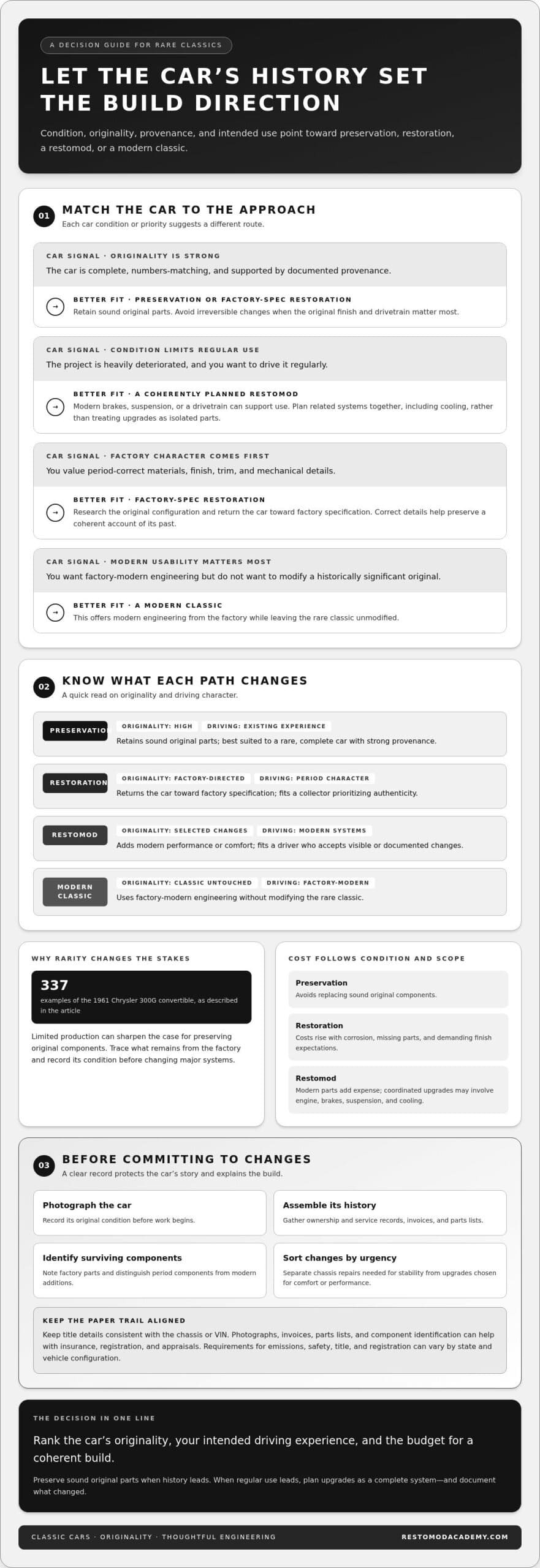
Start with the car’s condition, documented originality, and intended use. A complete, numbers-matching classic points toward preservation or factory-spec restoration, especially when its provenance matters to you. A heavily deteriorated project may suit a restomod, where modern brakes, suspension, or a drivetrain can support regular driving. A Modern Classic offers another route: modern engineering from the factory, without modifying a rare classic.
Set your priorities before choosing a finish. If you want period-correct materials and a faithful return to factory condition, restoration fits. If you want the classic’s shape with modern comfort or performance, consider a restomod. A Modern Classic may make more sense when daily convenience matters more than owning a historically significant original. List your must-haves, such as air conditioning or improved handling, then separate them from changes you can forgo.
Costs vary with the car’s condition and the project’s scope. Preservation avoids replacing sound original components; restoration costs rise with corrosion, missing parts, and demanding finish expectations. Modern replacement parts can add expense, while a restomod may require coordinated upgrades to the engine, brakes, suspension, and cooling system.
Insurance, title, registration, and appraisals depend on clear records of the car and its modifications. Keep the title details consistent with the chassis or VIN, and assemble a file of photographs, invoices, parts lists, and component identification. Agreed-value policies typically require thorough documentation and evidence of build quality. The same records help an appraiser distinguish careful engineering from expensive but poorly integrated parts.
Use this comparison to identify the best fit for a car you’ll drive, collect, or both. The ethics of restomodding a rare classic become clearer when you weigh personal use against the history carried by original components.
| Option | Originality | Driving | Best fit |
|---|---|---|---|
| Preservation | Retains sound original parts | Maintains the existing experience | A rare, complete car with strong provenance |
| Restoration | Returns the car toward factory specification | Follows its period character | A collector prioritizing authenticity |
| Restomod | Changes selected systems | Adds modern performance or comfort | A driver who accepts visible or documented changes |
| Modern Classic | Leaves the rare classic unmodified | Uses factory-modern engineering | An owner who wants modern usability |
Rank three priorities: the car’s originality, your intended driving experience, and the budget available for a coherent build. If preserving its original finish and drivetrain comes first, avoid irreversible changes. If regular use leads, plan upgrades as a complete system, not a collection of isolated parts.
Restoration vs Restomod: Which Is Right for Your Classic?
Factory-spec restoration treats the vehicle as both a historical artifact and a machine. The goal is to return its finish, interior, trim, chassis details, and mechanical components to a period-correct configuration. For example, someone restoring a classic Mustang would research its original color and trim before selecting replacement materials. Each correct detail helps tell a coherent story of the car’s past.
Originality deserves special weight when a car has documented historical significance or unusually rare factory equipment. A 1961 Chrysler 300G convertible, described as one of 337 examples, illustrates how limited production can sharpen interest in preserving original components. Before changing its engine or brakes, trace what remains from the factory and record its condition. Reversible repairs can protect surviving material while addressing deterioration.
Collector priorities also shape the decision. A period-correct restoration can honor the vehicle’s design and engineering, while a restomod makes room for personal preferences and modern systems. Neither approach guarantees a particular market response. Permanent changes to a rare chassis or distinctive drivetrain can, however, narrow the audience among collectors who value historical accuracy. Document every change, especially when original parts are removed or replaced.
In the United States, emissions, safety, title, and registration requirements can vary by state and vehicle configuration. Identify the rules that apply to the car’s model year and planned modifications before altering emissions equipment or road-use systems. Don’t assume one state’s process applies nationwide.
The ethical case for modifying a rare classic is strongest when upgrades preserve its identity while making it more usable, safer, or enjoyable to drive. The counterargument is that irreversible changes can erase scarce factory evidence and limit future owners’ choices. A respectful build records the car’s original condition, keeps removed parts when practical, and distinguishes period components from modern additions.
Follow a deliberate sequence before committing: photograph the vehicle, assemble its ownership and service records, identify surviving factory components, then list proposed changes by urgency. Separate repairs needed to stabilize the chassis from upgrades chosen for comfort or performance. This helps preserve historical details while shaping a restomod around your priorities.
If you’re still weighing how modern upgrades affect a classic’s character, explore this overview of what defines a restomod. Use that distinction to decide whether your project calls for factory accuracy, carefully chosen modifications, or a combination that leaves important original features intact.
Build records, provenance, and builder reputation
A restomod’s story lives in its records as much as in its finished stance. Compare documentation, component integration, flexibility, and workmanship when assessing its quality or long-term value.
Build Records and Provenance
A build file connects the car’s identity and history to each modification. Include the chassis number, title history, restoration photographs, invoices, parts list, and engine and transmission identification. Add alignment records, available dyno information, and warranty terms when applicable. Unlike a parts receipt alone, this file shows how the project developed and helps future owners understand what remains original.
Builder Reputation and Integration
A builder’s reputation matters most when it reflects consistent execution, not just a recognizable name. Check that modern components work together: an engine upgrade must suit the cooling system, brakes, and suspension. Aftermarket brand names alone add little when parts are poorly integrated. Supported components, accessible service points, and fewer one-off solutions make future maintenance clearer than a build that depends on custom fixes.
Ask how decisions are recorded throughout the project. A clear sequence of photographs can show concealed work, such as wiring routes, chassis repairs, and brake-line installation. Invoices and a parts list let you trace major components; alignment records help explain how the completed suspension was set up. Complete records support transparency, while gaps make it harder to distinguish careful craftsmanship from undocumented changes.
Some modifications are easier to reverse than others. Bolt-on wheels, seats, or suspension components may come off without cutting the body, while welded mounts, trimmed panels, and altered wiring can leave permanent marks. Store removed original parts with labels, record where each came from, and photograph the car before disassembly. This simple discipline keeps future options open.
Build cost alone does not determine a restomod’s value. A professionally completed, cohesive, documented build can sell for more than a stock example, while poor execution can leave it worth less. Tuning, alignment, and road testing can support buyer confidence and the asking price. Judge the result by how its components function together, not by horsepower claims or a premium parts list.
Plan the schedule around the work sequence, not an optimistic finish date. Rust repair or chassis correction can affect suspension geometry; late drivetrain decisions can require changes to mounts, cooling, and exhaust routing. A restoration may take months or even years, depending on the work required. For any build, written milestones and recorded design choices make progress easier to track.
Before approving a modification, ask whether it suits the car’s intended use, whether it can be serviced, and whether the original component can be retained. These three checks connect engineering choices to provenance, usability, and the values guiding the build.
Restomods compared with restored classics and custom cars
Think of a restored classic, a restomod, and a custom car as three different answers to one question: what should this vehicle become? A restored 1960s coupe aims for period-correct condition. A restomod keeps its classic identity while updating selected systems. A custom build gives greater priority to the owner’s design choices, which may reshape the car’s appearance or character.
A restored classic puts historical accuracy first. Its factory-style finish, interior, steering, and drivetrain follow the original design as closely as the available evidence allows. This path suits an owner who values authenticity and the experience the manufacturer intended. For example, replacing worn components with period-correct parts preserves the car’s original feel, but may not provide the comfort or reliability expected of a modern vehicle.
A restomod takes a more selective approach. Picture a classic coupe with its original exterior lines but upgraded brakes, suspension, steering, and air conditioning. Each modification should work with the others: stronger braking needs compatible tires and suspension, while an engine change can affect cooling and drivetrain choices. The aim is to blend familiar character with modern usability, rather than recreate factory specification.
A custom car offers the broadest scope for modification. An owner might change the bodywork, cabin layout, paint, or mechanical package to realize a distinct personal vision. Unlike a restomod, which typically balances classic appearance with modern upgrades, a custom build may treat the original design as a starting point. The base vehicle’s condition matters because extensive changes can require more fabrication.
These approaches preserve different kinds of value. A factory-style restoration emphasizes original features and historical continuity. A restomod’s appeal depends on the quality and coherence of its upgrades, while a custom car reflects its design and execution. Money spent alone doesn’t determine value. For each approach, clear records and honest descriptions help explain what changed and why.
Set a boundary before work begins. Name the features that must stay, such as a distinctive body shape or original dashboard. Then list the driving problems you want to solve, such as vague steering or limited braking confidence. If factory details come first, restore. If you want modern function within classic styling, restomod. If the design itself should change, build custom.
For a rare classic, the strongest choice fits its condition and your purpose without disguising its history. A restomod can be a thoughtful middle ground, but only when its engineering supports the vehicle and its changes remain transparent. Choose restoration for historical fidelity, restomodding for a classic-modern balance, or customization when personal design comes first.
What makes a classic car rare, and how can owners verify its originality and provenance?
Production numbers offer a starting point, not a complete measure of rarity. A 1961 Chrysler 300G convertible is described as one of 337 examples, while a 1970 Chrysler 300 Hurst is described as one of approximately 500. Those figures matter most when they match the car’s exact body style, factory configuration, and surviving history.
Unusual factory options, a distinctive drivetrain, or documented ownership can give a car historical significance beyond its production numbers. A rare badge alone proves little about an individual vehicle. Compare its configuration with period records, then distinguish factory-installed features from later additions. Condition matters, too: a car with scarce original components tells a different story from one retaining only its nameplate.
Begin with the chassis number and VIN shown on the vehicle and title. Record each identifier, then compare it with ownership papers, service records, and older photographs. Look for consistent dates, descriptions, and identifying details. If documents conflict, keep each version and investigate the discrepancy rather than treating one record as conclusive.
Next, assemble evidence of the factory configuration. Gather available production paperwork, original sales documents, manuals, and period photographs. Compare recorded paint, trim, engine, and option details with the car’s current configuration. Date-coded components may support a period-correct history, but a matching appearance alone doesn’t prove that a part was installed at the factory.
Build the ownership timeline from dated titles, registration papers, service invoices, and family photographs. A picture showing the car beside a recognizable location or owner can help connect a document to the vehicle. Bring names, dates, and descriptions together in a single chronology. Note any gaps plainly, so later owners can see where the documented history pauses.
Photograph the car’s current condition before restoration or modification begins. Capture the chassis, engine bay, interior, identification plates, and details that may disappear during disassembly. Match each image to a date and location when possible. For removed original components, record their origin, add a label, and retain them when practical. This creates a traceable record instead of relying on memory.
Use the evidence as a decision tool, not just a display file. A documented, complete example such as the 1961 Chrysler 300G deserves careful comparison between its surviving features and proposed changes. Separate verified facts from owner recollections, and mark replacement parts clearly. That discipline helps preserve the car’s story, whether you maintain its current configuration or plan a thoughtfully documented build.
Restomod Academy: The Ultimate Restomod Guide
After weighing originality, provenance, and intended use, Restomod Academy can help you shape the build. The Ultimate Restomod Guide provides practical guidance for planning a restomod, while Restomod Consulting Services offer help with project-specific decisions.
If your project is moving from concept toward execution, Premium Project Blueprints are another resource to consider. Use these offerings to clarify your direction, organize your priorities, and make deliberate choices about how modern upgrades fit a classic’s character.
Contact Restomod Academy to explore the resource that best fits your project.
Set Your Build’s North Star
Before the first wrench turns, write a short build charter. Name what must remain untouched, what you’re willing to modify, and how you plan to use the finished vehicle. This gives each later decision a clear reference point, from selecting a component to deciding whether a change can be reversed.
The ethics of restomodding a rare classic aren’t settled by choosing restoration or modern performance alone. They show in the care you bring to the process: respecting the car’s identity, recording your choices, and leaving the next caretaker an honest account of the work. Treat that record as part of the build, not paperwork to assemble at the end.
Turn your priorities into a plan you can follow in the workshop. For guidance as you shape that plan, contact Restomod Academy. The right direction is the one you can stand behind, and build with care.
Frequently Asked Questions
What is restomodding, and how does it differ from restoration or a replica?
Restomodding updates an existing classic with modern technology while retaining its classic identity. Restoration aims to return that specific car to factory condition, using period-correct parts and finishes where possible. A replica recreates a particular model’s design rather than preserving the history of one original vehicle. For example, updated steering in an original classic suggests a restomod; a faithful factory-spec rebuild is a restoration.
How does restomodding affect a rare classic car’s market value compared with an original restoration?
A restomod’s value depends on execution, documentation, and how well its modifications work together, not simply on the money invested. A cohesive, professionally completed build can be worth more than a stock example, while poor workmanship may reduce buyer interest. An original restoration can appeal to collectors seeking factory authenticity. Consider the car’s rarity, condition, provenance, and intended audience together; no approach guarantees a particular market outcome.
How can owners choose a restomod shop and document the work responsibly?
Choose based on relevant classic-car experience, careful integration, and clear records, not impressive parts names alone. Define the project scope in writing, including which original features stay and which changes are planned. Photograph the car before disassembly and capture work that will later be hidden. Keep invoices, component details, and test records together, giving the finished build a traceable history and future maintenance a practical starting point.
When is a restomod more ethically defensible than preserving a rare classic in original condition?
A restomod can be a reasonable choice when a classic’s condition makes faithful preservation impractical, or carefully planned upgrades support the owner’s intended use. The case is stronger when changes avoid unnecessary damage, retain removable original parts, and are honestly documented. By contrast, modifying a complete, historically significant car can erase scarce evidence. Weigh the vehicle’s individual provenance and surviving original components before deciding which changes respect its story.
What are the main mechanical, safety, and reliability risks of restomodding a rare classic?
Risks include poorly integrated upgrades, such as an engine the cooling system, brakes, or suspension can’t support, and one-off fixes that make maintenance harder. Welded mounts, trimmed panels, and altered wiring can also leave permanent changes. Plan upgrades as a system and document the work.
The best upgrade for a rare classic may be no upgrade at all. Choose a faithful restoration when the car is complete, numbers-matching, and supported by documented provenance. Consider a restomod when its condition or your driving goals make modern engineering a better fit. The ethics of restomodding a rare classic depend on what you preserve, what you change, and how clearly you document the work.
It’s natural to want modern braking, handling, and comfort without losing the shape and character that make a car special. But rarity and originality matter, too. A striking build isn’t automatically the right choice for every vehicle.
Use this guide to weigh originality, provenance, engineering, and workmanship before choosing restoration or restomod. You’ll see how a custom build differs from both approaches, which trade-offs matter most, and how to respect the car’s history while shaping it for the way you want to drive.
Key Takeaways
- Match the build approach to the car’s condition, originality, and the way you intend to drive it.
- Weigh factory-correct details against modern improvements in comfort, performance, and usability.
- Use provenance and rarity to understand what the car represents before deciding which changes make sense.
- Look beyond parts and horsepower: coherent engineering, clear build records, and skilled execution matter.
- Compare restored classics, restomods, and custom builds to find the balance of heritage and personal expression that fits your project.
When to Choose Full Restoration or Restomod?
Start with the car’s condition, documented originality, and intended use. A complete, numbers-matching classic points toward preservation or factory-spec restoration, especially when its provenance matters to you. A heavily deteriorated project may suit a restomod, where modern brakes, suspension, or a drivetrain can support regular driving. A Modern Classic offers another route: modern engineering from the factory, without modifying a rare classic.
Set your priorities before choosing a finish. If you want period-correct materials and a faithful return to factory condition, restoration fits. If you want the classic’s shape with modern comfort or performance, consider a restomod. A Modern Classic may make more sense when daily convenience matters more than owning a historically significant original. List your must-haves, such as air conditioning or improved handling, then separate them from changes you can forgo.
Costs vary with the car’s condition and the project’s scope. Preservation avoids replacing sound original components; restoration costs rise with corrosion, missing parts, and demanding finish expectations. Modern replacement parts can add expense, while a restomod may require coordinated upgrades to the engine, brakes, suspension, and cooling system.
Insurance, title, registration, and appraisals depend on clear records of the car and its modifications. Keep the title details consistent with the chassis or VIN, and assemble a file of photographs, invoices, parts lists, and component identification. Agreed-value policies typically require thorough documentation and evidence of build quality. The same records help an appraiser distinguish careful engineering from expensive but poorly integrated parts.
Use this comparison to identify the best fit for a car you’ll drive, collect, or both. The ethics of restomodding a rare classic become clearer when you weigh personal use against the history carried by original components.
| Option | Originality | Driving | Best fit |
|---|---|---|---|
| Preservation | Retains sound original parts | Maintains the existing experience | A rare, complete car with strong provenance |
| Restoration | Returns the car toward factory specification | Follows its period character | A collector prioritizing authenticity |
| Restomod | Changes selected systems | Adds modern performance or comfort | A driver who accepts visible or documented changes |
| Modern Classic | Leaves the rare classic unmodified | Uses factory-modern engineering | An owner who wants modern usability |
Rank three priorities: the car’s originality, your intended driving experience, and the budget available for a coherent build. If preserving its original finish and drivetrain comes first, avoid irreversible changes. If regular use leads, plan upgrades as a complete system, not a collection of isolated parts.
Restoration vs Restomod: Which Is Right for Your Classic?
Factory-spec restoration treats the vehicle as both a historical artifact and a machine. The goal is to return its finish, interior, trim, chassis details, and mechanical components to a period-correct configuration. For example, someone restoring a classic Mustang would research its original color and trim before selecting replacement materials. Each correct detail helps tell a coherent story of the car’s past.
Originality deserves special weight when a car has documented historical significance or unusually rare factory equipment. A 1961 Chrysler 300G convertible, described as one of 337 examples, illustrates how limited production can sharpen interest in preserving original components. Before changing its engine or brakes, trace what remains from the factory and record its condition. Reversible repairs can protect surviving material while addressing deterioration.
Collector priorities also shape the decision. A period-correct restoration can honor the vehicle’s design and engineering, while a restomod makes room for personal preferences and modern systems. Neither approach guarantees a particular market response. Permanent changes to a rare chassis or distinctive drivetrain can, however, narrow the audience among collectors who value historical accuracy. Document every change, especially when original parts are removed or replaced.
In the United States, emissions, safety, title, and registration requirements can vary by state and vehicle configuration. Identify the rules that apply to the car’s model year and planned modifications before altering emissions equipment or road-use systems. Don’t assume one state’s process applies nationwide.
The ethical case for modifying a rare classic is strongest when upgrades preserve its identity while making it more usable, safer, or enjoyable to drive. The counterargument is that irreversible changes can erase scarce factory evidence and limit future owners’ choices. A respectful build records the car’s original condition, keeps removed parts when practical, and distinguishes period components from modern additions.
Follow a deliberate sequence before committing: photograph the vehicle, assemble its ownership and service records, identify surviving factory components, then list proposed changes by urgency. Separate repairs needed to stabilize the chassis from upgrades chosen for comfort or performance. This helps preserve historical details while shaping a restomod around your priorities.
If you’re still weighing how modern upgrades affect a classic’s character, explore this overview of what defines a restomod. Use that distinction to decide whether your project calls for factory accuracy, carefully chosen modifications, or a combination that leaves important original features intact.
Build records, provenance, and builder reputation
A restomod’s story lives in its records as much as in its finished stance. Compare documentation, component integration, flexibility, and workmanship when assessing its quality or long-term value.
Build Records and Provenance
A build file connects the car’s identity and history to each modification. Include the chassis number, title history, restoration photographs, invoices, parts list, and engine and transmission identification. Add alignment records, available dyno information, and warranty terms when applicable. Unlike a parts receipt alone, this file shows how the project developed and helps future owners understand what remains original.
Builder Reputation and Integration
A builder’s reputation matters most when it reflects consistent execution, not just a recognizable name. Check that modern components work together: an engine upgrade must suit the cooling system, brakes, and suspension. Aftermarket brand names alone add little when parts are poorly integrated. Supported components, accessible service points, and fewer one-off solutions make future maintenance clearer than a build that depends on custom fixes.
Ask how decisions are recorded throughout the project. A clear sequence of photographs can show concealed work, such as wiring routes, chassis repairs, and brake-line installation. Invoices and a parts list let you trace major components; alignment records help explain how the completed suspension was set up. Complete records support transparency, while gaps make it harder to distinguish careful craftsmanship from undocumented changes.
Some modifications are easier to reverse than others. Bolt-on wheels, seats, or suspension components may come off without cutting the body, while welded mounts, trimmed panels, and altered wiring can leave permanent marks. Store removed original parts with labels, record where each came from, and photograph the car before disassembly. This simple discipline keeps future options open.
Build cost alone does not determine a restomod’s value. A professionally completed, cohesive, documented build can sell for more than a stock example, while poor execution can leave it worth less. Tuning, alignment, and road testing can support buyer confidence and the asking price. Judge the result by how its components function together, not by horsepower claims or a premium parts list.
Plan the schedule around the work sequence, not an optimistic finish date. Rust repair or chassis correction can affect suspension geometry; late drivetrain decisions can require changes to mounts, cooling, and exhaust routing. A restoration may take months or even years, depending on the work required. For any build, written milestones and recorded design choices make progress easier to track.
Before approving a modification, ask whether it suits the car’s intended use, whether it can be serviced, and whether the original component can be retained. These three checks connect engineering choices to provenance, usability, and the values guiding the build.
Restomods compared with restored classics and custom cars
Think of a restored classic, a restomod, and a custom car as three different answers to one question: what should this vehicle become? A restored 1960s coupe aims for period-correct condition. A restomod keeps its classic identity while updating selected systems. A custom build gives greater priority to the owner’s design choices, which may reshape the car’s appearance or character.
A restored classic puts historical accuracy first. Its factory-style finish, interior, steering, and drivetrain follow the original design as closely as the available evidence allows. This path suits an owner who values authenticity and the experience the manufacturer intended. For example, replacing worn components with period-correct parts preserves the car’s original feel, but may not provide the comfort or reliability expected of a modern vehicle.
A restomod takes a more selective approach. Picture a classic coupe with its original exterior lines but upgraded brakes, suspension, steering, and air conditioning. Each modification should work with the others: stronger braking needs compatible tires and suspension, while an engine change can affect cooling and drivetrain choices. The aim is to blend familiar character with modern usability, rather than recreate factory specification.
A custom car offers the broadest scope for modification. An owner might change the bodywork, cabin layout, paint, or mechanical package to realize a distinct personal vision. Unlike a restomod, which typically balances classic appearance with modern upgrades, a custom build may treat the original design as a starting point. The base vehicle’s condition matters because extensive changes can require more fabrication.
These approaches preserve different kinds of value. A factory-style restoration emphasizes original features and historical continuity. A restomod’s appeal depends on the quality and coherence of its upgrades, while a custom car reflects its design and execution. Money spent alone doesn’t determine value. For each approach, clear records and honest descriptions help explain what changed and why.
Set a boundary before work begins. Name the features that must stay, such as a distinctive body shape or original dashboard. Then list the driving problems you want to solve, such as vague steering or limited braking confidence. If factory details come first, restore. If you want modern function within classic styling, restomod. If the design itself should change, build custom.
For a rare classic, the strongest choice fits its condition and your purpose without disguising its history. A restomod can be a thoughtful middle ground, but only when its engineering supports the vehicle and its changes remain transparent. Choose restoration for historical fidelity, restomodding for a classic-modern balance, or customization when personal design comes first.
What makes a classic car rare, and how can owners verify its originality and provenance?
Production numbers offer a starting point, not a complete measure of rarity. A 1961 Chrysler 300G convertible is described as one of 337 examples, while a 1970 Chrysler 300 Hurst is described as one of approximately 500. Those figures matter most when they match the car’s exact body style, factory configuration, and surviving history.
Unusual factory options, a distinctive drivetrain, or documented ownership can give a car historical significance beyond its production numbers. A rare badge alone proves little about an individual vehicle. Compare its configuration with period records, then distinguish factory-installed features from later additions. Condition matters, too: a car with scarce original components tells a different story from one retaining only its nameplate.
Begin with the chassis number and VIN shown on the vehicle and title. Record each identifier, then compare it with ownership papers, service records, and older photographs. Look for consistent dates, descriptions, and identifying details. If documents conflict, keep each version and investigate the discrepancy rather than treating one record as conclusive.
Next, assemble evidence of the factory configuration. Gather available production paperwork, original sales documents, manuals, and period photographs. Compare recorded paint, trim, engine, and option details with the car’s current configuration. Date-coded components may support a period-correct history, but a matching appearance alone doesn’t prove that a part was installed at the factory.
Build the ownership timeline from dated titles, registration papers, service invoices, and family photographs. A picture showing the car beside a recognizable location or owner can help connect a document to the vehicle. Bring names, dates, and descriptions together in a single chronology. Note any gaps plainly, so later owners can see where the documented history pauses.
Photograph the car’s current condition before restoration or modification begins. Capture the chassis, engine bay, interior, identification plates, and details that may disappear during disassembly. Match each image to a date and location when possible. For removed original components, record their origin, add a label, and retain them when practical. This creates a traceable record instead of relying on memory.
Use the evidence as a decision tool, not just a display file. A documented, complete example such as the 1961 Chrysler 300G deserves careful comparison between its surviving features and proposed changes. Separate verified facts from owner recollections, and mark replacement parts clearly. That discipline helps preserve the car’s story, whether you maintain its current configuration or plan a thoughtfully documented build.
Restomod Academy: The Ultimate Restomod Guide
After weighing originality, provenance, and intended use, Restomod Academy can help you shape the build. The Ultimate Restomod Guide provides practical guidance for planning a restomod, while Restomod Consulting Services offer help with project-specific decisions.
If your project is moving from concept toward execution, Premium Project Blueprints are another resource to consider. Use these offerings to clarify your direction, organize your priorities, and make deliberate choices about how modern upgrades fit a classic’s character.
Contact Restomod Academy to explore the resource that best fits your project.
Set Your Build’s North Star
Before the first wrench turns, write a short build charter. Name what must remain untouched, what you’re willing to modify, and how you plan to use the finished vehicle. This gives each later decision a clear reference point, from selecting a component to deciding whether a change can be reversed.
The ethics of restomodding a rare classic aren’t settled by choosing restoration or modern performance alone. They show in the care you bring to the process: respecting the car’s identity, recording your choices, and leaving the next caretaker an honest account of the work. Treat that record as part of the build, not paperwork to assemble at the end.
Turn your priorities into a plan you can follow in the workshop. For guidance as you shape that plan, contact Restomod Academy. The right direction is the one you can stand behind, and build with care.
Frequently Asked Questions
What is restomodding, and how does it differ from restoration or a replica?
Restomodding updates an existing classic with modern technology while retaining its classic identity. Restoration aims to return that specific car to factory condition, using period-correct parts and finishes where possible. A replica recreates a particular model’s design rather than preserving the history of one original vehicle. For example, updated steering in an original classic suggests a restomod; a faithful factory-spec rebuild is a restoration.
How does restomodding affect a rare classic car’s market value compared with an original restoration?
A restomod’s value depends on execution, documentation, and how well its modifications work together, not simply on the money invested. A cohesive, professionally completed build can be worth more than a stock example, while poor workmanship may reduce buyer interest. An original restoration can appeal to collectors seeking factory authenticity. Consider the car’s rarity, condition, provenance, and intended audience together; no approach guarantees a particular market outcome.
How can owners choose a restomod shop and document the work responsibly?
Choose based on relevant classic-car experience, careful integration, and clear records, not impressive parts names alone. Define the project scope in writing, including which original features stay and which changes are planned. Photograph the car before disassembly and capture work that will later be hidden. Keep invoices, component details, and test records together, giving the finished build a traceable history and future maintenance a practical starting point.
When is a restomod more ethically defensible than preserving a rare classic in original condition?
A restomod can be a reasonable choice when a classic’s condition makes faithful preservation impractical, or carefully planned upgrades support the owner’s intended use. The case is stronger when changes avoid unnecessary damage, retain removable original parts, and are honestly documented. By contrast, modifying a complete, historically significant car can erase scarce evidence. Weigh the vehicle’s individual provenance and surviving original components before deciding which changes respect its story.
What are the main mechanical, safety, and reliability risks of restomodding a rare classic?
Risks include poorly integrated upgrades, such as an engine the cooling system, brakes, or suspension can’t support, and one-off fixes that make maintenance harder. Welded mounts, trimmed panels, and altered wiring can also leave permanent changes. Plan upgrades as a system and document the work.