

The best project car isn’t always the one with the most tempting story or the lowest asking price. The most useful skills to learn before buying a project car are asking focused questions, researching the model and its features, evaluating reviews, and judging whether the work fits your abilities and budget.
It’s natural to picture the finished build: classic lines, a smoothly running engine, and modern touches that make the car your own. But a rewarding restoration starts with a sound decision, not just a strong vision. A thoughtful conversation with the seller can reveal details missing from a polished listing, while careful research helps you distinguish a promising foundation from a project that could stretch your time, skills, or finances.
This guide covers how to speak with sellers, compare vehicles and features, and use reviews to make an informed choice. Balance enthusiasm with practical judgment before you commit, so the project you bring home has a realistic path to becoming the car you imagined.
Key Takeaways
- Ask sellers focused questions, explain your budget clearly, and be ready to walk away from pressure rather than rush a decision.
- Compare model-specific features and reviews to understand which vehicle best matches your goals and the kind of build you want.
- Build practical mechanical knowledge so you can judge the work a project may demand and plan your learning around the car.
- Inspect the body, frame, and mechanical condition carefully, then use Restomod Academy’s educational resources to shape your next steps.
Negotiation and communication with car sellers
Prepare before speaking with a seller. Write down how you plan to use the car, your project limits, and your budget. Then ask direct questions about its history, current faults, and unfinished work. For example, ask when the engine last ran and what prevents it from starting now.
Listen for details you can compare with the listing. Ask the seller to separate firsthand knowledge from information passed along by a previous owner. If answers change, pause and clarify instead of filling gaps with assumptions. A calm, specific conversation helps you assess both the car and the deal.
Negotiate based on evidence, not pressure. Explain how a documented defect or missing component affects your offer, and state the amount you’re prepared to spend without exceeding your limit. If the seller rejects your terms or rushes you, you can end the conversation and walk away.
Inspection, emissions, and registration rules depend on where the modified car will be registered and what has been changed. Before committing, identify the applicable local requirements through the relevant motor vehicle authority, then factor any required work into your plans.
Estimate repair costs by listing each known job, the parts required, specialist labor, and any machine work. Separate urgent repairs from upgrades, then leave room in your budget for problems a closer inspection may uncover. Compare the projected total with your financial limit before making an offer.
On a compatible vehicle, an OBD-II scanner can retrieve diagnostic trouble codes. Record the codes and symptoms before clearing anything. A code points to a system or condition, not necessarily one failed part. Compare the readings with an inspection and service information before deciding what needs repair.
Choose basic tools suited to the work, such as correctly sized hand tools, a torque wrench, eye protection, and a jack with rated stands. Work on firm, level ground, support the vehicle securely, and never reach beneath a car held only by a jack.
Learn to service oil and other fluids using the vehicle’s service information, including the specified fluid and disposal method. Before taking on brake work, understand component inspection and correct assembly. Wiring diagrams help you trace circuits by connector, fuse, and ground. Match parts research to the car’s year, model, engine, and configuration.
Researching vehicles, features, and reviews
Research turns a favorite model into a specific, testable project choice. Compare condition, equipment, reputation, and history before deciding whether the car’s character fits your plans.
Used-Car Condition Checks
A condition check is a systematic review of a car’s body, structure, and operating components. It matters because hidden rust or poorly repaired damage can reshape a project more than visible cosmetic flaws.
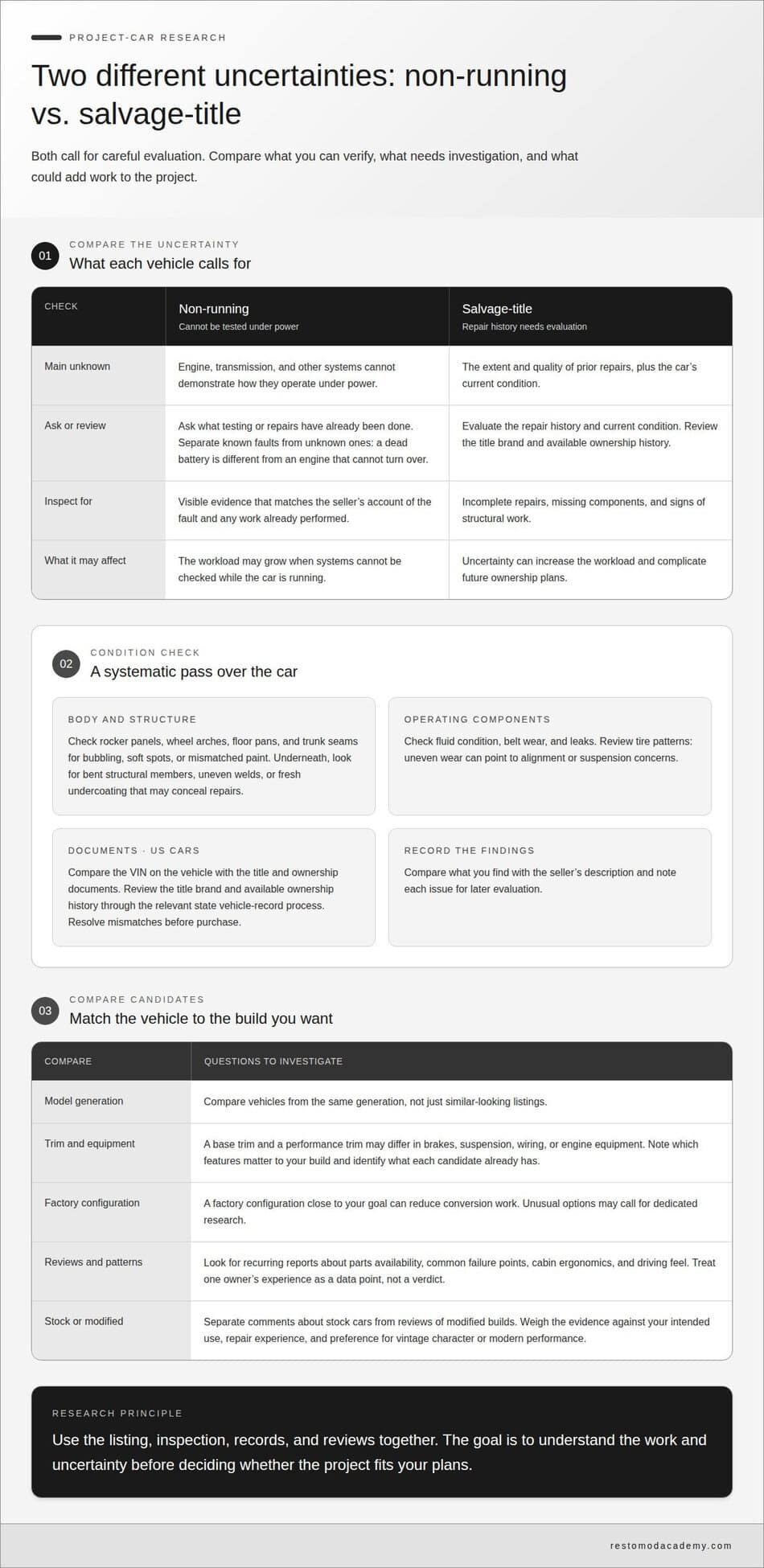
Inspect rocker panels, wheel arches, floor pans, and trunk seams for bubbling, soft spots, or mismatched paint. Look underneath for bent structural members, uneven welds, or fresh undercoating that may conceal repairs. Check fluid condition, belt wear, leaks, and tire patterns. Uneven tire wear can point to alignment or suspension concerns. Compare your findings with the seller’s description and record each issue for later evaluation.
For a US car, compare the VIN on the vehicle with the title and ownership documents. Review the title brand and available ownership history through the relevant state vehicle-record process. Resolve any mismatches before purchase.
Non-Running and Salvage Risks
A non-running car can’t show how its engine, transmission, or other systems operate under power. A salvage-title car may warrant careful evaluation of its repair history and current condition.
For a car that won’t start, separate known faults from unknown ones: a dead battery is different from an engine that cannot turn over. Ask what testing or repairs have already been done, then compare those details with visible evidence. With a salvage vehicle, look for incomplete repairs, missing components, and signs of structural work. These uncertainties can increase the workload and complicate future ownership plans.
Compare vehicles from the same model generation, not just similar-looking listings. A base trim and a performance trim may differ in brakes, suspension, wiring, or engine equipment. Note which features matter to your build, then identify what each candidate already has. A factory configuration close to your goal can reduce conversion work, while unusual options may call for dedicated research.
Look for recurring patterns in reviews rather than treating one owner’s experience as a verdict. Compare reports on parts availability, common failure points, cabin ergonomics, and driving feel. Separate comments about stock cars from reviews of modified builds. Then weigh that evidence against your intended use, repair experience, and preference for vintage character or modern performance. This makes research a practical part of choosing a project.
What mechanical skills should you learn before buying a project car?
Start with system-level knowledge rather than a long list of advanced repairs. Learn how the engine, cooling system, transmission, suspension, and fuel system work together. For example, overheating may involve coolant flow, a thermostat, a radiator, or a water pump. Understanding these relationships helps you distinguish a simple fault from a deeper diagnostic challenge.
Practice reading service information before attempting a repair. Follow a procedure for removing an intake manifold, replacing a water pump, or adjusting a valve train. Note the required sequence, special tools, and inspection points. Learn to identify fasteners and connectors before disassembly, then label and organize them so reassembly follows the factory layout.
Build diagnostic reasoning by connecting symptoms to possible causes. A misfire, for example, can involve ignition, fuel delivery, compression, or an air leak. Record how the engine behaves, when the symptom occurs, and what changes it. Test one likely cause at a time instead of replacing parts based on guesswork.
Know the difference between routine service and work that demands more experience. Replacing a belt or cooling hose follows a defined procedure; rebuilding an engine requires careful measurement, cleanliness, and disciplined assembly. Learn to recognize repairs involving machining, specialized calibration, or structural work beyond your current ability. That boundary helps you choose a car whose needs match your learning goals.
Before purchase, map the car’s known faults to skills you can practice. If a vintage coupe needs suspension bushings, study the layout and removal process. If it has engine noise, learn what inspection can distinguish valvetrain wear from a bearing problem. The skills to learn before buying a project car include patience, methodical diagnosis, and accurate recordkeeping. These habits turn each repair into knowledge you can use on the next system.
How to inspect a used car for rust, frame damage, and mechanical problems
Start with the body, where old repairs can hide beneath fresh paint. Check door bottoms, wheel arches, floor edges, and trunk seams for bubbling, flaky metal, or mismatched panels. Open and close each door, hood, and trunk; uneven gaps can signal previous impact damage. Note the location and extent of every defect, then compare it with the seller’s description.
Look beneath the car for crushed sections, irregular welds, bent structural members, or undercoating that conceals the metal. Compare the left and right sides for symmetry, especially around suspension mounting points. A clean-looking outer panel doesn’t prove the underlying structure is sound. If the car has visible repairs, ask what was replaced and look for supporting records or photographs.
Inspect the engine bay before starting the car. Freshly cleaned surfaces can hide leaks, so examine hose connections, gasket edges, and the area beneath the engine. Check fluid appearance and levels, then note cracked belts, brittle wiring, or improvised repairs. Milky residue under an oil cap or coolant staining warrants investigation, not an instant diagnosis.
During a test drive, note how the engine starts, idles, and responds to the throttle. Listen for knocks, belt squeal, or exhaust leaks. Watch the temperature gauge, observe smoke, and feel for vibration during acceleration or braking. Afterward, inspect beneath the car for fresh drips. Record each symptom and the conditions in which it appeared, such as a cold start or a turn.
Use those observations to distinguish cosmetic work from structural or drivetrain concerns. A faded fender and a damaged suspension mount demand very different plans. Ask for a professional pre-purchase inspection when your findings raise questions beyond your experience. For a better-prepared workspace, explore recommended garage gear before taking on hands-on restoration work.
Restomod Academy: The Ultimate Restomod Guide
Restomod Academy’s The Ultimate Restomod Guide can help turn early research into a clearer restoration and modification plan. Use it when you understand a project car’s condition but need direction on balancing its original character with modern upgrades. For a more defined build, Premium Project Blueprints can help organize your vision into a project framework. Restomod Consulting Services can support you as you weigh choices and refine your approach.
Let the car’s condition and your goals guide the next step. A vintage coupe that needs careful preservation calls for different decisions than a platform planned for contemporary performance upgrades. Focus your learning on the systems and modifications that matter to your chosen direction, then build methodically, one decision at a time.
Contact Restomod Academy to find a learning resource that fits your project.
Make Your First Decision Count
Choose a project for the work you want to learn, not only the finished car you picture. A sound plan starts with a clear purpose: preserve a classic’s character, improve its road manners, or combine vintage style with modern performance. Let that purpose guide which compromises you’ll accept and which changes would take the build away from your vision.
The skills to learn before buying a project car become more valuable when you apply them to a real goal. Write down what you want the car to become, then use that vision to keep future decisions focused. Each careful choice, from the first repair to the final adjustment, helps turn enthusiasm into craftsmanship.
When you’re ready to shape your direction, contact Restomod Academy and explore the next step for your build. Start with a vision you believe in, then bring it to life one considered decision at a time.
Frequently Asked Questions
How to do basic car maintenance such as oil changes, brakes, and fluid replacement
Use the vehicle’s service information to identify the specified fluids and disposal method. Before doing brake work, learn component inspection and correct assembly.
How to read wiring diagrams and troubleshoot automotive electrical problems
Use wiring diagrams to trace circuits by connector, fuse, and ground. Record symptoms and test one likely cause at a time instead of replacing parts based on guesswork.
How to find parts and check compatibility for a project car
Research parts to match the car’s year, model, engine, and configuration. Compare the features each candidate already has with those your build requires.
The best project car isn’t always the one with the most tempting story or the lowest asking price. The most useful skills to learn before buying a project car are asking focused questions, researching the model and its features, evaluating reviews, and judging whether the work fits your abilities and budget.
It’s natural to picture the finished build: classic lines, a smoothly running engine, and modern touches that make the car your own. But a rewarding restoration starts with a sound decision, not just a strong vision. A thoughtful conversation with the seller can reveal details missing from a polished listing, while careful research helps you distinguish a promising foundation from a project that could stretch your time, skills, or finances.
This guide covers how to speak with sellers, compare vehicles and features, and use reviews to make an informed choice. Balance enthusiasm with practical judgment before you commit, so the project you bring home has a realistic path to becoming the car you imagined.
Key Takeaways
- Ask sellers focused questions, explain your budget clearly, and be ready to walk away from pressure rather than rush a decision.
- Compare model-specific features and reviews to understand which vehicle best matches your goals and the kind of build you want.
- Build practical mechanical knowledge so you can judge the work a project may demand and plan your learning around the car.
- Inspect the body, frame, and mechanical condition carefully, then use Restomod Academy’s educational resources to shape your next steps.
Negotiation and communication with car sellers
Prepare before speaking with a seller. Write down how you plan to use the car, your project limits, and your budget. Then ask direct questions about its history, current faults, and unfinished work. For example, ask when the engine last ran and what prevents it from starting now.
Listen for details you can compare with the listing. Ask the seller to separate firsthand knowledge from information passed along by a previous owner. If answers change, pause and clarify instead of filling gaps with assumptions. A calm, specific conversation helps you assess both the car and the deal.
Negotiate based on evidence, not pressure. Explain how a documented defect or missing component affects your offer, and state the amount you’re prepared to spend without exceeding your limit. If the seller rejects your terms or rushes you, you can end the conversation and walk away.
Inspection, emissions, and registration rules depend on where the modified car will be registered and what has been changed. Before committing, identify the applicable local requirements through the relevant motor vehicle authority, then factor any required work into your plans.
Estimate repair costs by listing each known job, the parts required, specialist labor, and any machine work. Separate urgent repairs from upgrades, then leave room in your budget for problems a closer inspection may uncover. Compare the projected total with your financial limit before making an offer.
On a compatible vehicle, an OBD-II scanner can retrieve diagnostic trouble codes. Record the codes and symptoms before clearing anything. A code points to a system or condition, not necessarily one failed part. Compare the readings with an inspection and service information before deciding what needs repair.
Choose basic tools suited to the work, such as correctly sized hand tools, a torque wrench, eye protection, and a jack with rated stands. Work on firm, level ground, support the vehicle securely, and never reach beneath a car held only by a jack.
Learn to service oil and other fluids using the vehicle’s service information, including the specified fluid and disposal method. Before taking on brake work, understand component inspection and correct assembly. Wiring diagrams help you trace circuits by connector, fuse, and ground. Match parts research to the car’s year, model, engine, and configuration.
Researching vehicles, features, and reviews
Research turns a favorite model into a specific, testable project choice. Compare condition, equipment, reputation, and history before deciding whether the car’s character fits your plans.
Used-Car Condition Checks
A condition check is a systematic review of a car’s body, structure, and operating components. It matters because hidden rust or poorly repaired damage can reshape a project more than visible cosmetic flaws.
Inspect rocker panels, wheel arches, floor pans, and trunk seams for bubbling, soft spots, or mismatched paint. Look underneath for bent structural members, uneven welds, or fresh undercoating that may conceal repairs. Check fluid condition, belt wear, leaks, and tire patterns. Uneven tire wear can point to alignment or suspension concerns. Compare your findings with the seller’s description and record each issue for later evaluation.
For a US car, compare the VIN on the vehicle with the title and ownership documents. Review the title brand and available ownership history through the relevant state vehicle-record process. Resolve any mismatches before purchase.
Non-Running and Salvage Risks
A non-running car can’t show how its engine, transmission, or other systems operate under power. A salvage-title car may warrant careful evaluation of its repair history and current condition.
For a car that won’t start, separate known faults from unknown ones: a dead battery is different from an engine that cannot turn over. Ask what testing or repairs have already been done, then compare those details with visible evidence. With a salvage vehicle, look for incomplete repairs, missing components, and signs of structural work. These uncertainties can increase the workload and complicate future ownership plans.
Compare vehicles from the same model generation, not just similar-looking listings. A base trim and a performance trim may differ in brakes, suspension, wiring, or engine equipment. Note which features matter to your build, then identify what each candidate already has. A factory configuration close to your goal can reduce conversion work, while unusual options may call for dedicated research.
Look for recurring patterns in reviews rather than treating one owner’s experience as a verdict. Compare reports on parts availability, common failure points, cabin ergonomics, and driving feel. Separate comments about stock cars from reviews of modified builds. Then weigh that evidence against your intended use, repair experience, and preference for vintage character or modern performance. This makes research a practical part of choosing a project.
What mechanical skills should you learn before buying a project car?
Start with system-level knowledge rather than a long list of advanced repairs. Learn how the engine, cooling system, transmission, suspension, and fuel system work together. For example, overheating may involve coolant flow, a thermostat, a radiator, or a water pump. Understanding these relationships helps you distinguish a simple fault from a deeper diagnostic challenge.
Practice reading service information before attempting a repair. Follow a procedure for removing an intake manifold, replacing a water pump, or adjusting a valve train. Note the required sequence, special tools, and inspection points. Learn to identify fasteners and connectors before disassembly, then label and organize them so reassembly follows the factory layout.
Build diagnostic reasoning by connecting symptoms to possible causes. A misfire, for example, can involve ignition, fuel delivery, compression, or an air leak. Record how the engine behaves, when the symptom occurs, and what changes it. Test one likely cause at a time instead of replacing parts based on guesswork.
Know the difference between routine service and work that demands more experience. Replacing a belt or cooling hose follows a defined procedure; rebuilding an engine requires careful measurement, cleanliness, and disciplined assembly. Learn to recognize repairs involving machining, specialized calibration, or structural work beyond your current ability. That boundary helps you choose a car whose needs match your learning goals.
Before purchase, map the car’s known faults to skills you can practice. If a vintage coupe needs suspension bushings, study the layout and removal process. If it has engine noise, learn what inspection can distinguish valvetrain wear from a bearing problem. The skills to learn before buying a project car include patience, methodical diagnosis, and accurate recordkeeping. These habits turn each repair into knowledge you can use on the next system.
How to inspect a used car for rust, frame damage, and mechanical problems
Start with the body, where old repairs can hide beneath fresh paint. Check door bottoms, wheel arches, floor edges, and trunk seams for bubbling, flaky metal, or mismatched panels. Open and close each door, hood, and trunk; uneven gaps can signal previous impact damage. Note the location and extent of every defect, then compare it with the seller’s description.
Look beneath the car for crushed sections, irregular welds, bent structural members, or undercoating that conceals the metal. Compare the left and right sides for symmetry, especially around suspension mounting points. A clean-looking outer panel doesn’t prove the underlying structure is sound. If the car has visible repairs, ask what was replaced and look for supporting records or photographs.
Inspect the engine bay before starting the car. Freshly cleaned surfaces can hide leaks, so examine hose connections, gasket edges, and the area beneath the engine. Check fluid appearance and levels, then note cracked belts, brittle wiring, or improvised repairs. Milky residue under an oil cap or coolant staining warrants investigation, not an instant diagnosis.
During a test drive, note how the engine starts, idles, and responds to the throttle. Listen for knocks, belt squeal, or exhaust leaks. Watch the temperature gauge, observe smoke, and feel for vibration during acceleration or braking. Afterward, inspect beneath the car for fresh drips. Record each symptom and the conditions in which it appeared, such as a cold start or a turn.
Use those observations to distinguish cosmetic work from structural or drivetrain concerns. A faded fender and a damaged suspension mount demand very different plans. Ask for a professional pre-purchase inspection when your findings raise questions beyond your experience. For a better-prepared workspace, explore recommended garage gear before taking on hands-on restoration work.
Restomod Academy: The Ultimate Restomod Guide
Restomod Academy’s The Ultimate Restomod Guide can help turn early research into a clearer restoration and modification plan. Use it when you understand a project car’s condition but need direction on balancing its original character with modern upgrades. For a more defined build, Premium Project Blueprints can help organize your vision into a project framework. Restomod Consulting Services can support you as you weigh choices and refine your approach.
Let the car’s condition and your goals guide the next step. A vintage coupe that needs careful preservation calls for different decisions than a platform planned for contemporary performance upgrades. Focus your learning on the systems and modifications that matter to your chosen direction, then build methodically, one decision at a time.
Contact Restomod Academy to find a learning resource that fits your project.
Make Your First Decision Count
Choose a project for the work you want to learn, not only the finished car you picture. A sound plan starts with a clear purpose: preserve a classic’s character, improve its road manners, or combine vintage style with modern performance. Let that purpose guide which compromises you’ll accept and which changes would take the build away from your vision.
The skills to learn before buying a project car become more valuable when you apply them to a real goal. Write down what you want the car to become, then use that vision to keep future decisions focused. Each careful choice, from the first repair to the final adjustment, helps turn enthusiasm into craftsmanship.
When you’re ready to shape your direction, contact Restomod Academy and explore the next step for your build. Start with a vision you believe in, then bring it to life one considered decision at a time.
Frequently Asked Questions
How to do basic car maintenance such as oil changes, brakes, and fluid replacement
Use the vehicle’s service information to identify the specified fluids and disposal method. Before doing brake work, learn component inspection and correct assembly.
How to read wiring diagrams and troubleshoot automotive electrical problems
Use wiring diagrams to trace circuits by connector, fuse, and ground. Record symptoms and test one likely cause at a time instead of replacing parts based on guesswork.
How to find parts and check compatibility for a project car
Research parts to match the car’s year, model, engine, and configuration. Compare the features each candidate already has with those your build requires.