
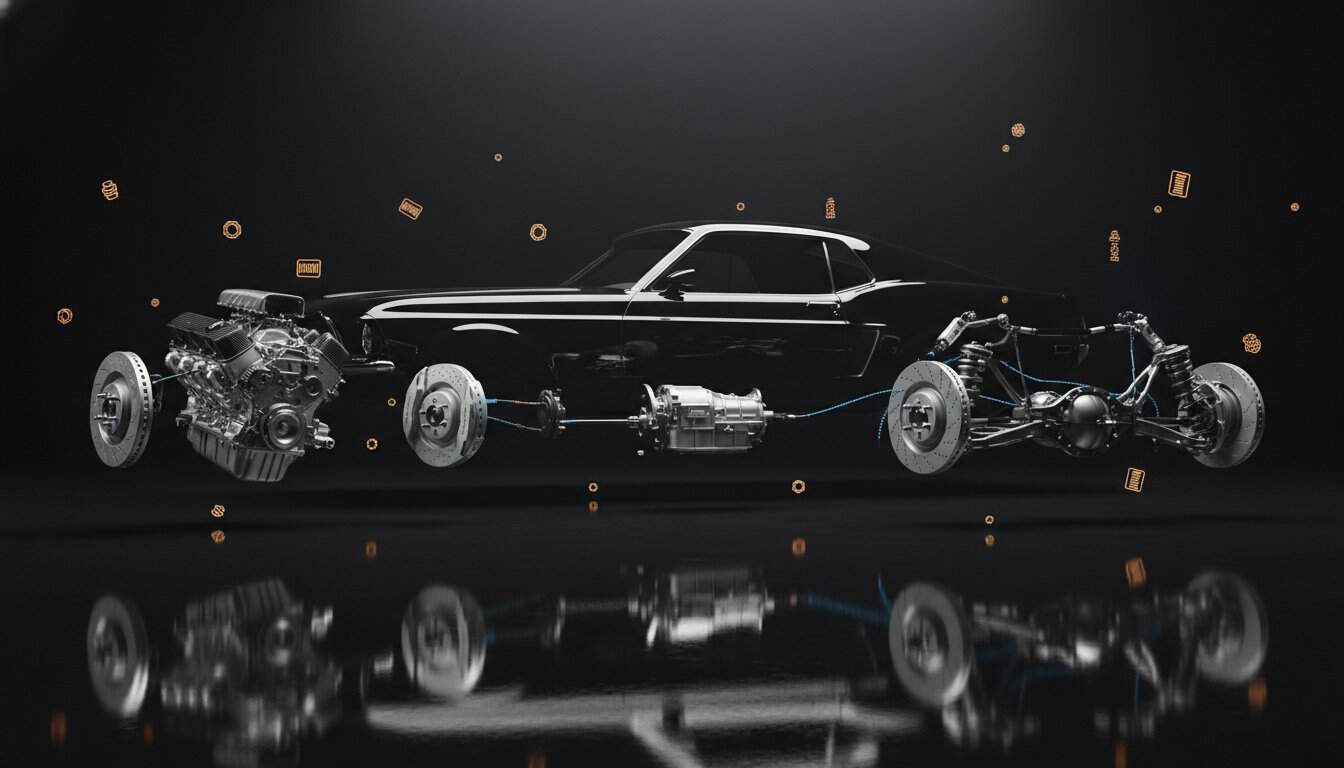
Your parts catalog is lying to you. While you have already accounted for that $11,499.99 Gen 4 Coyote crate engine and those high-performance brakes, the true hidden costs of restomodding a car rarely live in the big-ticket items. You likely feel the weight of nostalgia every time you step into the garage, but that passion can quickly turn to stress when unexpected price spikes or incompatible modern electronics stall your progress. It’s a common story in 2026, where even a mid-range paint job can jump thousands of dollars due to the recent 20% increase in material costs from suppliers like PPG.
I want to help you transition from a frustrated owner to a confident creator by building a roadmap that accounts for every variable. You’ll learn how to navigate specialized labor rates that now average $135 per hour and understand exactly where to invest your capital versus where to save. We are going to explore the integration tax of custom fabrication and the logistical expenses that often stay invisible until it’s too late. It’s time to secure your project’s future with a budget that is as precise as a modern fuel injection system.
Key Takeaways
- Master the integration tax by learning why a crate engine’s sticker price covers only a fraction of the total mechanical swap requirements.
- Secure your logistics budget against the rising costs of freight shipping and the often forgotten expense of return core charges for modern components.
- Inventory your small-scale hardware and workshop consumables to account for the cumulative hidden costs of restomodding a car.
- Identify when to call in specialized fabrication experts for critical suspension and engine geometry that exceeds standard DIY capabilities.
- Shield your project from financial exhaustion by establishing a 20 percent contingency fund and using a professional roadmap to prevent double-spending.
Beyond the Big-Ticket Items: Defining the Integration Tax
Stop looking at your project as a collection of parts and start seeing it as a complex engineering puzzle. Most builders focus on the marquee items, like a shiny new crate engine or a six-piston brake kit, yet they overlook the integration tax. This is the financial and temporal toll you pay to force modern components to coexist with a vintage chassis. While Wikipedia defines a restomod as a vehicle that combines classic aesthetics with modern performance, it rarely accounts for the mechanical friction involved in that marriage.
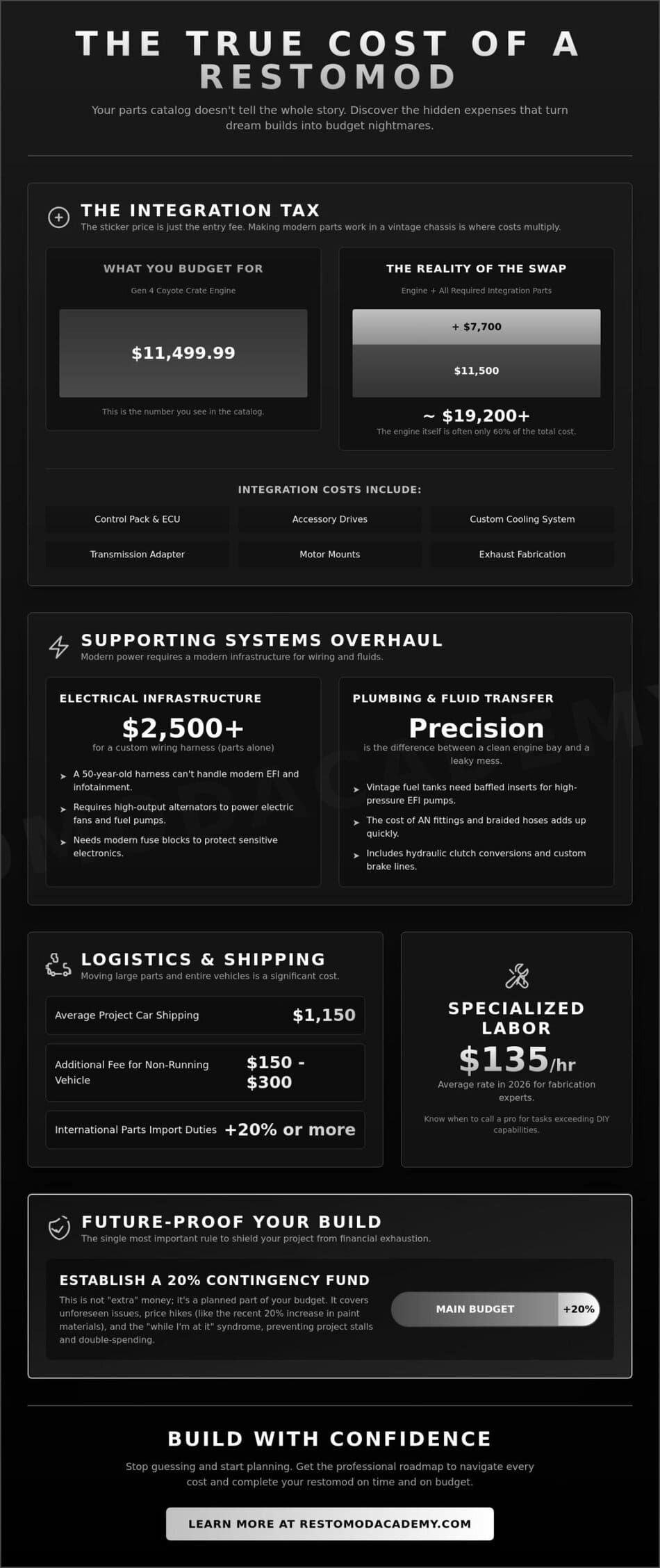
Consider the popular Gen 4 Coyote crate engine. In 2026, the unit itself costs approximately $11,499.99, but this sticker price is often only 60 percent of the total swap cost. You’ll soon realize that the engine alone won’t move the car. You need a control pack, accessory drives, and custom cooling solutions that weren’t designed for a 50 year old engine bay. These are the primary hidden costs of restomodding a car that turn a weekend swap into a multi-month ordeal. If you are planning a different platform, like a Chevy, our definitive guide to an LS engine swap breaks down those specific component requirements.
To better understand how these costs manifest in a real-world build, watch this helpful video:
The “while I am at it” syndrome is the silent killer of many budgets. It starts with a simple engine refresh and quickly spirals into a full frame-off modernization. Once the engine is out, you’ll see the firewall needs smoothing, the frame needs powder coating, and the steering box feels loose. This scope creep isn’t just a lack of discipline; it’s the natural result of trying to bring one system up to modern standards, which inevitably exposes the weaknesses in everything surrounding it.
The Electrical Infrastructure Overhaul
Don’t trust a 50 year old wiring harness to handle the demands of modern EFI or high-definition infotainment systems. A complete custom wiring harness for a restomod can cost around $2,500 for parts alone, and that’s before you factor in the labor for routing and pinning. You’ll need high-output alternators to power electric fans and modern fuse blocks to protect sensitive electronics. Even the gauges present a challenge; you’ll likely need custom sending units or digital conversion kits to ensure your vintage needles can talk to your modern computer.
Plumbing and Fluid Transfer Challenges
Fuel delivery is another area where costs compound quickly. Your original tank wasn’t built for high-pressure EFI pumps, which means you’ll need an internal pump conversion or a completely new baffled tank. Beyond fuel, you’ll face hydraulic clutch conversions and custom-bent brake lines. The price of AN fittings and braided stainless hoses adds up faster than you expect. A clean, leak-free engine bay requires a level of precision in plumbing that simply didn’t exist when your car first rolled off the assembly line.
Shipping, Freight, and the Logistics of Modernization
Ordering parts is the high point of any build, but the logistics of moving those components can quickly erode your financial reserves. Freight shipping for engines, full frames, or body shells can add thousands to your total spend. It is not just about the weight; it is about the equipment required to move it. If you are shipping a project car to a specialist, the average cost sits around $1,150, but non-running vehicles often incur an additional fee of $150 to $300 because they require winches or specialized trailers. These logistics are among the most persistent hidden costs of restomodding a car.
Beyond domestic shipping, you must account for the complexities of international sourcing. If you are hunting for rare trim pieces or specialized performance parts from overseas, customs duties and import taxes can inflate the price by 20 percent or more. Navigating federal regulatory oversight regarding imported components or replica parts adds another layer of administrative labor that most builders ignore until their parts are stuck at a port of entry.
Managing Freight and Oversized Deliveries
Efficiency in shipping requires a commercial mindset. Residential delivery with a liftgate service is convenient, but it is also the most expensive way to receive parts. You can save hundreds by having oversized items delivered to a local commercial dock or a friend’s business with a forklift. To minimize costs, follow these steps:
- Batch your orders from a single supplier to consolidate freight shipments into one pallet.
- Insure every high-value component for its full replacement value to protect against transit damage.
- Confirm the delivery vehicle size; a 53 foot trailer cannot navigate every residential cul-de-sac.
If you find that your project has outgrown your home garage, the price of secure, climate-controlled storage becomes a necessary line item. Storing a vehicle and its organized parts stash in a dedicated facility can cost several hundred dollars a month, which adds up over a multi-year build. To ensure you are making the right logistical calls from day one, consider reviewing our list of recommended gear for organizing and moving heavy components in your own shop.
Core Charges and Return Logistics
Manufacturers often hold your money hostage through core deposits. This is common with transmissions, steering racks, and high-output alternators. While the refund sounds appealing, you must calculate the return shipping cost first. Sending a heavy cast-iron steering box across the country can cost more than the core refund itself. Sourcing these parts from local vendors or choosing no-core aftermarket alternatives is often the smarter financial move. Before you commit to a major purchase, consulting The Ultimate Restomod Guide can help you identify which components are better bought new to avoid core-related headaches.
The Death of a Thousand Cuts: Hardware and Consumables
Look at your workbench right now. You see the big parts, but you likely don’t see the five empty cans of brake cleaner or the pile of dull drill bits. This is what I call the consumables tax. It is one of the most persistent hidden costs of restomodding a car. You’ll spend hundreds on high-strength fasteners because you cannot trust a 50 year old bolt to hold your modern suspension geometry. Every time you upgrade a component, you must upgrade the hardware that secures it to ensure safety and precision.
Don’t make the mistake of buying hardware one bolt at a time. Individual trips to the store kill your momentum and your wallet. Bulk buying common sizes of zinc-plated or stainless hardware is the only way to maintain a professional pace in your shop. You also need to account for specialty clips, grommets, and weatherstripping kits. These small plastic and rubber components often cost more than the metal they attach to, yet they are essential for preventing leaks and rattles in your finished build.
High-Quality Fasteners and Hardware
When you transition from a standard restoration to a high-performance build, your hardware requirements change. You need Grade 8 or higher for any structural or drivetrain application. Replacing rusted, original bolts with modern fasteners isn’t just about aesthetics; it’s about engineering integrity. Consider these hardware essentials:
- Stainless steel bolt kits for engine accessories and body panels.
- Specialized automotive fasteners for interior trim and door cards.
- Bulk assortments of washers, nyloc nuts, and cotter pins.
Workshop Consumables and Supplies
Your shop chemicals and supplies are a constant financial drain. From high-build primers to specialized lubricants, these liquids vanish quickly during a project. Keep in mind that major paint suppliers like PPG announced price increases of up to 20 percent in 2026. This means your budget for bodywork materials needs to be more flexible than in previous years. Sandpaper, welding wire, and shielding gas are invisible expenses that stack up every single day you spend in the garage.
Don’t skimp on disposable safety gear or fluids either. Nitrile gloves, respirators, and eye protection are overhead costs that ensure you stay healthy enough to finish the job. When it’s time to fire the engine, you’ll face the cost of break-in oil, high-performance coolant, and synthetic gear oils. For those specialized tasks that require one-time-use tools, check our recommended gear to see which items are worth owning versus renting. Managing these small expenses is how you keep the hidden costs of restomodding a car from derailing your dream.
Specialized Labor and the Limits of the Home Garage
Building a car in your own garage is a badge of honor, but recognizing the limits of your equipment and expertise is a sign of a seasoned builder. Specialized labor represents one of the most significant hidden costs of restomodding a car. As of May 2026, the average auto repair labor rate in the United States has climbed to between $120 and $159 per hour. For high-end restoration shops, expect to pay at least $135 per hour, while specialized fabricators often charge $150 per hour or more for their precision. Attempting complex structural welds or intricate suspension geometry without the proper jigs can compromise the safety and value of your dream machine.
Modern performance demands a rigid foundation that many vintage frames simply cannot provide without modification. You will likely need professional intervention for chassis stiffening or correcting frame alignment that has drifted over decades of use. Precision machining for engine blocks or creating custom wheel offsets also requires specialized equipment that most home workshops lack. If you are preparing to dive into metalwork, our Classic Car Bodywork Guide provides the essential context for these advanced fabrication techniques.
Fabrication and Precision Machining
Chassis work is often where a project hits a wall. While you can bolt on a new suspension kit, ensuring that the geometry is correct requires specialized tools. If your build involves a modern engine swap, you may need custom engine mounts or clearancing that requires professional TIG welding. These tasks aren’t just about making parts fit; they are about maintaining the structural integrity of the vehicle. Machining costs for block prep or custom axle shortening are non-negotiable expenses that ensure your modern drivetrain operates without vibration or premature failure.
Software, Tuning, and Calibration
The marriage of vintage iron and modern technology is as much digital as it is mechanical. While you can route a wiring harness yourself, modern EFI systems require professional dyno tuning to ensure long-term reliability and drivability. You must account for the cost of tuning software licenses and the hourly rates of a professional calibrator who can navigate complex fuel maps. Additionally, the EPA has clarified that all vehicle emissions equipment must remain intact regardless of vehicle age, making professional guidance essential for ensuring your engine swap remains federally legal.
Bodywork and paint preparation remain the most labor-intensive and expensive phases of any project. With paint material suppliers like PPG announcing price increases of up to 20 percent in 2026, a premium, show-quality paint job can now range from $5,000 to over $10,000. This is where precision meets artistry, and the labor involved in reaching a mirror-like finish is immense. If you feel overwhelmed by these technical hurdles, our Restomod Consulting Services can provide the expert guidance needed to decide which tasks to tackle yourself and which to outsource to the professionals.
Strategic Budgeting: How to Future-Proof Your Build
Success in the workshop begins with a spreadsheet. You’ve seen how integration taxes, shipping logistics, and workshop consumables can quietly bleed a project dry. To ensure your dream reaches the pavement, you must approach your finances with the same surgical precision you apply to a suspension alignment. The hidden costs of restomodding a car are not a matter of if, but when. By building a strategic framework now, you protect yourself from the heartbreak of a half-finished project sitting under a dusty tarp.
Documentation is your best defense against the volatility of the 2026 market. Keep every receipt and log every hour of labor, whether it’s your own or a professional’s. This level of detail is essential for securing an agreed-value insurance policy that reflects the true worth of your build. It also provides a transparent history for future buyers, proving that you prioritized quality over shortcuts. When you can show the exact provenance of every high-strength bolt and custom-tuned ECU, you transform a hobbyist’s effort into a high-value asset.
The 20 Percent Contingency Rule
Adopt a mindset of aggressive realism. Your final budget should always be 1.2 times your most pessimistic estimate. This 20 percent buffer is not for the parts you want; it is for the unknown unknowns that inevitably surface once the teardown begins. If you discover hidden rust in the rockers or an incompatible spline count on a custom axle, this fund keeps the momentum alive. For a structured approach to these challenges, follow a restomod project planning roadmap to ensure you are spending on the right priorities at the right time.
Tools for Financial Success
Smart spending is about knowing where to invest and where to be frugal. You don’t always need a brand-new rotisserie for a one-time build, but you should never compromise on the quality of your measurement or safety equipment. Use our curated list of recommended gear to identify which professional-grade tools will actually save you money by preventing costly mistakes. Investing in the right knowledge early is the most effective way to avoid the hidden costs of restomodding a car.
The journey from a passive admirer to an active creator is a long one, but you don’t have to walk it alone. We provide the mentorship you need to overcome every mechanical and financial hurdle. Secure your project’s future by investing in The Ultimate Restomod Guide or utilizing our Restomod Consulting Services. With our Premium Project Blueprints, you’ll have a clear, achievable path to the finish line. Let’s get to work and build something that honors the past while dominating the future.
Secure Your Vision and Start the Build
You’ve identified the integration tax and the logistical hurdles that often remain invisible until they hit your bank account. You now understand that a successful project requires more than just a crate engine; it demands a strategic buffer for specialized labor and the cumulative expense of workshop consumables. Managing the hidden costs of restomodding a car is the difference between a machine that gathers dust and one that conquers the open road. Precision in planning is just as vital as the precision you apply in the workshop.
Created by enthusiast Brook Walsh, our framework offers the expert guidance needed to navigate these financial complexities. You’ll find step-by-step blueprints for LS and Coyote swaps alongside a supportive community of professional and DIY builders who share your drive for perfection. Don’t let your project stall because of a lack of preparation or overlooked expenses.
Master your budget with The Ultimate Restomod Guide and take the first step toward a bulletproof build today. Your dream car is waiting in the garage. Go out there and build it with confidence and clarity.
Frequently Asked Questions
How much should I realistically budget for a first-time restomod?
Realistic budgets for a quality restomod in 2026 generally range from $40,000 to $120,000 for a DIY or hybrid build. This figure assumes you start with a solid donor car and invest in professional-grade components. If you are aiming for a show-quality, professionally built vehicle, expect those costs to start at $300,000 and potentially exceed $400,000. Always account for a 20 percent contingency fund to handle the unexpected hurdles that arise during assembly.
Is it cheaper to buy a finished restomod or build one myself?
It’s often more cost-effective to purchase a completed, high-quality restomod than to build one from scratch in the current market. With specialized shop rates averaging $135 per hour, the final cost of a new build frequently exceeds its immediate market value. Buyers in 2026 show a strong preference for turnkey vehicles with modern reliability. This shift makes buying a finished project a smarter financial move for those who want to drive rather than build.
What is the most expensive part of a restomod project?
Specialized labor and the integration of modern systems are typically the most expensive aspects of any build. While a Gen 4 Coyote crate engine costs approximately $11,499.99, the fabrication required to fit it into a vintage chassis can double that investment. High-end bodywork and paint also carry a premium price. These factors represent the most significant hidden costs of restomodding a car that home builders often overlook.
How do I avoid scope creep during my car restoration?
You can avoid scope creep by following a strict project roadmap and defining your goals before the first bolt is turned. The “while I am at it” syndrome is the primary driver of budget overruns. Focus on achieving modern drivability and safety first. By using a structured plan, you can prevent double-spending on parts and ensure that every hour spent in the garage moves the car closer to the finish line.
Are restomod cars a good financial investment in 2026?
Professionally built restomods remain a strong investment, particularly those that prioritize modern drivability and performance. High-end auctions in early 2026 showed record-breaking results for elite-certified builds, even as the broader collector market saw slight dips. The key to value lies in the quality of the execution. Vehicles that successfully blend heritage aesthetics with contemporary technology continue to command premium prices and attract a new generation of collectors.
What are the most common hidden mechanical problems in donor cars?
Structural rust and compromised electrical systems are the most common mechanical issues lurking within donor cars. These problems are often masked by cosmetic repairs, making them difficult to spot during a casual inspection. Discovering frame rot or melted wiring harnesses after you’ve started your build is a major contributor to the hidden costs of restomodding a car. Always perform a thorough teardown or a professional inspection before finalizing your purchase of a donor vehicle.
Can I finance a restomod build or do I need cash upfront?
You should check with specialty automotive lenders, as traditional banks typically don’t offer financing for project cars or restomod builds. Most enthusiasts rely on cash or personal lines of credit to fund their projects. Some collector car insurance companies and lenders offer specialized products for high-value builds, but these usually require a finished appraisal. Plan to have your capital ready upfront to keep your project moving at a steady pace.
What insurance do I need for a car that is mid-restomod?
You need an agreed-value insurance policy specifically designed for vehicles under restoration. Standard auto insurance doesn’t account for the labor or the expensive modern components you’re adding to the car. An agreed-value policy ensures that if a fire or theft occurs in your shop, you’re reimbursed for the actual investment you’ve made. This coverage protects your parts stash and the growing value of your machine throughout the project.
Your parts catalog is lying to you. While you have already accounted for that $11,499.99 Gen 4 Coyote crate engine and those high-performance brakes, the true hidden costs of restomodding a car rarely live in the big-ticket items. You likely feel the weight of nostalgia every time you step into the garage, but that passion can quickly turn to stress when unexpected price spikes or incompatible modern electronics stall your progress. It’s a common story in 2026, where even a mid-range paint job can jump thousands of dollars due to the recent 20% increase in material costs from suppliers like PPG.
I want to help you transition from a frustrated owner to a confident creator by building a roadmap that accounts for every variable. You’ll learn how to navigate specialized labor rates that now average $135 per hour and understand exactly where to invest your capital versus where to save. We are going to explore the integration tax of custom fabrication and the logistical expenses that often stay invisible until it’s too late. It’s time to secure your project’s future with a budget that is as precise as a modern fuel injection system.
Key Takeaways
- Master the integration tax by learning why a crate engine’s sticker price covers only a fraction of the total mechanical swap requirements.
- Secure your logistics budget against the rising costs of freight shipping and the often forgotten expense of return core charges for modern components.
- Inventory your small-scale hardware and workshop consumables to account for the cumulative hidden costs of restomodding a car.
- Identify when to call in specialized fabrication experts for critical suspension and engine geometry that exceeds standard DIY capabilities.
- Shield your project from financial exhaustion by establishing a 20 percent contingency fund and using a professional roadmap to prevent double-spending.
Beyond the Big-Ticket Items: Defining the Integration Tax
Stop looking at your project as a collection of parts and start seeing it as a complex engineering puzzle. Most builders focus on the marquee items, like a shiny new crate engine or a six-piston brake kit, yet they overlook the integration tax. This is the financial and temporal toll you pay to force modern components to coexist with a vintage chassis. While Wikipedia defines a restomod as a vehicle that combines classic aesthetics with modern performance, it rarely accounts for the mechanical friction involved in that marriage.
Consider the popular Gen 4 Coyote crate engine. In 2026, the unit itself costs approximately $11,499.99, but this sticker price is often only 60 percent of the total swap cost. You’ll soon realize that the engine alone won’t move the car. You need a control pack, accessory drives, and custom cooling solutions that weren’t designed for a 50 year old engine bay. These are the primary hidden costs of restomodding a car that turn a weekend swap into a multi-month ordeal. If you are planning a different platform, like a Chevy, our definitive guide to an LS engine swap breaks down those specific component requirements.
To better understand how these costs manifest in a real-world build, watch this helpful video:
The “while I am at it” syndrome is the silent killer of many budgets. It starts with a simple engine refresh and quickly spirals into a full frame-off modernization. Once the engine is out, you’ll see the firewall needs smoothing, the frame needs powder coating, and the steering box feels loose. This scope creep isn’t just a lack of discipline; it’s the natural result of trying to bring one system up to modern standards, which inevitably exposes the weaknesses in everything surrounding it.
The Electrical Infrastructure Overhaul
Don’t trust a 50 year old wiring harness to handle the demands of modern EFI or high-definition infotainment systems. A complete custom wiring harness for a restomod can cost around $2,500 for parts alone, and that’s before you factor in the labor for routing and pinning. You’ll need high-output alternators to power electric fans and modern fuse blocks to protect sensitive electronics. Even the gauges present a challenge; you’ll likely need custom sending units or digital conversion kits to ensure your vintage needles can talk to your modern computer.
Plumbing and Fluid Transfer Challenges
Fuel delivery is another area where costs compound quickly. Your original tank wasn’t built for high-pressure EFI pumps, which means you’ll need an internal pump conversion or a completely new baffled tank. Beyond fuel, you’ll face hydraulic clutch conversions and custom-bent brake lines. The price of AN fittings and braided stainless hoses adds up faster than you expect. A clean, leak-free engine bay requires a level of precision in plumbing that simply didn’t exist when your car first rolled off the assembly line.
Shipping, Freight, and the Logistics of Modernization
Ordering parts is the high point of any build, but the logistics of moving those components can quickly erode your financial reserves. Freight shipping for engines, full frames, or body shells can add thousands to your total spend. It is not just about the weight; it is about the equipment required to move it. If you are shipping a project car to a specialist, the average cost sits around $1,150, but non-running vehicles often incur an additional fee of $150 to $300 because they require winches or specialized trailers. These logistics are among the most persistent hidden costs of restomodding a car.
Beyond domestic shipping, you must account for the complexities of international sourcing. If you are hunting for rare trim pieces or specialized performance parts from overseas, customs duties and import taxes can inflate the price by 20 percent or more. Navigating federal regulatory oversight regarding imported components or replica parts adds another layer of administrative labor that most builders ignore until their parts are stuck at a port of entry.
Managing Freight and Oversized Deliveries
Efficiency in shipping requires a commercial mindset. Residential delivery with a liftgate service is convenient, but it is also the most expensive way to receive parts. You can save hundreds by having oversized items delivered to a local commercial dock or a friend’s business with a forklift. To minimize costs, follow these steps:
- Batch your orders from a single supplier to consolidate freight shipments into one pallet.
- Insure every high-value component for its full replacement value to protect against transit damage.
- Confirm the delivery vehicle size; a 53 foot trailer cannot navigate every residential cul-de-sac.
If you find that your project has outgrown your home garage, the price of secure, climate-controlled storage becomes a necessary line item. Storing a vehicle and its organized parts stash in a dedicated facility can cost several hundred dollars a month, which adds up over a multi-year build. To ensure you are making the right logistical calls from day one, consider reviewing our list of recommended gear for organizing and moving heavy components in your own shop.
Core Charges and Return Logistics
Manufacturers often hold your money hostage through core deposits. This is common with transmissions, steering racks, and high-output alternators. While the refund sounds appealing, you must calculate the return shipping cost first. Sending a heavy cast-iron steering box across the country can cost more than the core refund itself. Sourcing these parts from local vendors or choosing no-core aftermarket alternatives is often the smarter financial move. Before you commit to a major purchase, consulting The Ultimate Restomod Guide can help you identify which components are better bought new to avoid core-related headaches.
The Death of a Thousand Cuts: Hardware and Consumables
Look at your workbench right now. You see the big parts, but you likely don’t see the five empty cans of brake cleaner or the pile of dull drill bits. This is what I call the consumables tax. It is one of the most persistent hidden costs of restomodding a car. You’ll spend hundreds on high-strength fasteners because you cannot trust a 50 year old bolt to hold your modern suspension geometry. Every time you upgrade a component, you must upgrade the hardware that secures it to ensure safety and precision.
Don’t make the mistake of buying hardware one bolt at a time. Individual trips to the store kill your momentum and your wallet. Bulk buying common sizes of zinc-plated or stainless hardware is the only way to maintain a professional pace in your shop. You also need to account for specialty clips, grommets, and weatherstripping kits. These small plastic and rubber components often cost more than the metal they attach to, yet they are essential for preventing leaks and rattles in your finished build.
High-Quality Fasteners and Hardware
When you transition from a standard restoration to a high-performance build, your hardware requirements change. You need Grade 8 or higher for any structural or drivetrain application. Replacing rusted, original bolts with modern fasteners isn’t just about aesthetics; it’s about engineering integrity. Consider these hardware essentials:
- Stainless steel bolt kits for engine accessories and body panels.
- Specialized automotive fasteners for interior trim and door cards.
- Bulk assortments of washers, nyloc nuts, and cotter pins.
Workshop Consumables and Supplies
Your shop chemicals and supplies are a constant financial drain. From high-build primers to specialized lubricants, these liquids vanish quickly during a project. Keep in mind that major paint suppliers like PPG announced price increases of up to 20 percent in 2026. This means your budget for bodywork materials needs to be more flexible than in previous years. Sandpaper, welding wire, and shielding gas are invisible expenses that stack up every single day you spend in the garage.
Don’t skimp on disposable safety gear or fluids either. Nitrile gloves, respirators, and eye protection are overhead costs that ensure you stay healthy enough to finish the job. When it’s time to fire the engine, you’ll face the cost of break-in oil, high-performance coolant, and synthetic gear oils. For those specialized tasks that require one-time-use tools, check our recommended gear to see which items are worth owning versus renting. Managing these small expenses is how you keep the hidden costs of restomodding a car from derailing your dream.
Specialized Labor and the Limits of the Home Garage
Building a car in your own garage is a badge of honor, but recognizing the limits of your equipment and expertise is a sign of a seasoned builder. Specialized labor represents one of the most significant hidden costs of restomodding a car. As of May 2026, the average auto repair labor rate in the United States has climbed to between $120 and $159 per hour. For high-end restoration shops, expect to pay at least $135 per hour, while specialized fabricators often charge $150 per hour or more for their precision. Attempting complex structural welds or intricate suspension geometry without the proper jigs can compromise the safety and value of your dream machine.
Modern performance demands a rigid foundation that many vintage frames simply cannot provide without modification. You will likely need professional intervention for chassis stiffening or correcting frame alignment that has drifted over decades of use. Precision machining for engine blocks or creating custom wheel offsets also requires specialized equipment that most home workshops lack. If you are preparing to dive into metalwork, our Classic Car Bodywork Guide provides the essential context for these advanced fabrication techniques.
Fabrication and Precision Machining
Chassis work is often where a project hits a wall. While you can bolt on a new suspension kit, ensuring that the geometry is correct requires specialized tools. If your build involves a modern engine swap, you may need custom engine mounts or clearancing that requires professional TIG welding. These tasks aren’t just about making parts fit; they are about maintaining the structural integrity of the vehicle. Machining costs for block prep or custom axle shortening are non-negotiable expenses that ensure your modern drivetrain operates without vibration or premature failure.
Software, Tuning, and Calibration
The marriage of vintage iron and modern technology is as much digital as it is mechanical. While you can route a wiring harness yourself, modern EFI systems require professional dyno tuning to ensure long-term reliability and drivability. You must account for the cost of tuning software licenses and the hourly rates of a professional calibrator who can navigate complex fuel maps. Additionally, the EPA has clarified that all vehicle emissions equipment must remain intact regardless of vehicle age, making professional guidance essential for ensuring your engine swap remains federally legal.
Bodywork and paint preparation remain the most labor-intensive and expensive phases of any project. With paint material suppliers like PPG announcing price increases of up to 20 percent in 2026, a premium, show-quality paint job can now range from $5,000 to over $10,000. This is where precision meets artistry, and the labor involved in reaching a mirror-like finish is immense. If you feel overwhelmed by these technical hurdles, our Restomod Consulting Services can provide the expert guidance needed to decide which tasks to tackle yourself and which to outsource to the professionals.
Strategic Budgeting: How to Future-Proof Your Build
Success in the workshop begins with a spreadsheet. You’ve seen how integration taxes, shipping logistics, and workshop consumables can quietly bleed a project dry. To ensure your dream reaches the pavement, you must approach your finances with the same surgical precision you apply to a suspension alignment. The hidden costs of restomodding a car are not a matter of if, but when. By building a strategic framework now, you protect yourself from the heartbreak of a half-finished project sitting under a dusty tarp.
Documentation is your best defense against the volatility of the 2026 market. Keep every receipt and log every hour of labor, whether it’s your own or a professional’s. This level of detail is essential for securing an agreed-value insurance policy that reflects the true worth of your build. It also provides a transparent history for future buyers, proving that you prioritized quality over shortcuts. When you can show the exact provenance of every high-strength bolt and custom-tuned ECU, you transform a hobbyist’s effort into a high-value asset.
The 20 Percent Contingency Rule
Adopt a mindset of aggressive realism. Your final budget should always be 1.2 times your most pessimistic estimate. This 20 percent buffer is not for the parts you want; it is for the unknown unknowns that inevitably surface once the teardown begins. If you discover hidden rust in the rockers or an incompatible spline count on a custom axle, this fund keeps the momentum alive. For a structured approach to these challenges, follow a restomod project planning roadmap to ensure you are spending on the right priorities at the right time.
Tools for Financial Success
Smart spending is about knowing where to invest and where to be frugal. You don’t always need a brand-new rotisserie for a one-time build, but you should never compromise on the quality of your measurement or safety equipment. Use our curated list of recommended gear to identify which professional-grade tools will actually save you money by preventing costly mistakes. Investing in the right knowledge early is the most effective way to avoid the hidden costs of restomodding a car.
The journey from a passive admirer to an active creator is a long one, but you don’t have to walk it alone. We provide the mentorship you need to overcome every mechanical and financial hurdle. Secure your project’s future by investing in The Ultimate Restomod Guide or utilizing our Restomod Consulting Services. With our Premium Project Blueprints, you’ll have a clear, achievable path to the finish line. Let’s get to work and build something that honors the past while dominating the future.
Secure Your Vision and Start the Build
You’ve identified the integration tax and the logistical hurdles that often remain invisible until they hit your bank account. You now understand that a successful project requires more than just a crate engine; it demands a strategic buffer for specialized labor and the cumulative expense of workshop consumables. Managing the hidden costs of restomodding a car is the difference between a machine that gathers dust and one that conquers the open road. Precision in planning is just as vital as the precision you apply in the workshop.
Created by enthusiast Brook Walsh, our framework offers the expert guidance needed to navigate these financial complexities. You’ll find step-by-step blueprints for LS and Coyote swaps alongside a supportive community of professional and DIY builders who share your drive for perfection. Don’t let your project stall because of a lack of preparation or overlooked expenses.
Master your budget with The Ultimate Restomod Guide and take the first step toward a bulletproof build today. Your dream car is waiting in the garage. Go out there and build it with confidence and clarity.
Frequently Asked Questions
How much should I realistically budget for a first-time restomod?
Realistic budgets for a quality restomod in 2026 generally range from $40,000 to $120,000 for a DIY or hybrid build. This figure assumes you start with a solid donor car and invest in professional-grade components. If you are aiming for a show-quality, professionally built vehicle, expect those costs to start at $300,000 and potentially exceed $400,000. Always account for a 20 percent contingency fund to handle the unexpected hurdles that arise during assembly.
Is it cheaper to buy a finished restomod or build one myself?
It’s often more cost-effective to purchase a completed, high-quality restomod than to build one from scratch in the current market. With specialized shop rates averaging $135 per hour, the final cost of a new build frequently exceeds its immediate market value. Buyers in 2026 show a strong preference for turnkey vehicles with modern reliability. This shift makes buying a finished project a smarter financial move for those who want to drive rather than build.
What is the most expensive part of a restomod project?
Specialized labor and the integration of modern systems are typically the most expensive aspects of any build. While a Gen 4 Coyote crate engine costs approximately $11,499.99, the fabrication required to fit it into a vintage chassis can double that investment. High-end bodywork and paint also carry a premium price. These factors represent the most significant hidden costs of restomodding a car that home builders often overlook.
How do I avoid scope creep during my car restoration?
You can avoid scope creep by following a strict project roadmap and defining your goals before the first bolt is turned. The “while I am at it” syndrome is the primary driver of budget overruns. Focus on achieving modern drivability and safety first. By using a structured plan, you can prevent double-spending on parts and ensure that every hour spent in the garage moves the car closer to the finish line.
Are restomod cars a good financial investment in 2026?
Professionally built restomods remain a strong investment, particularly those that prioritize modern drivability and performance. High-end auctions in early 2026 showed record-breaking results for elite-certified builds, even as the broader collector market saw slight dips. The key to value lies in the quality of the execution. Vehicles that successfully blend heritage aesthetics with contemporary technology continue to command premium prices and attract a new generation of collectors.
What are the most common hidden mechanical problems in donor cars?
Structural rust and compromised electrical systems are the most common mechanical issues lurking within donor cars. These problems are often masked by cosmetic repairs, making them difficult to spot during a casual inspection. Discovering frame rot or melted wiring harnesses after you’ve started your build is a major contributor to the hidden costs of restomodding a car. Always perform a thorough teardown or a professional inspection before finalizing your purchase of a donor vehicle.
Can I finance a restomod build or do I need cash upfront?
You should check with specialty automotive lenders, as traditional banks typically don’t offer financing for project cars or restomod builds. Most enthusiasts rely on cash or personal lines of credit to fund their projects. Some collector car insurance companies and lenders offer specialized products for high-value builds, but these usually require a finished appraisal. Plan to have your capital ready upfront to keep your project moving at a steady pace.
What insurance do I need for a car that is mid-restomod?
You need an agreed-value insurance policy specifically designed for vehicles under restoration. Standard auto insurance doesn’t account for the labor or the expensive modern components you’re adding to the car. An agreed-value policy ensures that if a fire or theft occurs in your shop, you’re reimbursed for the actual investment you’ve made. This coverage protects your parts stash and the growing value of your machine throughout the project.