
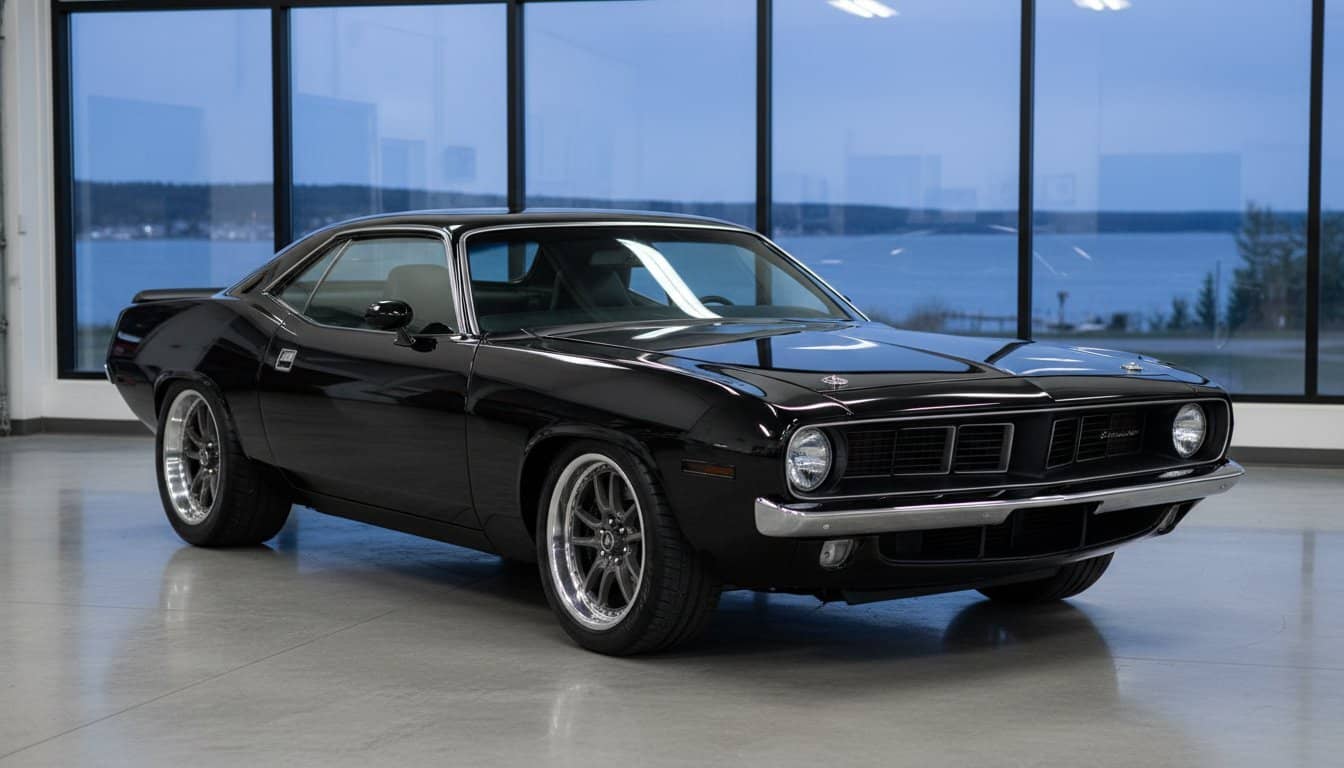
The most valuable Plymouth Barracuda isn’t the one gathering dust in a climate controlled museum; it’s the one capable of out-braking a 2026 sports car on a crowded highway. You likely agree that while the 1970 E-body silhouette is automotive perfection, the original torsion bar suspension and 50 year old drum brakes often make driving feel more like a survival exercise than a thrill. It’s a common fear that a modern engine swap might strip away the car’s heritage, but the right upgrades actually honor that legacy by making the vehicle roadworthy for the next century.
This guide promises to give you the technical confidence to master a full restomod build without losing that iconic muscle soul. We will provide a clear roadmap for selecting the right donor, from the sleek 1967 fastbacks to the aggressive 1971 grilles. You’ll learn how to navigate the complexities of Gen III Hemi wiring harnesses and replace outdated steering geometry with precision-engineered subframes. We are diving into the specific drivetrain and suspension components that turn a temperamental classic into a reliable daily driver.
Key Takeaways
- Identify the ideal generation for your build by balancing initial entry costs with the superior aftermarket support found in 1970–1974 E-body models.
- Learn how to bridge the gap between vintage muscle and modern performance by selecting the perfect fuel-injected powerplant for your plymouth barracuda.
- Master the “built, not bought” philosophy by stiffening your chassis and upgrading the original torsion-bar suspension for precision high-speed cornering.
- Transform a raw muscle car into a luxury cruiser by integrating the three pillars of comfort: sound deadening, climate control, and modern ergonomics.
- Discover the strategic roadmap for preserving iconic Mopar soul while implementing the cutting-edge technology required for a reliable daily driver.
Plymouth Barracuda: The Evolution of a Mopar Legend
On April 1, 1964, Chrysler launched the Plymouth Barracuda, beating the Ford Mustang to market by exactly 14 days. This early release established the “Fish” as the pioneer of the pony car segment. While early models focused on sleek fastback styling, the car eventually evolved into a brutal street machine that dominated the muscle car era. At Restomod Academy, we believe the Plymouth Barracuda is the ultimate platform for builders who want to bridge the gap between 1960s style and 2026 performance capability. Our philosophy centers on preserving the iconic roar of a Mopar V8 while perfecting the mechanical precision that modern drivers demand. It is a high performance canvas where vintage aesthetics meet contemporary engineering.
To see how a legendary builder approaches this platform, watch this detailed walkthrough of a custom build from a premier collection:
The Three Generations of the ‘Fish’
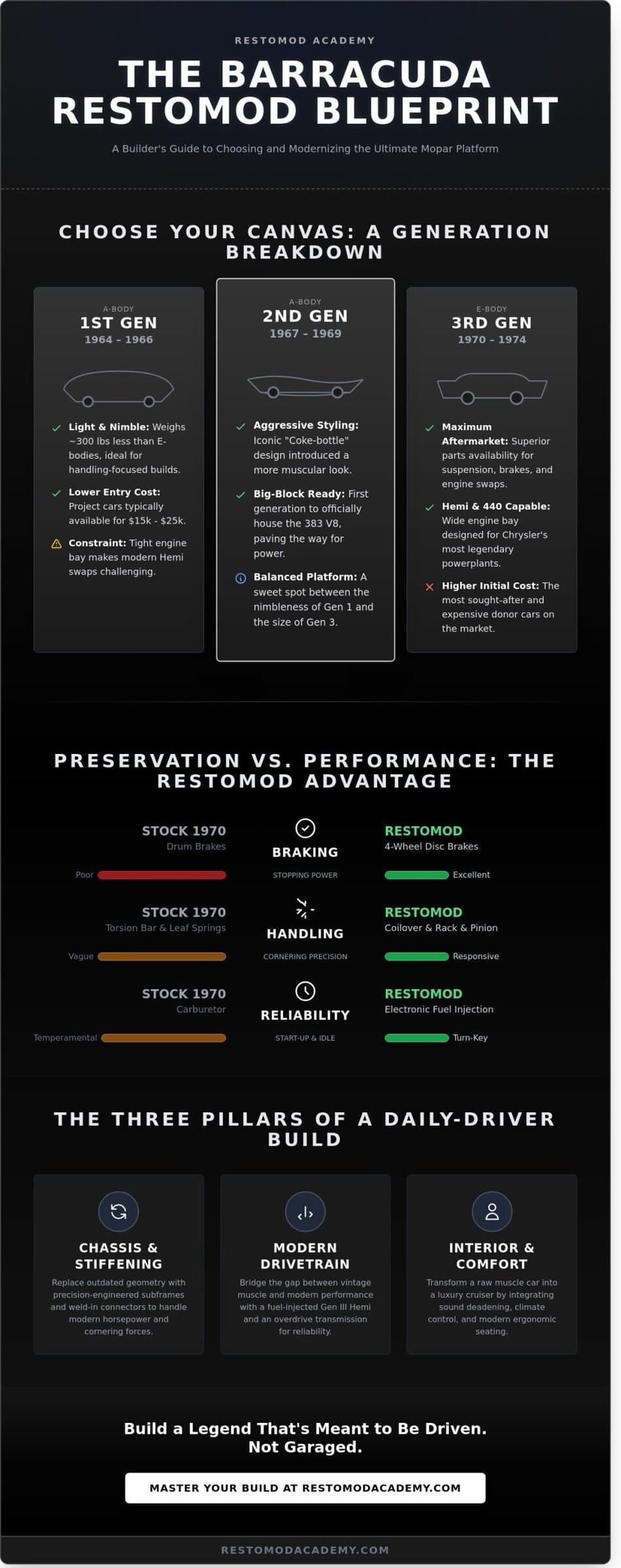
The first generation, produced from 1964 to 1966, is famous for its massive 14.4 square foot wrap-around rear glass. These A-body cars are lightweight and nimble, making them excellent candidates for modern suspension swaps. The second generation (1967 to 1969) shifted toward a more aggressive Coke-bottle design and introduced the 383 cubic inch big-block engine. Finally, the third generation (1970 to 1974) abandoned the A-body for the wider E-body platform. This move allowed for the legendary 426 Hemi and 440 Six-Pack engines, creating the most sought-after silhouettes in Plymouth Barracuda history. Each generation offers a unique starting point for a restomod project, depending on whether you value compact agility or wide-body aggression.
Restomod vs. Restoration: Why Modernize?
Restoring a car to factory specifications is a noble pursuit, but it often leaves you with 50-year-old reliability issues. Cold starts with a finicky carburetor or fading drum brakes can turn a weekend cruise into a stressful ordeal. Learning what is a restomod helps you see the value in upgrading these weak points. Modernizing your build with electronic fuel injection (EFI) and multi-piston disc brakes ensures your car starts every time and stops on a dime. It’s about taking a classic design and making it viable for the roads of today.
Safety is a non-negotiable priority in any Restomod Academy project. Replacing antiquated steering components with a modern rack and pinion setup provides the feedback you need to handle high-horsepower outputs safely. Swapping out old lap belts for three-point harnesses and adding structural bracing transforms the driving experience. We want you to build a car that you actually drive, not one that just sits under a cover because it’s too temperamental for the street. By focusing on these upgrades, you preserve the legacy of the Plymouth Barracuda while ensuring it performs with modern precision.
Choosing Your Plymouth Barracuda Donor: Generation Guide
Finding your donor car is a high-stakes decision that dictates your build’s ceiling and its floor. You aren’t just buying a shell; you’re buying a set of engineering constraints. The plymouth barracuda evolved rapidly over its decade-long run, shifting from a compact commuter with a glass fastback to a wide-hipped muscle titan. Before you pull the trailer, inspect the unibody. Mopar’s 1960s construction relies on structural integrity in the floor pans, frame rails, and torsion bar crossmember. If the rear spring shackles are pulling through the trunk floor, you’re looking at 100+ hours of fabrication before the first performance part arrives.
The A-Body Advantage (1964–1969)
The early years offer a lighter, more nimble platform for builders who value agility over raw displacement. These cars weigh roughly 300 pounds less than their successors, making them ideal for corner-carving builds. You can find a decent project car for $15,000 to $25,000, which is a fraction of later prices. However, the engine bay is tight. Fitting a modern Gen III Hemi requires specialized headers or manual steering conversions. This first-generation Plymouth Barracuda reference highlights why these early cars were pioneers in the pony car market. Stick to high-revving small blocks or modern turbo V6 swaps to keep the weight balance perfect.
- Pros: Lower entry cost, exceptional power-to-weight potential.
- Cons: Cramped engine bay limits big-block swaps without major cutting.
- Best for: Pro-touring builds focused on handling and unique sleeper aesthetics.
The E-Body Icon (1970–1974)
This is the aesthetic peak for most builders. The 1970–1974 models feature the wide engine bay designed to swallow a 426 Hemi, making modern Hellcat swaps a straightforward fit. Aftermarket support is massive. Companies like AMD produce every single body panel, meaning you can virtually build a new car from a VIN plate. Expect to pay a premium. A rough E-body roller can easily exceed $35,000. You’ll also face purist pushback. Modifying a numbers-matching car might draw glares at the local meet, but for a true performance build, starting with a base-model “BH” VIN plymouth barracuda saves thousands over a genuine “BS” code ‘Cuda.
- Pros: Massive engine bay, aggressive styling, and the most comprehensive aftermarket suspension kits.
- Cons: Extremely high entry cost and high expectations for finish quality.
The ‘Cuda was the performance variant, often featuring heavy-duty suspension and upgraded cooling from the factory. For a restomod, these original parts are usually discarded, so paying the $10,000 premium for a ‘Cuda badge is often a poor financial move. Buy the base model and spend that money on modern suspension geometry instead. If you’re still weighing your options, take a moment to understand what is a restomod in the modern era to ensure your budget aligns with your performance goals.
Modern Powerplants: Engine Swaps for the Plymouth Barracuda
Forget the temperamental cold starts and fuel-soaked gaskets of the original LA-series small blocks. While the classic 318 or 340 served their purpose for decades, the 2026 restomod standard demands the reliability of electronic fuel injection (EFI) and the raw power of modern engineering. Transforming your plymouth barracuda requires a choice between purist loyalty and raw efficiency. The “Mopar or No Car” crowd argues that a Chrysler body deserves a Chrysler heart, and they have a point. Keeping the build within the family often preserves a higher resale value at major auctions. However, the swap involves more than just dropping a block into the bay. You must integrate a high-pressure fuel system, a 400-lph fuel pump, and a modern cooling stack featuring a dual-pass aluminum radiator to handle the increased thermal loads. Precision wiring is your best friend here; invest in a high-quality harness to ensure your modern ECU communicates perfectly with your sensors.
The Gen III Hemi Swap: 5.7L, 6.1L, and Hellcat
The Gen III Hemi stands as the gold standard for any serious E-body project. Whether you opt for a 345-horsepower 5.7L or the 707-horsepower Hellcat crate engine, the technical hurdles remain consistent. The plymouth barracuda engine bay is deceptively narrow at the frame rails. You’ll need an aftermarket tubular K-member to clear the modern oil pans and provide room for long-tube headers. These components don’t just solve clearance issues; they shed approximately 40 pounds from the front end, which significantly improves weight distribution. This swap requires a dedicated plan for the steering linkage, as the modern Hemi’s width can interfere with the traditional steering box. Address these mechanical constraints early to avoid costly fabrication delays later in the build.
The ‘Dark Side’ Swap: LS Engines in a Mopar
Purists might call it sacrilege, but the LS swap is a logical choice for builders prioritizing budget and power density. An aluminum-block LS engine can weigh 100 pounds less than a cast-iron Mopar small block, which radically changes how the car handles a corner. The power-to-dollar ratio is hard to beat, as parts are available at every local auto store. If you decide to cross the brand line, consult the definitive guide to an LS engine swap for technical specs on mounting and transmission adapters. This route ensures your build is about driving, not hunting for rare Mopar-specific sensors at a swap meet. Focus on the ultimate goal: a reliable, fast machine that honors the spirit of the road while embracing the efficiency of today.
Handling and Braking: Modernizing the Plymouth Barracuda Chassis
Don’t let the aggressive lines of your plymouth barracuda fool you. Underneath that iconic sheet metal lies a 1970s chassis designed for straight-line sprints, not high-speed cornering. The original torsion-bar suspension was a clever space-saver for big-block engines, but it lacks the lateral stability required for modern performance. If you push a stock E-body into a sharp turn at 60 mph, you’ll feel the front end dive and the body roll like a ship at sea. Power is a liability if you can’t control it. To transform this Mopar into a corner-hugging machine, you must embrace the “Built, Not Bought” philosophy by reinforcing the foundation first.
Stiffen the skeleton before you add the muscle. Install weld-in subframe connectors to bridge the gap between the front and rear subframes. This modification can reduce chassis flex by as much as 50 percent, ensuring your suspension actually does its job instead of the body twisting under load. Once the frame is rigid, focus on your contact patch. Moving from 14-inch bias-ply tires to 18-inch radials completely changes the car’s stance and grip. Modern wheel fitment allows you to run wider rubber, which is essential for putting 500+ horsepower to the pavement without spinning out of control.
Suspension Geometry and Coilover Conversions
Swapping the factory K-member for a modern coilover system is the single most effective way to modernize your plymouth barracuda. This upgrade eliminates antiquated torsion bars and replaces them with adjustable shocks and springs. Manufacturers like QA1 and Ridetech offer bolt-in kits that provide precise ride height control and improved caster settings. If you want the peak of performance, Gerst tubular systems provide a complete front-end overhaul that mimics modern supercar geometry. These setups shave 30 to 40 pounds off the nose and allow for wider front tires, giving you the front-end bite needed for autocross. For a deeper technical analysis of these components, consult our expert resources on suspension upgrades.
Big Brake Kits and Master Cylinder Upgrades
Stopping a 3,400-pound car with modern power requires more than factory drums or basic discs. You need 14-inch rotors and 6-piston calipers to shed heat during aggressive driving. Moving to a big brake kit from Wilwood or Baer provides the clamping force necessary to bring your build to a halt safely. Pair these with a modern power rack-and-pinion setup to replace the vague, over-assisted feel of the original steering box. For those handling their own plumbing, check out our recommended gear for the specific flaring tools and benders required for professional-grade brake line fabrication.
Mastering the chassis is the difference between a car that looks fast and a car that is fast. Take the next step in your restomod journey here.
Interior and Tech: Creating a Daily-Driver Plymouth Barracuda
Shift your focus from the engine bay to the cockpit. This is where you’ll spend every mile of your journey, and it’s where the transition from a vintage muscle car to a 2026 luxury performer becomes real. A true restomod transforms the plymouth barracuda from a noisy, vibrating machine into a sophisticated grand tourer. You want the tactile feedback of a modern vehicle without losing the iconic Mopar soul. It’s the difference between a car you only show and a car you actually want to drive across the country.
Think about the sensory experience. Modernize your interface by installing digital gauges that mirror the classic 1970 Rallye dash aesthetic. Manufacturers now produce direct-fit clusters that offer 0.1 percent accuracy for RPM and temperature while maintaining the original four-pod layout. When it comes to audio, don’t cut into that precious original dashboard. Use a hidden Bluetooth receiver or a period-correct head unit to control high-fidelity components tucked under the seats or behind the panels. This preserves the visual heritage of your plymouth barracuda while providing the 300-watt clarity of a modern system.
Vintage Air and Modern HVAC
Ditch the bulky, inefficient factory heater box. Install a compact, modern AC system designed to fit entirely behind a 1970s dashboard. These units use electronically controlled servos instead of old vacuum lines, providing ice-cold air even on 100-degree days. To support these electronics, you must upgrade your charging system. A high-output alternator providing at least 140 amps is essential to handle the combined load of the AC clutch, electric cooling fans, and modern stereo. You can find more technical advice on choosing these components in our recommended gear section.
Sound Deadening and Custom Upholstery
Strip the interior to bare metal before you even think about carpet. Apply 80-mil butyl-based deadeners to every square inch of the floor pans, doors, and roof to kill the resonance of the vintage sheet metal. NVH, which stands for Noise, Vibration, and Harshness, is the enemy of a quality restomod. Once the cabin is sealed, look at your seating options. You can choose modern buckets from brands like Corbeau for superior lateral support or rebuild your original frames with high-density foam and bolstered side supports. This ensures you stay planted during high-G cornering while enjoying the lumbar support required for a true daily driver.
Bring Your Mopar Vision to Life
The journey from a weathered shell to a high-performance machine requires a clear roadmap and a steady hand. You now have the foundational knowledge to modernize your plymouth barracuda, whether you are sourcing a 1964 A-body or a 1970 E-body donor. By focusing on modern Gen III Hemi swaps and precision suspension geometry, you bridge the gap between 1960s soul and 2026 reliability. Every weld and wiring harness brings you closer to a car that commands respect on the open road. Stop dreaming about the finish line and start turning wrenches with professional precision.
Take the next step in your restoration journey with expert mentorship from Brook Walsh. You can access specialized blueprints for both E-body and A-body projects while joining a dedicated community of 10,000 builders who value craftsmanship over shortcuts. Download the Ultimate Restomod Guide & Start Your Barracuda Build Today! It’s time to stop being a spectator and become the master of your own garage. Your legacy is waiting to be built.
Frequently Asked Questions
Is a Plymouth Barracuda the same as a ‘Cuda?
No, the ‘Cuda was the performance-oriented trim level of the Plymouth Barracuda, officially introduced as a separate package in 1969. While every ‘Cuda is a Barracuda, not every Barracuda is a ‘Cuda. Base models often featured different grilles and flat hoods, whereas the ‘Cuda variant usually boasted the iconic shaker or dual-scooped hood designs.
How much does it cost to restomod a Plymouth Barracuda in 2026?
A professional restomod project typically ranges from $100,000 to over $250,000 according to 2025 Hagerty valuation trends. These figures exclude the initial purchase price of the donor car. Labor costs for custom fabrication and paint usually account for 60 percent of your total budget. Invest in a detailed build plan before you turn a single wrench to avoid mid-build financial fatigue.
What is the best engine for a Barracuda restomod project?
The 6.2L Supercharged Hellcat V8 is the gold standard for modern Mopar performance, delivering 707 horsepower with factory reliability. If you prefer a naturally aspirated setup, the 6.4L 392 Apache HEMI offers a balanced 485 horsepower. Both options provide the drivability and cold-start consistency that vintage carburetors simply can’t match in a modern environment.
Will a Hellcat engine fit in a 1970 Plymouth Barracuda?
Yes, a Hellcat engine fits into a 1970 model, but it requires substantial modifications to the engine bay and suspension. You must install an aftermarket K-member to clear the oil pan and exhaust manifolds properly. Expect to modify the firewall and transmission tunnel to accommodate the beefier 8HP90 eight-speed automatic transmission required to handle the torque.
Can I daily drive a restomodded Plymouth Barracuda?
You can absolutely daily drive a restomodded plymouth barracuda if you prioritize modern climate control and safety upgrades. Integrating a Vintage Air Gen IV system and Wilwood disc brakes transforms the car into a reliable commuter. Focus on sound deadening materials like Dynamat to reduce cabin noise by up to 12 decibels for a more comfortable experience.
What are the most common rust areas on a Plymouth Barracuda?
The lower rear quarters, trunk floor, and cowl panel are the most frequent victims of corrosion on these Mopar classics. Specifically, check the rear window channels where water often pools and rots the metal from the inside out. Inspect the frame rails carefully; 30 percent of unrestored E-bodies show structural decay in the rear shackle mounts.
How do I choose between an A-body and an E-body Barracuda?
Choose the A-body (1964-1969) for a lighter, more nimble driving experience or the E-body (1970-1974) for that iconic wide-track muscle car stance. The A-body is 500 pounds lighter on average, making it an excellent candidate for autocross builds. The E-body offers a larger engine bay that accommodates modern HEMI swaps with fewer clearance headaches during the fabrication stage.
Do restomodded Barracudas hold their value better than original restorations?
Restomodded plymouth barracuda builds often command higher prices at major auctions than standard restorations. Data from 2024 sales shows that high-end restomods can sell for 20 to 30 percent more than numbers-matching originals. Buyers today value the combination of vintage aesthetics and modern performance features like power steering, electronic fuel injection, and upgraded braking systems.
The most valuable Plymouth Barracuda isn’t the one gathering dust in a climate controlled museum; it’s the one capable of out-braking a 2026 sports car on a crowded highway. You likely agree that while the 1970 E-body silhouette is automotive perfection, the original torsion bar suspension and 50 year old drum brakes often make driving feel more like a survival exercise than a thrill. It’s a common fear that a modern engine swap might strip away the car’s heritage, but the right upgrades actually honor that legacy by making the vehicle roadworthy for the next century.
This guide promises to give you the technical confidence to master a full restomod build without losing that iconic muscle soul. We will provide a clear roadmap for selecting the right donor, from the sleek 1967 fastbacks to the aggressive 1971 grilles. You’ll learn how to navigate the complexities of Gen III Hemi wiring harnesses and replace outdated steering geometry with precision-engineered subframes. We are diving into the specific drivetrain and suspension components that turn a temperamental classic into a reliable daily driver.
Key Takeaways
- Identify the ideal generation for your build by balancing initial entry costs with the superior aftermarket support found in 1970–1974 E-body models.
- Learn how to bridge the gap between vintage muscle and modern performance by selecting the perfect fuel-injected powerplant for your plymouth barracuda.
- Master the “built, not bought” philosophy by stiffening your chassis and upgrading the original torsion-bar suspension for precision high-speed cornering.
- Transform a raw muscle car into a luxury cruiser by integrating the three pillars of comfort: sound deadening, climate control, and modern ergonomics.
- Discover the strategic roadmap for preserving iconic Mopar soul while implementing the cutting-edge technology required for a reliable daily driver.
Plymouth Barracuda: The Evolution of a Mopar Legend
On April 1, 1964, Chrysler launched the Plymouth Barracuda, beating the Ford Mustang to market by exactly 14 days. This early release established the “Fish” as the pioneer of the pony car segment. While early models focused on sleek fastback styling, the car eventually evolved into a brutal street machine that dominated the muscle car era. At Restomod Academy, we believe the Plymouth Barracuda is the ultimate platform for builders who want to bridge the gap between 1960s style and 2026 performance capability. Our philosophy centers on preserving the iconic roar of a Mopar V8 while perfecting the mechanical precision that modern drivers demand. It is a high performance canvas where vintage aesthetics meet contemporary engineering.
To see how a legendary builder approaches this platform, watch this detailed walkthrough of a custom build from a premier collection:
The Three Generations of the ‘Fish’
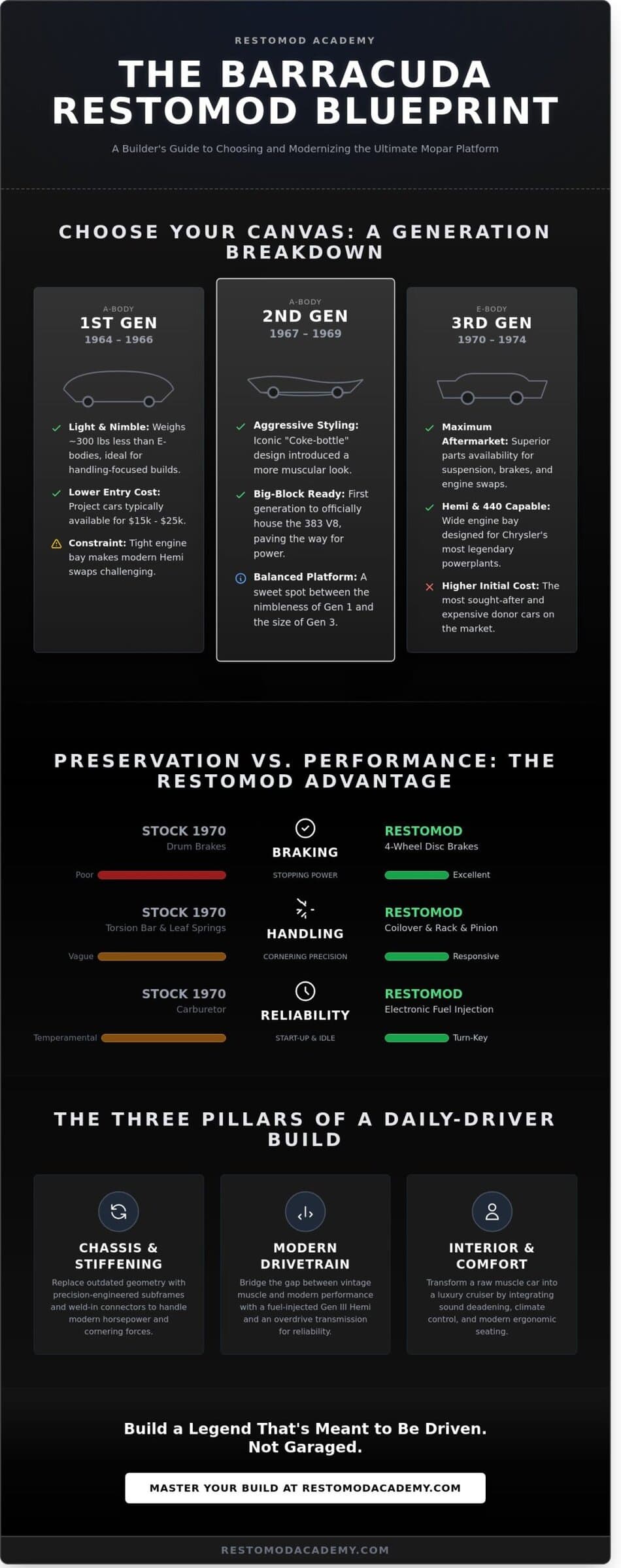
The first generation, produced from 1964 to 1966, is famous for its massive 14.4 square foot wrap-around rear glass. These A-body cars are lightweight and nimble, making them excellent candidates for modern suspension swaps. The second generation (1967 to 1969) shifted toward a more aggressive Coke-bottle design and introduced the 383 cubic inch big-block engine. Finally, the third generation (1970 to 1974) abandoned the A-body for the wider E-body platform. This move allowed for the legendary 426 Hemi and 440 Six-Pack engines, creating the most sought-after silhouettes in Plymouth Barracuda history. Each generation offers a unique starting point for a restomod project, depending on whether you value compact agility or wide-body aggression.
Restomod vs. Restoration: Why Modernize?
Restoring a car to factory specifications is a noble pursuit, but it often leaves you with 50-year-old reliability issues. Cold starts with a finicky carburetor or fading drum brakes can turn a weekend cruise into a stressful ordeal. Learning what is a restomod helps you see the value in upgrading these weak points. Modernizing your build with electronic fuel injection (EFI) and multi-piston disc brakes ensures your car starts every time and stops on a dime. It’s about taking a classic design and making it viable for the roads of today.
Safety is a non-negotiable priority in any Restomod Academy project. Replacing antiquated steering components with a modern rack and pinion setup provides the feedback you need to handle high-horsepower outputs safely. Swapping out old lap belts for three-point harnesses and adding structural bracing transforms the driving experience. We want you to build a car that you actually drive, not one that just sits under a cover because it’s too temperamental for the street. By focusing on these upgrades, you preserve the legacy of the Plymouth Barracuda while ensuring it performs with modern precision.
Choosing Your Plymouth Barracuda Donor: Generation Guide
Finding your donor car is a high-stakes decision that dictates your build’s ceiling and its floor. You aren’t just buying a shell; you’re buying a set of engineering constraints. The plymouth barracuda evolved rapidly over its decade-long run, shifting from a compact commuter with a glass fastback to a wide-hipped muscle titan. Before you pull the trailer, inspect the unibody. Mopar’s 1960s construction relies on structural integrity in the floor pans, frame rails, and torsion bar crossmember. If the rear spring shackles are pulling through the trunk floor, you’re looking at 100+ hours of fabrication before the first performance part arrives.
The A-Body Advantage (1964–1969)
The early years offer a lighter, more nimble platform for builders who value agility over raw displacement. These cars weigh roughly 300 pounds less than their successors, making them ideal for corner-carving builds. You can find a decent project car for $15,000 to $25,000, which is a fraction of later prices. However, the engine bay is tight. Fitting a modern Gen III Hemi requires specialized headers or manual steering conversions. This first-generation Plymouth Barracuda reference highlights why these early cars were pioneers in the pony car market. Stick to high-revving small blocks or modern turbo V6 swaps to keep the weight balance perfect.
- Pros: Lower entry cost, exceptional power-to-weight potential.
- Cons: Cramped engine bay limits big-block swaps without major cutting.
- Best for: Pro-touring builds focused on handling and unique sleeper aesthetics.
The E-Body Icon (1970–1974)
This is the aesthetic peak for most builders. The 1970–1974 models feature the wide engine bay designed to swallow a 426 Hemi, making modern Hellcat swaps a straightforward fit. Aftermarket support is massive. Companies like AMD produce every single body panel, meaning you can virtually build a new car from a VIN plate. Expect to pay a premium. A rough E-body roller can easily exceed $35,000. You’ll also face purist pushback. Modifying a numbers-matching car might draw glares at the local meet, but for a true performance build, starting with a base-model “BH” VIN plymouth barracuda saves thousands over a genuine “BS” code ‘Cuda.
- Pros: Massive engine bay, aggressive styling, and the most comprehensive aftermarket suspension kits.
- Cons: Extremely high entry cost and high expectations for finish quality.
The ‘Cuda was the performance variant, often featuring heavy-duty suspension and upgraded cooling from the factory. For a restomod, these original parts are usually discarded, so paying the $10,000 premium for a ‘Cuda badge is often a poor financial move. Buy the base model and spend that money on modern suspension geometry instead. If you’re still weighing your options, take a moment to understand what is a restomod in the modern era to ensure your budget aligns with your performance goals.
Modern Powerplants: Engine Swaps for the Plymouth Barracuda
Forget the temperamental cold starts and fuel-soaked gaskets of the original LA-series small blocks. While the classic 318 or 340 served their purpose for decades, the 2026 restomod standard demands the reliability of electronic fuel injection (EFI) and the raw power of modern engineering. Transforming your plymouth barracuda requires a choice between purist loyalty and raw efficiency. The “Mopar or No Car” crowd argues that a Chrysler body deserves a Chrysler heart, and they have a point. Keeping the build within the family often preserves a higher resale value at major auctions. However, the swap involves more than just dropping a block into the bay. You must integrate a high-pressure fuel system, a 400-lph fuel pump, and a modern cooling stack featuring a dual-pass aluminum radiator to handle the increased thermal loads. Precision wiring is your best friend here; invest in a high-quality harness to ensure your modern ECU communicates perfectly with your sensors.
The Gen III Hemi Swap: 5.7L, 6.1L, and Hellcat
The Gen III Hemi stands as the gold standard for any serious E-body project. Whether you opt for a 345-horsepower 5.7L or the 707-horsepower Hellcat crate engine, the technical hurdles remain consistent. The plymouth barracuda engine bay is deceptively narrow at the frame rails. You’ll need an aftermarket tubular K-member to clear the modern oil pans and provide room for long-tube headers. These components don’t just solve clearance issues; they shed approximately 40 pounds from the front end, which significantly improves weight distribution. This swap requires a dedicated plan for the steering linkage, as the modern Hemi’s width can interfere with the traditional steering box. Address these mechanical constraints early to avoid costly fabrication delays later in the build.
The ‘Dark Side’ Swap: LS Engines in a Mopar
Purists might call it sacrilege, but the LS swap is a logical choice for builders prioritizing budget and power density. An aluminum-block LS engine can weigh 100 pounds less than a cast-iron Mopar small block, which radically changes how the car handles a corner. The power-to-dollar ratio is hard to beat, as parts are available at every local auto store. If you decide to cross the brand line, consult the definitive guide to an LS engine swap for technical specs on mounting and transmission adapters. This route ensures your build is about driving, not hunting for rare Mopar-specific sensors at a swap meet. Focus on the ultimate goal: a reliable, fast machine that honors the spirit of the road while embracing the efficiency of today.
Handling and Braking: Modernizing the Plymouth Barracuda Chassis
Don’t let the aggressive lines of your plymouth barracuda fool you. Underneath that iconic sheet metal lies a 1970s chassis designed for straight-line sprints, not high-speed cornering. The original torsion-bar suspension was a clever space-saver for big-block engines, but it lacks the lateral stability required for modern performance. If you push a stock E-body into a sharp turn at 60 mph, you’ll feel the front end dive and the body roll like a ship at sea. Power is a liability if you can’t control it. To transform this Mopar into a corner-hugging machine, you must embrace the “Built, Not Bought” philosophy by reinforcing the foundation first.
Stiffen the skeleton before you add the muscle. Install weld-in subframe connectors to bridge the gap between the front and rear subframes. This modification can reduce chassis flex by as much as 50 percent, ensuring your suspension actually does its job instead of the body twisting under load. Once the frame is rigid, focus on your contact patch. Moving from 14-inch bias-ply tires to 18-inch radials completely changes the car’s stance and grip. Modern wheel fitment allows you to run wider rubber, which is essential for putting 500+ horsepower to the pavement without spinning out of control.
Suspension Geometry and Coilover Conversions
Swapping the factory K-member for a modern coilover system is the single most effective way to modernize your plymouth barracuda. This upgrade eliminates antiquated torsion bars and replaces them with adjustable shocks and springs. Manufacturers like QA1 and Ridetech offer bolt-in kits that provide precise ride height control and improved caster settings. If you want the peak of performance, Gerst tubular systems provide a complete front-end overhaul that mimics modern supercar geometry. These setups shave 30 to 40 pounds off the nose and allow for wider front tires, giving you the front-end bite needed for autocross. For a deeper technical analysis of these components, consult our expert resources on suspension upgrades.
Big Brake Kits and Master Cylinder Upgrades
Stopping a 3,400-pound car with modern power requires more than factory drums or basic discs. You need 14-inch rotors and 6-piston calipers to shed heat during aggressive driving. Moving to a big brake kit from Wilwood or Baer provides the clamping force necessary to bring your build to a halt safely. Pair these with a modern power rack-and-pinion setup to replace the vague, over-assisted feel of the original steering box. For those handling their own plumbing, check out our recommended gear for the specific flaring tools and benders required for professional-grade brake line fabrication.
Mastering the chassis is the difference between a car that looks fast and a car that is fast. Take the next step in your restomod journey here.
Interior and Tech: Creating a Daily-Driver Plymouth Barracuda
Shift your focus from the engine bay to the cockpit. This is where you’ll spend every mile of your journey, and it’s where the transition from a vintage muscle car to a 2026 luxury performer becomes real. A true restomod transforms the plymouth barracuda from a noisy, vibrating machine into a sophisticated grand tourer. You want the tactile feedback of a modern vehicle without losing the iconic Mopar soul. It’s the difference between a car you only show and a car you actually want to drive across the country.
Think about the sensory experience. Modernize your interface by installing digital gauges that mirror the classic 1970 Rallye dash aesthetic. Manufacturers now produce direct-fit clusters that offer 0.1 percent accuracy for RPM and temperature while maintaining the original four-pod layout. When it comes to audio, don’t cut into that precious original dashboard. Use a hidden Bluetooth receiver or a period-correct head unit to control high-fidelity components tucked under the seats or behind the panels. This preserves the visual heritage of your plymouth barracuda while providing the 300-watt clarity of a modern system.
Vintage Air and Modern HVAC
Ditch the bulky, inefficient factory heater box. Install a compact, modern AC system designed to fit entirely behind a 1970s dashboard. These units use electronically controlled servos instead of old vacuum lines, providing ice-cold air even on 100-degree days. To support these electronics, you must upgrade your charging system. A high-output alternator providing at least 140 amps is essential to handle the combined load of the AC clutch, electric cooling fans, and modern stereo. You can find more technical advice on choosing these components in our recommended gear section.
Sound Deadening and Custom Upholstery
Strip the interior to bare metal before you even think about carpet. Apply 80-mil butyl-based deadeners to every square inch of the floor pans, doors, and roof to kill the resonance of the vintage sheet metal. NVH, which stands for Noise, Vibration, and Harshness, is the enemy of a quality restomod. Once the cabin is sealed, look at your seating options. You can choose modern buckets from brands like Corbeau for superior lateral support or rebuild your original frames with high-density foam and bolstered side supports. This ensures you stay planted during high-G cornering while enjoying the lumbar support required for a true daily driver.
Bring Your Mopar Vision to Life
The journey from a weathered shell to a high-performance machine requires a clear roadmap and a steady hand. You now have the foundational knowledge to modernize your plymouth barracuda, whether you are sourcing a 1964 A-body or a 1970 E-body donor. By focusing on modern Gen III Hemi swaps and precision suspension geometry, you bridge the gap between 1960s soul and 2026 reliability. Every weld and wiring harness brings you closer to a car that commands respect on the open road. Stop dreaming about the finish line and start turning wrenches with professional precision.
Take the next step in your restoration journey with expert mentorship from Brook Walsh. You can access specialized blueprints for both E-body and A-body projects while joining a dedicated community of 10,000 builders who value craftsmanship over shortcuts. Download the Ultimate Restomod Guide & Start Your Barracuda Build Today! It’s time to stop being a spectator and become the master of your own garage. Your legacy is waiting to be built.
Frequently Asked Questions
Is a Plymouth Barracuda the same as a ‘Cuda?
No, the ‘Cuda was the performance-oriented trim level of the Plymouth Barracuda, officially introduced as a separate package in 1969. While every ‘Cuda is a Barracuda, not every Barracuda is a ‘Cuda. Base models often featured different grilles and flat hoods, whereas the ‘Cuda variant usually boasted the iconic shaker or dual-scooped hood designs.
How much does it cost to restomod a Plymouth Barracuda in 2026?
A professional restomod project typically ranges from $100,000 to over $250,000 according to 2025 Hagerty valuation trends. These figures exclude the initial purchase price of the donor car. Labor costs for custom fabrication and paint usually account for 60 percent of your total budget. Invest in a detailed build plan before you turn a single wrench to avoid mid-build financial fatigue.
What is the best engine for a Barracuda restomod project?
The 6.2L Supercharged Hellcat V8 is the gold standard for modern Mopar performance, delivering 707 horsepower with factory reliability. If you prefer a naturally aspirated setup, the 6.4L 392 Apache HEMI offers a balanced 485 horsepower. Both options provide the drivability and cold-start consistency that vintage carburetors simply can’t match in a modern environment.
Will a Hellcat engine fit in a 1970 Plymouth Barracuda?
Yes, a Hellcat engine fits into a 1970 model, but it requires substantial modifications to the engine bay and suspension. You must install an aftermarket K-member to clear the oil pan and exhaust manifolds properly. Expect to modify the firewall and transmission tunnel to accommodate the beefier 8HP90 eight-speed automatic transmission required to handle the torque.
Can I daily drive a restomodded Plymouth Barracuda?
You can absolutely daily drive a restomodded plymouth barracuda if you prioritize modern climate control and safety upgrades. Integrating a Vintage Air Gen IV system and Wilwood disc brakes transforms the car into a reliable commuter. Focus on sound deadening materials like Dynamat to reduce cabin noise by up to 12 decibels for a more comfortable experience.
What are the most common rust areas on a Plymouth Barracuda?
The lower rear quarters, trunk floor, and cowl panel are the most frequent victims of corrosion on these Mopar classics. Specifically, check the rear window channels where water often pools and rots the metal from the inside out. Inspect the frame rails carefully; 30 percent of unrestored E-bodies show structural decay in the rear shackle mounts.
How do I choose between an A-body and an E-body Barracuda?
Choose the A-body (1964-1969) for a lighter, more nimble driving experience or the E-body (1970-1974) for that iconic wide-track muscle car stance. The A-body is 500 pounds lighter on average, making it an excellent candidate for autocross builds. The E-body offers a larger engine bay that accommodates modern HEMI swaps with fewer clearance headaches during the fabrication stage.
Do restomodded Barracudas hold their value better than original restorations?
Restomodded plymouth barracuda builds often command higher prices at major auctions than standard restorations. Data from 2024 sales shows that high-end restomods can sell for 20 to 30 percent more than numbers-matching originals. Buyers today value the combination of vintage aesthetics and modern performance features like power steering, electronic fuel injection, and upgraded braking systems.