

What if your 1966 Mustang wasn’t just a garage queen, but the most dependable vehicle in your driveway? Many enthusiasts dream of commuting in a classic, yet they hesitate because they fear a mechanical failure on the highway or can’t stomach the harsh noise and vibration of a vintage cabin. Achieving true daily driver restomod reliability isn’t a matter of luck; it’s a deliberate engineering outcome that balances heritage aesthetics with the precision of 2026 technology. You deserve a car that starts the first time, every time, while keeping you cool with modern climate control and safe with contemporary braking systems.
I understand the frustration of a poorly engineered project that drains your wallet and stays on jack stands. In this guide, you’ll learn how to master the 30-20-20-30 budgeting rule to ensure your drivetrain and chassis work in harmony. We will explore how to integrate modern components into a package that feels as refined as a new vehicle without losing its soul. From navigating the potential impacts of Leno’s Law to managing professional labor rates that average $135 per hour, we’ll walk through the logical steps to build a machine that’s both a work of art and a reliable tool for the road.
Key Takeaways
- Define what it means to build for the road by prioritizing consistency and safety over purely cosmetic show-car standards.
- Understand how integrating modern crate engines and electronic fuel injection creates the foundation for daily driver restomod reliability during your morning commute.
- Master the chassis upgrades necessary to eliminate vintage steering play and provide the modern stopping power required for today’s heavy traffic.
- Implement a proactive 5,000-mile maintenance schedule and a critical post-build inspection to ensure your machine remains predictable.
- Explore how using premium project blueprints can help you avoid expensive engineering mistakes and keep your build on track.
Defining the Standards for Daily Driver Restomod Reliability
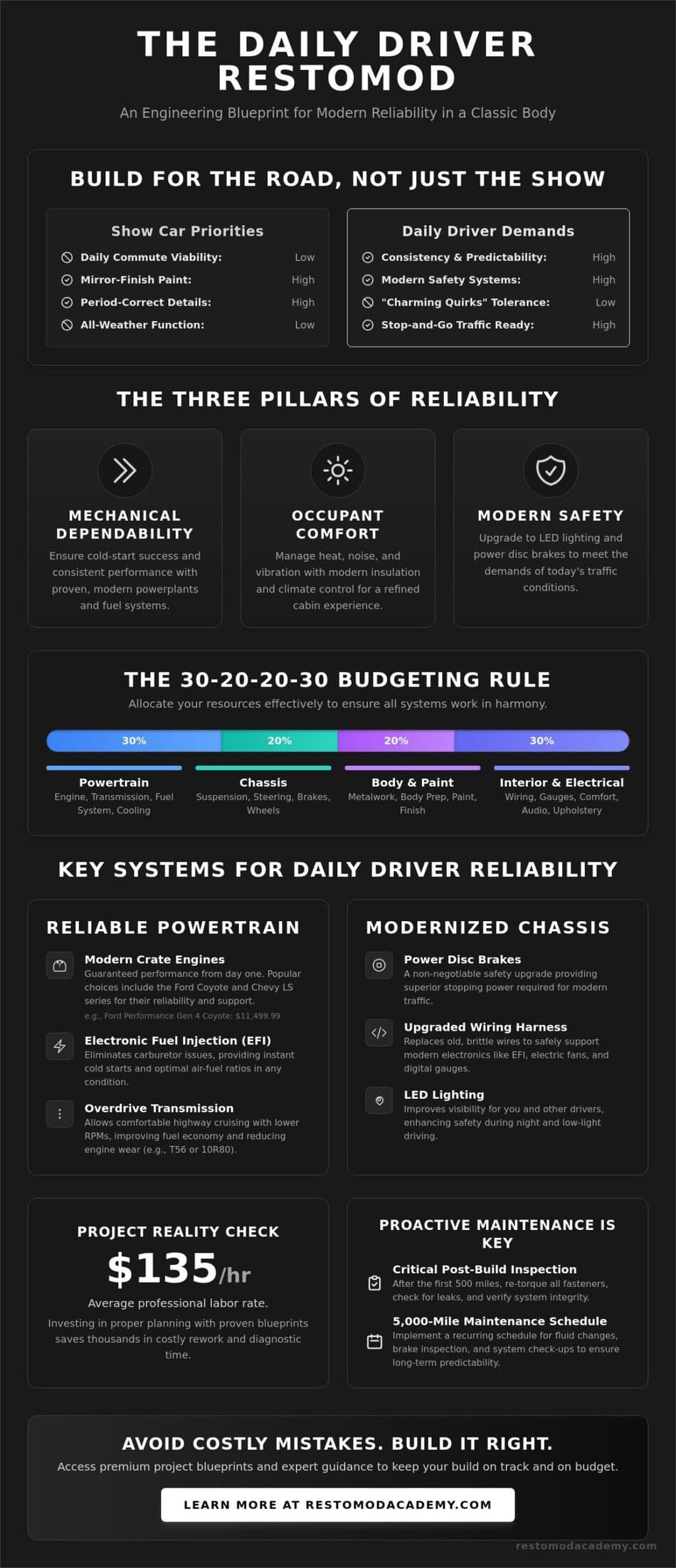
Build your classic for the pavement, not the trailer. When you commit to a project, you must decide early if you are chasing a trophy or a commute. A show car prioritizes mirror-finish paint and period-correct tags, but a daily driver demands consistency, safety, and predictability. Achieving true daily driver restomod reliability means your vintage machine must behave like a modern vehicle every time you turn the key. This requires an engineering mindset where every component is chosen for its ability to perform under the stress of stop-and-go traffic and varying weather conditions.
The year 2026 has brought a new era of viability for these builds. With legislative shifts like California Senate Bill 1392 potentially easing emissions for older vehicles and the continued production of high-performance V8s, the technical barrier to entry is lower than ever. However, the psychological shift is often the hardest part for enthusiasts. You must move past the “charming quirks” of a 60-year-old car and embrace the precision of contemporary systems. Understanding the nuances of Defining Restomod vs. a standard restoration is the first step in this journey.
To better understand how a classic can handle the rigors of the road, watch this helpful video:
The Three Pillars of a Daily Driver Build
Success rests on three specific foundations. First, mechanical dependability is paramount. This means using proven powerplants, such as a Ford Performance Gen 4 Coyote crate engine, which currently retails for $11,499.99, to ensure cold-start success. Second, occupant comfort is essential. You won’t drive the car if it’s a sensory assault; you must manage heat and sound through modern insulation. Finally, modern safety is non-negotiable. Upgrading to LED lighting and power disc brakes is a requirement for surviving modern morning traffic where reaction times are slim.
Common Misconceptions About Modernized Classics
Many builders fall into the trap of thinking a modern engine swap is a magic bullet for reliability. In reality, daily driver restomod reliability lives in the systems integration. A 400-horsepower engine is useless if the 40-year-old wiring harness fails or the cooling system can’t handle a summer heatwave. Don’t let the transition from a modern appliance to a custom machine cause anxiety. By following a structured plan, such as those found in what is a restomod, you can bridge the gap between vintage soul and modern dependability. Remember that professional labor rates now average $135 per hour, so investing time in the planning phase saves significant capital during the assembly process.
Engineering the Reliable Powertrain: Engine, Fueling, and Cooling
Focus your energy on the heart of the machine to ensure your project doesn’t leave you stranded. While a vintage block has undeniable soul, the modern crate engine is the undisputed gold standard for anyone seeking daily driver restomod reliability. These powerplants offer a level of modern powertrain engineering that guarantees your car behaves exactly like a showroom floor model. Whether you choose the compact versatility of an LS or the high-revving sophistication of a Ford Coyote, you are buying peace of mind alongside horsepower.
Electronic Fuel Injection (EFI) is the primary driver of this dependability. It eliminates the temperamental nature of carburetors, providing instant cold starts and optimal air-fuel ratios regardless of altitude or temperature. To bridge the gap between classic aesthetics and modern performance, you must also consider your transmission. An overdrive unit, such as a T56 six-speed or a 10R80 automatic, allows you to cruise at highway speeds without taxing the engine, effectively balancing fuel economy with that visceral classic feel.
The Case for Modern Engine Swaps
Deciding between an LS and a Coyote often comes down to your donor car’s engine bay and your personal brand loyalty. Both platforms offer extended maintenance cycles that far exceed their vintage predecessors. If you are leaning toward the General Motors ecosystem, our The Definitive Guide to an LS Engine Swap provides the technical precision needed to avoid common pitfalls. Regardless of the block, prioritize factory-style wiring harnesses. These integrated looms prevent nearly 90 percent of the electrical gremlins that plague custom builds, ensuring your sensors and ECU communicate without interference.
Fuel Systems and Cooling Infrastructure
Reliability lives in the support systems you can’t see. When designing your fuel delivery, opt for an in-tank pump rather than an external unit. In-tank pumps stay cooler, last longer, and significantly reduce the high-pitched hum that can ruin a peaceful morning commute. Cooling is equally critical. An oversized aluminum radiator is a good start, but it’s only half the battle. You need high-cfm electric fans and a properly designed shroud to pull air through the core during stop-and-go city traffic. Integrate modern temperature and pressure sensors into your dashboard to catch potential issues before they become catastrophic failures. If you find yourself overwhelmed by the technical requirements, our Premium Project Blueprints can help you map out these critical systems with confidence.
Chassis and Electrical Infrastructure for Daily Use
Build a foundation that supports your ambition. While the engine provides the thrill, the chassis and electrical systems determine your daily driver restomod reliability. You cannot trust fifty-year-old copper wiring to handle the current of modern fuel pumps and high-output alternators; old insulation becomes brittle and creates a legitimate fire hazard. Stripping the car to its shell and installing a modern, fused wiring harness is a non-negotiable step for any builder who values safety and peace of mind. This systematic approach ensures that every light, sensor, and accessory functions without the intermittent failures common in aging classics.
Achieving a seamless blend of vintage design and modern engineering requires more than just new wires. It involves a total reimagining of how the car interacts with the road. Modern traffic moves faster and stops more abruptly than it did in the 1960s. If you’re still running four-wheel drum brakes, you’re taking an unnecessary risk every time you enter a highway. Switching to power disc brakes with a modern master cylinder ensures your stopping distances match the vehicles around you, providing the confidence needed for heavy morning traffic.
Suspension and Braking for the Modern Road
Eliminate the vague, floating sensation common in vintage steering. Traditional leaf springs and twin-tube shocks were designed for a different era of tire technology. For a daily driver, coilovers offer superior adjustability and ride quality, allowing you to fine-tune the suspension for your specific local roads. Since your drivetrain now produces significantly more torque, your chassis must be stiff enough to handle that power without compromising comfort. To improve urban maneuverability, consider an electric power steering conversion to reduce engine drag and simplify your plumbing while maintaining a modern, responsive feel at the wheel.
The Interior Environment: AC and Sound
Don’t let driver fatigue end your journey early. The secret to a car you actually want to sit in for an hour lies in managing Noise, Vibration, and Harshness (NVH). High-quality sound deadening on the floorboards and inside door skins transforms the cabin from a tin can into a refined space. This also improves the efficiency of climate control systems like Vintage Air, which is essential for surviving summer commutes. By focusing on these ergonomic details, you ensure your project remains a joy to drive, day after day. If you’re still in the early phases of your project, reviewing our guide on what is a restomod can help you prioritize these comfort-focused upgrades alongside your mechanical goals.
The Practical Reality: Maintenance and Lifecycle
Precision doesn’t end when you roll out of the workshop. To maintain daily driver restomod reliability, you must adopt the mindset of a modern fleet manager rather than a hobbyist. While a traditional classic might require constant tinkering, a well-engineered restomod should follow a predictable 5,000-mile service interval. This shift in perspective is what separates a reliable commuter from a weekend project. The most critical milestone in your car’s life is the first 1,000 miles. Perform a comprehensive nut and bolt check during this period to ensure that vibrations haven’t loosened any critical fasteners, especially in the suspension and drivetrain mounts.
Protecting your investment also means acknowledging the elements. If you intend to drive in all weather, high-quality seam sealing and undercoating are essential to prevent road salt and rain from reclaiming the steel. You’ve spent significant capital, potentially between $40,000 and $120,000, so don’t let a lack of weatherproofing undermine your labor. Treat your machine with the respect its engineering deserves, and it will return the favor with years of trouble-free operation.
Creating a Maintenance Roadmap
Establish a digital or physical log to track the life of your fluids. Modern synthetic oils in a crate engine can easily go 5,000 miles, but don’t forget the vintage-style differential or the custom steering rack. Utilize digital gauges to monitor real-time health data like oil pressure and coolant temperature. If you see a deviation from the baseline, investigate it immediately. Regularly inspect your suspension bushings and rod ends. These components endure higher loads than original equipment and require a watchful eye to maintain that crisp, modern handling feel.
Sourcing and Documentation
Documentation is your best friend when a component eventually wears out. Create a Build Book that lists every part number, from the brake pads to the specific alternator belt you used. This makes sourcing parts simple, as you can walk into any local store and ask for a late-model part instead of guessing what fits. Whenever possible, design your systems around off-the-shelf components rather than one-off custom fabrications. This ensures that a failed water pump in a remote town doesn’t end your trip permanently. For those who want to ensure every detail is documented correctly from day one, our Premium Project Blueprints provide the organizational framework you need.
Always carry a tailored roadside emergency kit. This should include a basic tool set, a spare serpentine belt, and a jump starter. Being prepared isn’t a sign of weakness; it’s the hallmark of a seasoned builder. If you are ready to take the next step in your journey, download The Ultimate Restomod Guide to master the art of long-term vehicle care and engineering excellence.
Executing Your Reliable Build with Restomod Academy
Stop being a passive admirer and take the leap into becoming an active creator. Building a machine you can trust every single morning requires a shift from hobbyist tinkering to professional-grade engineering. Achieving daily driver restomod reliability is a meticulous process that demands more than just a collection of high-performance parts. It requires a mentor who understands the emotional weight of vintage aesthetics and the technical precision of modern technology. By utilizing our Restomod Consulting Services, you can vet your engineering choices before you ever turn a wrench, ensuring your time and capital are spent with maximum efficiency. Precision matters.
One of the greatest threats to any project is scope creep. It’s easy to get distracted by show-car aesthetics and lose sight of the primary goal: a dependable machine. With professional labor rates in 2026 averaging $135 per hour, every hour spent correcting a planning mistake is a significant financial loss. Our structured approach helps you avoid these failures by prioritizing systems integration over isolated upgrades. Whether you’re installing a 1,000 horsepower ZZ632/1000 crate engine or a simple EFI kit, the success of the build depends on the logic of the assembly.
Strategic Planning for Longevity
Budgeting is the foundation of your success. We recommend following a disciplined allocation of your resources, and you can learn more about this framework by reading what is a restomod and how it differs from a standard restoration. Our Premium Project Blueprints take this a step further by providing the exact technical specifications needed to ensure your electrical, cooling, and fueling systems work together from day one. Don’t work in a vacuum; the peer review found within our community provides the camaraderie and feedback necessary to overcome even the most daunting mechanical hurdles.
Your Next Steps in the Workshop
Pick up your flashlight and begin with a thorough safety audit of your donor car. Inspect the frame for rust and evaluate the integrity of every structural component. This is the baseline from which all reliability grows. Once you’ve established a solid foundation, ensure you have the right tools for the job by exploring our list of Recommended Gear. Embrace the slow, rewarding pace of this project. The satisfaction of driving a vintage machine that starts every time and handles with modern precision is a reward few ever experience. Join our community today and download The Ultimate Restomod Guide to turn your vision into a street-legal reality.
Master the Road in Your Modernized Classic
You have explored the essential engineering required to turn a vintage shell into a dependable commuter. From the precision of modern crate engines to the critical management of cabin comfort, every choice you make in the workshop defines your daily driver restomod reliability. Success isn’t found in a single high-end part but in the seamless integration of your electrical, fueling, and cooling systems. You now have the framework to transition from a passive admirer to a confident creator who understands that precision is the ultimate form of artistry.
Don’t let the complexity of a custom build stall your progress. You can access expert mentorship from Brook Walsh and utilize comprehensive system integration blueprints that have been vetted by a community of professional and DIY builders. This collective knowledge ensures your project moves forward with clarity and safety. Take the next step toward the driver’s seat today.
Download the Ultimate Restomod Guide and build your reliable dream car today. The road is waiting for a machine that carries the soul of the past and the dependability of the future. Start your journey now.
Frequently Asked Questions
Is a restomod more reliable than a standard classic car restoration?
Yes, a restomod is significantly more reliable because it replaces aging, low-tolerance vintage components with modern, high-precision engineering. While a standard restoration aims for historical accuracy, it often retains outdated technology like points ignition or drum brakes. A restomod prioritizes daily driver restomod reliability by integrating systems like fuel injection and modern chassis geometry that are designed for the rigors of 2026 traffic.
What is the best engine for a reliable daily driver restomod?
The GM LS-series and Ford Coyote engines are the top choices for reliability due to their extensive aftermarket support and proven longevity. A Ford Performance Gen 4 Coyote crate engine, priced at $11,499.99, offers modern ECU control and performance that a vintage block cannot match. These engines provide the consistency needed for a vehicle that must start every morning without fail.
How much does it cost to make a classic car reliable enough for daily use?
A high-quality build that ensures true daily driver restomod reliability typically ranges from $40,000 to $120,000. This budget covers the essential 30-20-20-30 allocation for drivetrain, chassis, interior, and body work. Professional labor rates average $135 per hour in 2026, so the total cost often depends on how much of the assembly you perform yourself in the workshop.
Can I daily drive a restomod in the rain or winter?
Yes, you can drive a restomod in any weather if you have properly integrated modern sealing, climate control, and rust prevention. Use high-quality seam sealers and modern undercoating to protect the metal from road salt. Ensure your HVAC system is correctly charged to keep the glass clear and the cabin comfortable during harsh winter commutes.
Do I need a special insurance policy for a daily driven restomod?
You must secure an agreed-value policy that explicitly allows for daily use, as standard classic car insurance often has strict mileage limits. As of May 2026, full coverage classic car insurance starts around $110 per month. Check with providers to ensure your policy covers the high valuation of a restomod while permitting the 5,000-mile or higher annual use required for a daily commute.
What are the most common points of failure in a restomod build?
Most failures occur in the interfaces between modern and vintage systems, particularly in the wiring harnesses and cooling plumbing. Using a factory-style wiring loom instead of a universal kit prevents 90 percent of electrical gremlins. Ensure your fuel system uses an in-tank pump to avoid the overheating and vapor lock issues common with external pumps in stop-and-go traffic.
How do I manage the noise and heat in an old car for a daily commute?
Effective management of noise, vibration, and harshness requires a systematic application of modern sound deadening and thermal insulation. Line the floorboards, firewall, and door skins with butyl-based damping material to reduce road noise. This creates a refined cabin environment that prevents driver fatigue, making an hour-long commute feel as comfortable as it would in a modern luxury sedan.
Is fuel injection necessary for a reliable restomod?
Electronic Fuel Injection is essential for any car intended for daily use because it provides instant starts and adapts to changing environmental conditions. Carburetors are sensitive to temperature and altitude, which can lead to stalling or poor fuel economy. EFI systems monitor engine health in real-time, ensuring your vehicle remains predictable and efficient throughout the week.
What if your 1966 Mustang wasn’t just a garage queen, but the most dependable vehicle in your driveway? Many enthusiasts dream of commuting in a classic, yet they hesitate because they fear a mechanical failure on the highway or can’t stomach the harsh noise and vibration of a vintage cabin. Achieving true daily driver restomod reliability isn’t a matter of luck; it’s a deliberate engineering outcome that balances heritage aesthetics with the precision of 2026 technology. You deserve a car that starts the first time, every time, while keeping you cool with modern climate control and safe with contemporary braking systems.
I understand the frustration of a poorly engineered project that drains your wallet and stays on jack stands. In this guide, you’ll learn how to master the 30-20-20-30 budgeting rule to ensure your drivetrain and chassis work in harmony. We will explore how to integrate modern components into a package that feels as refined as a new vehicle without losing its soul. From navigating the potential impacts of Leno’s Law to managing professional labor rates that average $135 per hour, we’ll walk through the logical steps to build a machine that’s both a work of art and a reliable tool for the road.
Key Takeaways
- Define what it means to build for the road by prioritizing consistency and safety over purely cosmetic show-car standards.
- Understand how integrating modern crate engines and electronic fuel injection creates the foundation for daily driver restomod reliability during your morning commute.
- Master the chassis upgrades necessary to eliminate vintage steering play and provide the modern stopping power required for today’s heavy traffic.
- Implement a proactive 5,000-mile maintenance schedule and a critical post-build inspection to ensure your machine remains predictable.
- Explore how using premium project blueprints can help you avoid expensive engineering mistakes and keep your build on track.
Defining the Standards for Daily Driver Restomod Reliability
Build your classic for the pavement, not the trailer. When you commit to a project, you must decide early if you are chasing a trophy or a commute. A show car prioritizes mirror-finish paint and period-correct tags, but a daily driver demands consistency, safety, and predictability. Achieving true daily driver restomod reliability means your vintage machine must behave like a modern vehicle every time you turn the key. This requires an engineering mindset where every component is chosen for its ability to perform under the stress of stop-and-go traffic and varying weather conditions.
The year 2026 has brought a new era of viability for these builds. With legislative shifts like California Senate Bill 1392 potentially easing emissions for older vehicles and the continued production of high-performance V8s, the technical barrier to entry is lower than ever. However, the psychological shift is often the hardest part for enthusiasts. You must move past the “charming quirks” of a 60-year-old car and embrace the precision of contemporary systems. Understanding the nuances of Defining Restomod vs. a standard restoration is the first step in this journey.
To better understand how a classic can handle the rigors of the road, watch this helpful video:
The Three Pillars of a Daily Driver Build
Success rests on three specific foundations. First, mechanical dependability is paramount. This means using proven powerplants, such as a Ford Performance Gen 4 Coyote crate engine, which currently retails for $11,499.99, to ensure cold-start success. Second, occupant comfort is essential. You won’t drive the car if it’s a sensory assault; you must manage heat and sound through modern insulation. Finally, modern safety is non-negotiable. Upgrading to LED lighting and power disc brakes is a requirement for surviving modern morning traffic where reaction times are slim.
Common Misconceptions About Modernized Classics
Many builders fall into the trap of thinking a modern engine swap is a magic bullet for reliability. In reality, daily driver restomod reliability lives in the systems integration. A 400-horsepower engine is useless if the 40-year-old wiring harness fails or the cooling system can’t handle a summer heatwave. Don’t let the transition from a modern appliance to a custom machine cause anxiety. By following a structured plan, such as those found in what is a restomod, you can bridge the gap between vintage soul and modern dependability. Remember that professional labor rates now average $135 per hour, so investing time in the planning phase saves significant capital during the assembly process.
Engineering the Reliable Powertrain: Engine, Fueling, and Cooling
Focus your energy on the heart of the machine to ensure your project doesn’t leave you stranded. While a vintage block has undeniable soul, the modern crate engine is the undisputed gold standard for anyone seeking daily driver restomod reliability. These powerplants offer a level of modern powertrain engineering that guarantees your car behaves exactly like a showroom floor model. Whether you choose the compact versatility of an LS or the high-revving sophistication of a Ford Coyote, you are buying peace of mind alongside horsepower.
Electronic Fuel Injection (EFI) is the primary driver of this dependability. It eliminates the temperamental nature of carburetors, providing instant cold starts and optimal air-fuel ratios regardless of altitude or temperature. To bridge the gap between classic aesthetics and modern performance, you must also consider your transmission. An overdrive unit, such as a T56 six-speed or a 10R80 automatic, allows you to cruise at highway speeds without taxing the engine, effectively balancing fuel economy with that visceral classic feel.
The Case for Modern Engine Swaps
Deciding between an LS and a Coyote often comes down to your donor car’s engine bay and your personal brand loyalty. Both platforms offer extended maintenance cycles that far exceed their vintage predecessors. If you are leaning toward the General Motors ecosystem, our The Definitive Guide to an LS Engine Swap provides the technical precision needed to avoid common pitfalls. Regardless of the block, prioritize factory-style wiring harnesses. These integrated looms prevent nearly 90 percent of the electrical gremlins that plague custom builds, ensuring your sensors and ECU communicate without interference.
Fuel Systems and Cooling Infrastructure
Reliability lives in the support systems you can’t see. When designing your fuel delivery, opt for an in-tank pump rather than an external unit. In-tank pumps stay cooler, last longer, and significantly reduce the high-pitched hum that can ruin a peaceful morning commute. Cooling is equally critical. An oversized aluminum radiator is a good start, but it’s only half the battle. You need high-cfm electric fans and a properly designed shroud to pull air through the core during stop-and-go city traffic. Integrate modern temperature and pressure sensors into your dashboard to catch potential issues before they become catastrophic failures. If you find yourself overwhelmed by the technical requirements, our Premium Project Blueprints can help you map out these critical systems with confidence.
Chassis and Electrical Infrastructure for Daily Use
Build a foundation that supports your ambition. While the engine provides the thrill, the chassis and electrical systems determine your daily driver restomod reliability. You cannot trust fifty-year-old copper wiring to handle the current of modern fuel pumps and high-output alternators; old insulation becomes brittle and creates a legitimate fire hazard. Stripping the car to its shell and installing a modern, fused wiring harness is a non-negotiable step for any builder who values safety and peace of mind. This systematic approach ensures that every light, sensor, and accessory functions without the intermittent failures common in aging classics.
Achieving a seamless blend of vintage design and modern engineering requires more than just new wires. It involves a total reimagining of how the car interacts with the road. Modern traffic moves faster and stops more abruptly than it did in the 1960s. If you’re still running four-wheel drum brakes, you’re taking an unnecessary risk every time you enter a highway. Switching to power disc brakes with a modern master cylinder ensures your stopping distances match the vehicles around you, providing the confidence needed for heavy morning traffic.
Suspension and Braking for the Modern Road
Eliminate the vague, floating sensation common in vintage steering. Traditional leaf springs and twin-tube shocks were designed for a different era of tire technology. For a daily driver, coilovers offer superior adjustability and ride quality, allowing you to fine-tune the suspension for your specific local roads. Since your drivetrain now produces significantly more torque, your chassis must be stiff enough to handle that power without compromising comfort. To improve urban maneuverability, consider an electric power steering conversion to reduce engine drag and simplify your plumbing while maintaining a modern, responsive feel at the wheel.
The Interior Environment: AC and Sound
Don’t let driver fatigue end your journey early. The secret to a car you actually want to sit in for an hour lies in managing Noise, Vibration, and Harshness (NVH). High-quality sound deadening on the floorboards and inside door skins transforms the cabin from a tin can into a refined space. This also improves the efficiency of climate control systems like Vintage Air, which is essential for surviving summer commutes. By focusing on these ergonomic details, you ensure your project remains a joy to drive, day after day. If you’re still in the early phases of your project, reviewing our guide on what is a restomod can help you prioritize these comfort-focused upgrades alongside your mechanical goals.
The Practical Reality: Maintenance and Lifecycle
Precision doesn’t end when you roll out of the workshop. To maintain daily driver restomod reliability, you must adopt the mindset of a modern fleet manager rather than a hobbyist. While a traditional classic might require constant tinkering, a well-engineered restomod should follow a predictable 5,000-mile service interval. This shift in perspective is what separates a reliable commuter from a weekend project. The most critical milestone in your car’s life is the first 1,000 miles. Perform a comprehensive nut and bolt check during this period to ensure that vibrations haven’t loosened any critical fasteners, especially in the suspension and drivetrain mounts.
Protecting your investment also means acknowledging the elements. If you intend to drive in all weather, high-quality seam sealing and undercoating are essential to prevent road salt and rain from reclaiming the steel. You’ve spent significant capital, potentially between $40,000 and $120,000, so don’t let a lack of weatherproofing undermine your labor. Treat your machine with the respect its engineering deserves, and it will return the favor with years of trouble-free operation.
Creating a Maintenance Roadmap
Establish a digital or physical log to track the life of your fluids. Modern synthetic oils in a crate engine can easily go 5,000 miles, but don’t forget the vintage-style differential or the custom steering rack. Utilize digital gauges to monitor real-time health data like oil pressure and coolant temperature. If you see a deviation from the baseline, investigate it immediately. Regularly inspect your suspension bushings and rod ends. These components endure higher loads than original equipment and require a watchful eye to maintain that crisp, modern handling feel.
Sourcing and Documentation
Documentation is your best friend when a component eventually wears out. Create a Build Book that lists every part number, from the brake pads to the specific alternator belt you used. This makes sourcing parts simple, as you can walk into any local store and ask for a late-model part instead of guessing what fits. Whenever possible, design your systems around off-the-shelf components rather than one-off custom fabrications. This ensures that a failed water pump in a remote town doesn’t end your trip permanently. For those who want to ensure every detail is documented correctly from day one, our Premium Project Blueprints provide the organizational framework you need.
Always carry a tailored roadside emergency kit. This should include a basic tool set, a spare serpentine belt, and a jump starter. Being prepared isn’t a sign of weakness; it’s the hallmark of a seasoned builder. If you are ready to take the next step in your journey, download The Ultimate Restomod Guide to master the art of long-term vehicle care and engineering excellence.
Executing Your Reliable Build with Restomod Academy
Stop being a passive admirer and take the leap into becoming an active creator. Building a machine you can trust every single morning requires a shift from hobbyist tinkering to professional-grade engineering. Achieving daily driver restomod reliability is a meticulous process that demands more than just a collection of high-performance parts. It requires a mentor who understands the emotional weight of vintage aesthetics and the technical precision of modern technology. By utilizing our Restomod Consulting Services, you can vet your engineering choices before you ever turn a wrench, ensuring your time and capital are spent with maximum efficiency. Precision matters.
One of the greatest threats to any project is scope creep. It’s easy to get distracted by show-car aesthetics and lose sight of the primary goal: a dependable machine. With professional labor rates in 2026 averaging $135 per hour, every hour spent correcting a planning mistake is a significant financial loss. Our structured approach helps you avoid these failures by prioritizing systems integration over isolated upgrades. Whether you’re installing a 1,000 horsepower ZZ632/1000 crate engine or a simple EFI kit, the success of the build depends on the logic of the assembly.
Strategic Planning for Longevity
Budgeting is the foundation of your success. We recommend following a disciplined allocation of your resources, and you can learn more about this framework by reading what is a restomod and how it differs from a standard restoration. Our Premium Project Blueprints take this a step further by providing the exact technical specifications needed to ensure your electrical, cooling, and fueling systems work together from day one. Don’t work in a vacuum; the peer review found within our community provides the camaraderie and feedback necessary to overcome even the most daunting mechanical hurdles.
Your Next Steps in the Workshop
Pick up your flashlight and begin with a thorough safety audit of your donor car. Inspect the frame for rust and evaluate the integrity of every structural component. This is the baseline from which all reliability grows. Once you’ve established a solid foundation, ensure you have the right tools for the job by exploring our list of Recommended Gear. Embrace the slow, rewarding pace of this project. The satisfaction of driving a vintage machine that starts every time and handles with modern precision is a reward few ever experience. Join our community today and download The Ultimate Restomod Guide to turn your vision into a street-legal reality.
Master the Road in Your Modernized Classic
You have explored the essential engineering required to turn a vintage shell into a dependable commuter. From the precision of modern crate engines to the critical management of cabin comfort, every choice you make in the workshop defines your daily driver restomod reliability. Success isn’t found in a single high-end part but in the seamless integration of your electrical, fueling, and cooling systems. You now have the framework to transition from a passive admirer to a confident creator who understands that precision is the ultimate form of artistry.
Don’t let the complexity of a custom build stall your progress. You can access expert mentorship from Brook Walsh and utilize comprehensive system integration blueprints that have been vetted by a community of professional and DIY builders. This collective knowledge ensures your project moves forward with clarity and safety. Take the next step toward the driver’s seat today.
Download the Ultimate Restomod Guide and build your reliable dream car today. The road is waiting for a machine that carries the soul of the past and the dependability of the future. Start your journey now.
Frequently Asked Questions
Is a restomod more reliable than a standard classic car restoration?
Yes, a restomod is significantly more reliable because it replaces aging, low-tolerance vintage components with modern, high-precision engineering. While a standard restoration aims for historical accuracy, it often retains outdated technology like points ignition or drum brakes. A restomod prioritizes daily driver restomod reliability by integrating systems like fuel injection and modern chassis geometry that are designed for the rigors of 2026 traffic.
What is the best engine for a reliable daily driver restomod?
The GM LS-series and Ford Coyote engines are the top choices for reliability due to their extensive aftermarket support and proven longevity. A Ford Performance Gen 4 Coyote crate engine, priced at $11,499.99, offers modern ECU control and performance that a vintage block cannot match. These engines provide the consistency needed for a vehicle that must start every morning without fail.
How much does it cost to make a classic car reliable enough for daily use?
A high-quality build that ensures true daily driver restomod reliability typically ranges from $40,000 to $120,000. This budget covers the essential 30-20-20-30 allocation for drivetrain, chassis, interior, and body work. Professional labor rates average $135 per hour in 2026, so the total cost often depends on how much of the assembly you perform yourself in the workshop.
Can I daily drive a restomod in the rain or winter?
Yes, you can drive a restomod in any weather if you have properly integrated modern sealing, climate control, and rust prevention. Use high-quality seam sealers and modern undercoating to protect the metal from road salt. Ensure your HVAC system is correctly charged to keep the glass clear and the cabin comfortable during harsh winter commutes.
Do I need a special insurance policy for a daily driven restomod?
You must secure an agreed-value policy that explicitly allows for daily use, as standard classic car insurance often has strict mileage limits. As of May 2026, full coverage classic car insurance starts around $110 per month. Check with providers to ensure your policy covers the high valuation of a restomod while permitting the 5,000-mile or higher annual use required for a daily commute.
What are the most common points of failure in a restomod build?
Most failures occur in the interfaces between modern and vintage systems, particularly in the wiring harnesses and cooling plumbing. Using a factory-style wiring loom instead of a universal kit prevents 90 percent of electrical gremlins. Ensure your fuel system uses an in-tank pump to avoid the overheating and vapor lock issues common with external pumps in stop-and-go traffic.
How do I manage the noise and heat in an old car for a daily commute?
Effective management of noise, vibration, and harshness requires a systematic application of modern sound deadening and thermal insulation. Line the floorboards, firewall, and door skins with butyl-based damping material to reduce road noise. This creates a refined cabin environment that prevents driver fatigue, making an hour-long commute feel as comfortable as it would in a modern luxury sedan.
Is fuel injection necessary for a reliable restomod?
Electronic Fuel Injection is essential for any car intended for daily use because it provides instant starts and adapts to changing environmental conditions. Carburetors are sensitive to temperature and altitude, which can lead to stalling or poor fuel economy. EFI systems monitor engine health in real-time, ensuring your vehicle remains predictable and efficient throughout the week.