
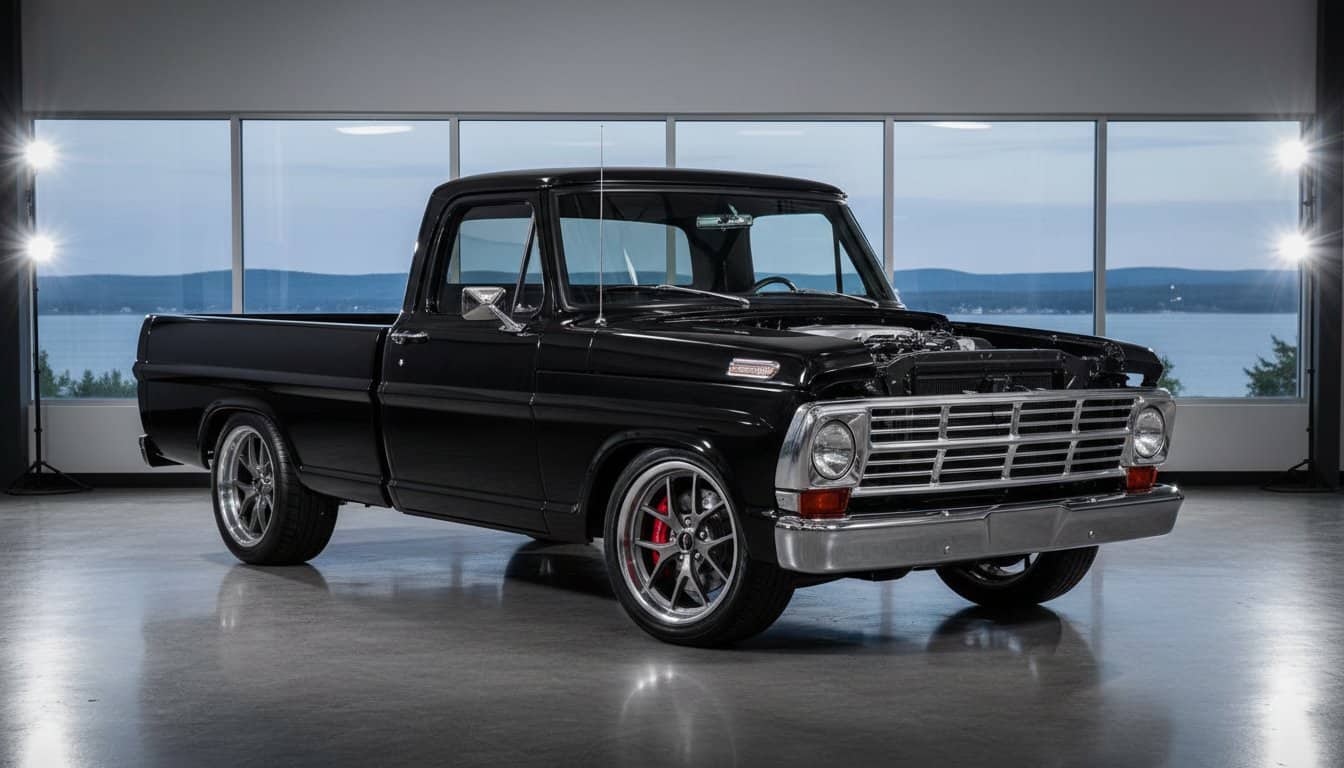
Driving a stock 1968 F-100 through modern traffic isn’t a nostalgic trip; it’s a dangerous workout. You love the iconic lines of vintage steel, but you’re likely tired of the heavy steering, weak drum brakes, and the feeling that you’re piloting a farm tractor rather than a pickup. It’s a frustration shared by thousands of enthusiasts who want the aesthetic of the past without the mechanical headaches of the 1960s. Building a restomod truck is the solution that bridges this gap, turning a temperamental relic into a high-performance machine that can keep up with any 2024 model on the highway.
At The Restomod Academy, we believe in the “built, not bought” philosophy. We’ll show you how to master this craft by providing a clear roadmap for your project. You’ll gain the confidence to choose the right donor vehicle and understand exactly which modern powerplants, like the 430-horsepower Chevrolet LS3 or the Ford 5.0L Coyote, fit your specific chassis. We’ll break down the complexities of suspension geometry and wiring harnesses into logical, achievable steps. This guide covers everything from sourcing parts to final assembly, ensuring you have the knowledge to transform a 50 year old garage find into a reliable, modern masterpiece.
Key Takeaways
- Understand the core philosophy of the restomod truck by learning how to blend timeless vintage aesthetics with the safety and reliability of modern engineering.
- Select your perfect canvas by identifying high-potential donor pickups while learning to spot the structural rust and frame damage that can sink a project.
- Master the technical foundation of your build by exploring chassis stiffening techniques and the transition from leaf springs to precision suspension systems.
- Modernize your driving experience by integrating high-performance HVAC systems and ergonomic interior upgrades that maintain a classic look and feel.
- Develop a realistic project blueprint and budget strategy to navigate the “while I’m at it” phase and ensure your build crosses the finish line.
What is a Restomod Truck? Defining the Modern Classic Pickup
Stop viewing your vintage pickup as a relic of the past and start seeing it as a blank canvas for high-performance engineering. A restomod truck represents the perfect marriage between mid-century soul and 21st-century capability. While a traditional restoration focuses on preserving every factory-correct nut and bolt, the restomod philosophy prioritizes the driving experience. You keep the iconic silhouette of a 1967 Chevy C10 or a 1978 Ford F-150 but replace the sluggish, drum-brake reality with the precision of modern automotive technology. When Defining Restomod projects, we focus on making the vehicle safer, faster, and more reliable than the day it rolled off the assembly line.
To better understand this concept, watch this helpful video:
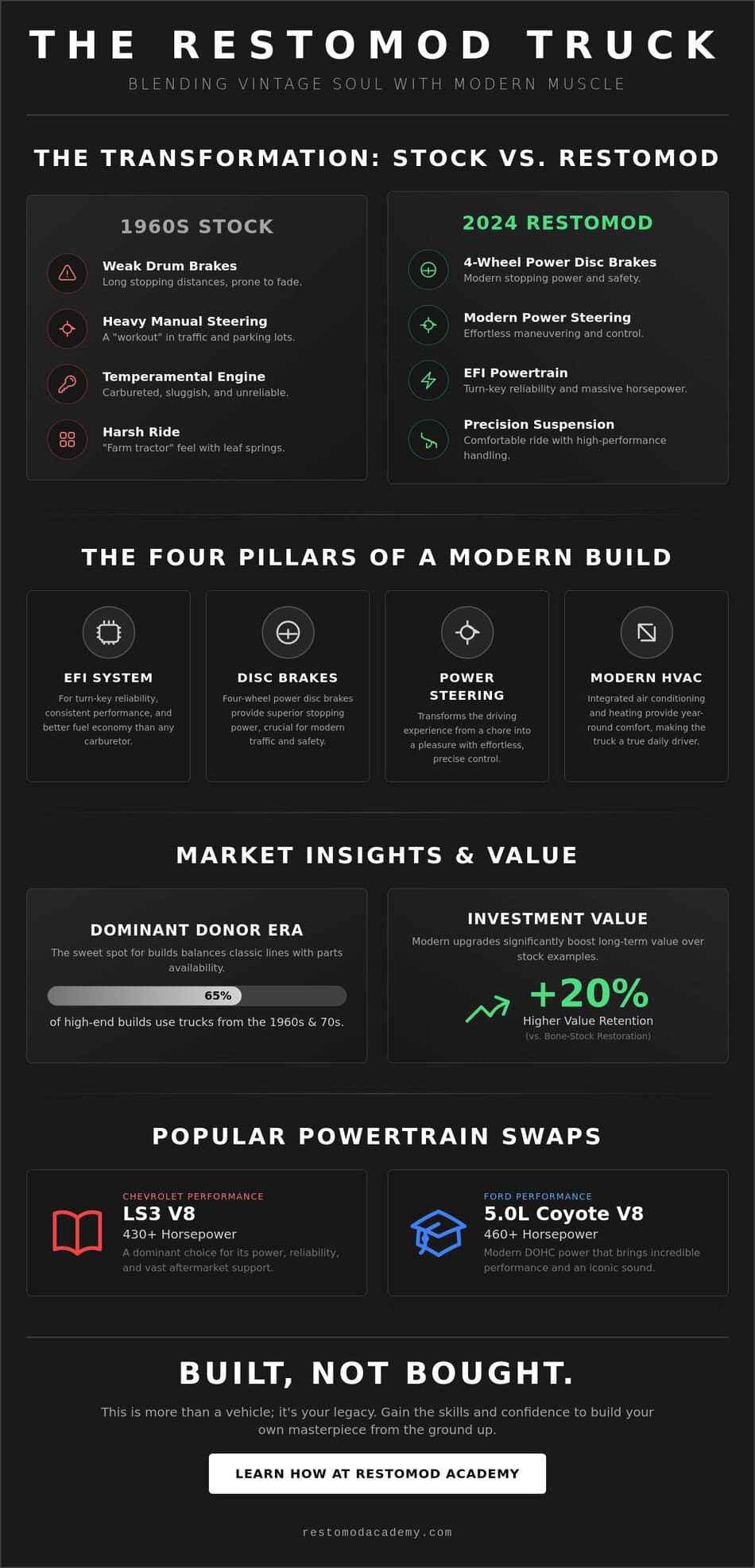
Embracing the “Built, Not Bought” mentality means you’re taking control of the machine’s DNA. You aren’t just a driver; you’re the lead engineer of your own legacy. A true restomod truck build typically includes four non-negotiable upgrades: electronic fuel injection (EFI) for turn-key reliability, four-wheel power disc brakes for modern stopping distances, power steering for effortless maneuvering, and integrated air conditioning for cabin comfort. These modifications transform a temperamental workhorse into a vehicle you can confidently drive across the country or through heavy morning traffic.
The Rise of the Restomod Pickup
Trucks have officially dethroned traditional muscle cars as the most desirable platforms for custom builders. This shift happened because pickups offer a unique emotional connection that a coupe can’t match. They represent a history of hard work and utility, now repurposed for a modern lifestyle. Data from 2023 auction results shows that well-executed vintage trucks are often the top sellers, drawing crowds who value the grit of a truck with the polish of a supercar. If you want a deeper dive into the foundations of this movement, check out our guide on what is a restomod to master the basics before you pick up a wrench.
Investment Value and Market Trends
The market for restomod trucks is surging because these vehicles offer double the value of a standard restoration. They serve as both a high-end showpiece and a functional tool that can actually haul a trailer or cruise at 80 mph on the highway. According to 2023 market reports from Hagerty, trucks with modern engine swaps and suspension upgrades see a 20% higher retention of value compared to bone-stock original examples. The sweet spot for restomod investment leading into 2026 focuses on 1980s “Square Body” pickups equipped with modern crate engines and digital interior integration.
Choosing Your Canvas: The Best Trucks for Restomodding
Every legendary build starts with a strategic purchase. You aren’t just looking for a vehicle; you’re selecting a foundation for a high-performance machine. Currently, 1960s and 70s models dominate the scene because they strike a perfect balance between vintage character and engine bay space. Data from recent auction trends shows that these two decades account for over 65 percent of all high-end truck builds. This popularity isn’t just about looks. It’s about the massive ecosystem of bolt-on parts that allow you to skip custom fabrication and get straight to the assembly.
Don’t let nostalgia blind you during an inspection. Rust is your primary enemy. While surface oxidation is manageable, “deal-breaker” rust lives in the cab corners, floor pans, and specifically the frame rails. If you see heavy scaling that flakes off in thick chunks or holes in the structural steel, walk away. A compromised frame ruins suspension geometry and safety. Additionally, always verify that the VIN on the dashboard matches the stamping on the frame. A “clean” title that doesn’t match the metal can slash your future resale value by 30 percent and create a nightmare at the DMV. Start your journey by understanding what is a restomod before you spend a dime on a donor vehicle.
Chevrolet C10: The King of the Aftermarket
The 1967 to 1972 “Action Line” Chevy is the most supported restomod truck in history. You can literally build an entire C10 from a catalog without using a single original GM part. These trucks are prized for their factory trailing arm rear suspension, which provides a much smoother ride than the leaf springs found on period Fords. This layout makes lowering the truck or installing an air-ride system remarkably simple. If you’re planning a modern powerplant, the engine bay is cavernous. It’s designed to swallow a V8 with room to spare. Check our LS engine swap guide to see why this chassis is the gold standard for enthusiasts who want 500 horsepower with daily-driver reliability.
Ford F-100: The Coyote-Powered Alternative
Ford fans typically hunt for the 1953 to 1956 “Effie” or the 1967 to 1972 “Bumpside” models. These trucks offer a rugged, industrial aesthetic that stands out in a sea of Chevys. However, the Ford chassis presents unique hurdles. The factory Twin I-Beam front suspension is notorious for poor tire wear and difficult alignment when lowered. To solve this, the pro move is a front-end swap using a subframe from a 2003 to 2011 Ford Crown Victoria. This modification grants you modern rack-and-pinion steering and massive disc brakes in one afternoon of welding. It’s a technical challenge, but it transforms a wandering farm truck into a precision-handling restomod truck that can carve corners as well as any modern sport sedan.
The Technical Foundation: Chassis, Power, and Braking
Building a high-performance restomod truck starts where the eyes rarely look: the frame. Most vintage pickups, such as the iconic 1967-1972 Chevy C10, utilize an open C-channel chassis. While this design was perfect for hauling farm equipment in 1970, it lacks the torsional rigidity required to handle 500 horsepower. When you drop a high-output engine into an unreinforced frame, the metal twists under load. You must weld in steel boxing plates to transform that C-channel into a rigid box. This modification can increase frame stiffness by more than 50 percent, providing a stable platform for every other upgrade.
Safety is your next priority. Ditch the manual drum brakes immediately. Stopping a 4,000-pound steel vehicle with 1950s technology is a recipe for disaster. Upgrade to a power-assisted big brake kit featuring 12-inch or 13-inch vented rotors. This hardware ensures consistent stopping power without the terrifying brake fade common in stock setups. Pair your new brakes with a modern steering conversion. Moving from a sloppy recirculating ball gearbox to a rack-and-pinion system eliminates that four-inch “dead zone” in the steering wheel. It gives you the precision of a modern sports car while you’re sitting behind the wheel of a classic.
Engine Swaps: LS vs. Coyote vs. EV
Modern fuel injection is non-negotiable if you want a truck that starts every time it’s cold. The GM LS platform is the undisputed king for budget-conscious builders. You can source a 5.3L Vortec engine from a salvage yard for approximately $1,500 and achieve 350 horsepower with ease. It’s a compact, reliable powerhouse. If you’re ready to dive in, explore our definitive guide to an LS engine swap for a step-by-step breakdown. Ford enthusiasts often prefer the 5.0L Coyote for its high-revving nature, though its wide footprint requires a larger engine bay. A new trend is “E-Modding,” where builders install electric crate motors. These setups offer 100 percent of their torque at zero RPM, providing a silent but violent acceleration that redefines the pickup experience.
Suspension Geometry and Ride Quality
The factory leaf spring setup was built for utility, not comfort. To achieve car-like handling, swap the rear for a 4-link suspension system. This setup locates the axle more precisely and eliminates axle wrap during hard acceleration. Up front, an Independent Front Suspension (IFS) kit is the most significant upgrade you can perform. You’ll need to choose between coilovers and air ride. Coilovers are the choice for those who value mechanical simplicity and track-ready handling. Air ride is the go-to for the “slammed” aesthetic, allowing you to park the frame on the grass at a show and then raise it to a comfortable height for the drive home. For more technical details on these systems, check out our suspension upgrades for cars guide.
Modernizing the Cab: Interior Comfort and Functional Utility
Your project might look like a 1968 C10 from the curb, but it shouldn’t feel like a tractor once you climb inside. The soul of a restomod truck lies in the cabin. Start with the seating. You don’t have to swap in bucket seats from a modern SUV to get comfort. Companies like TMI Products offer replacement foam and upholstery kits for original bench seats. These kits add aggressive bolsters and lumbar support while keeping that iconic flat-bench silhouette. It’s about maintaining the heritage while saving your lower back during a three-hour cruise.
Temperature control is your next priority. A standard heater box from 1972 won’t cut it in July. Integrate a Vintage Air Gen IV or Gen V system. These units are compact and tuck neatly behind the dashboard, replacing the bulky factory heater and adding ice-cold air conditioning. They use electronic servo motors instead of old vacuum cables, giving you precise control over airflow through your original dash vents.
Don’t overlook the silence. A high-performance build is loud, so you need a barrier between the road and your ears. Apply 100% butyl sound deadener, like Dynamat or HushMat, to the floor pans, firewall, and back wall. This layer can reduce interior noise levels by 10 to 15 decibels. It transforms a rattling tin box into a refined driving environment where you can actually hold a conversation at 70 mph.
For the bed, choose a balance of form and function. If you plan to use your restomod truck for hauling, a spray-in liner color-matched to your paint is the most durable route. If it’s a show-stopper, install a Mar-K wood bed kit with stainless steel strips. Use a UV-resistant marine-grade finish to prevent the wood from graying after 24 months of sun exposure. Hidden bed floor fasteners are a great touch to keep the floor surface smooth and clean.
Digital Integration and Audio
Monitor your engine with precision. Swap your mechanical gauges for a Dakota Digital RTX system. These units look like factory needles and numbers until you turn the key, revealing digital sub-menus and GPS-driven speed accuracy. For sound, use a RetroSound head unit. It fits the stock radio opening without cutting the metal, providing Bluetooth 5.0 and 300 watts of power. For more inspiration, see our Restomod Interior Ideas to blend vintage style with modern comfort.
Exterior Aesthetics and Paint
Decide on your visual identity early. A high-gloss finish requires hundreds of hours of block sanding, while a preserved patina look celebrates the truck’s history. If you go the patina route, use a matte clear coat to freeze the oxidation and prevent further rust. Upgrade your safety with LED lighting. Modern 7-inch round LED headlights, like those from Holley RetroBright, produce 4,000 lumens compared to the 1,000 lumens of a standard sealed beam. Consult our Classic Car Bodywork Guide for professional metal prep techniques.
Ready to start your transformation? Check out our recommended gear to find the tools you need for a professional-grade cabin overhaul.
Planning Your Project: Budget, Blueprints, and Execution
Building a restomod truck requires more than just a toolbox and a dream; it demands a tactical map. Your first move is to draft a budget that reflects reality. Experience shows that even the most meticulous planners should add a 20% contingency fund to their total estimate. This “while I’m at it” tax covers the inevitable discoveries, like hidden frame rot or the sudden urge to upgrade to a four-link suspension while the bed is already off. If you plan for these costs early, they won’t stall your momentum later.
Don’t let your project become a permanent lawn ornament. Adopt a phase-based build strategy to keep the wheels turning. Start with the “Go” (engine and drivetrain), move to the “Stop” (brakes and suspension), and finish with the “Show” (paint and interior). This approach ensures you enjoy the fruits of your labor during the process rather than waiting five years for a single test drive. It keeps the passion alive when the mechanical hurdles feel high.
While the “built, not bought” ethos is our North Star, pure DIY trial and error can be a black hole for your time. Professional consulting isn’t an admission of defeat; it’s a strategic shortcut. Spending an hour with a mentor can prevent a $2,000 mistake in suspension geometry or drivetrain alignment. Value your time as much as your parts list.
Restomod Academy Resources
Our Premium Project Blueprints act as your master engineering file. They eliminate the guesswork that typically consumes 100 or more hours of fabrication time. Use these guides to ensure every bracket and mount fits the first time. Before you turn a single bolt, visit our Recommended Gear page to stock your shop with the essential tools required for high-level craftsmanship. If you hit a wall, book a session with an Expert Mentor to get your build back on track.
The Final Checklist
The transition from shop floor to open road is the most dangerous phase of any restomod truck build. Follow these non-negotiable protocols before you turn the key:
- Wiring Integrity: Replace every inch of 50-year-old copper. Original harnesses are brittle and prone to fire; modern electronics demand the stable voltage of a new, fused system.
- Fluid Dynamics: Perform a 24-hour leak check on all systems. For new crate engines, follow the manufacturer’s specific break-in oil requirements to protect your investment.
- Torque Verification: Mark every critical chassis bolt with a paint pen once it reaches final torque spec to provide a visual safety confirmation.
The Academy approach ensures that your first drive is defined by the roar of the exhaust rather than the scent of burning oil.
Take the Wheel of Your Custom Build
Transforming a vintage pickup into a high-performance restomod truck is a journey that demands both grit and precision. You’ve learned the essential pillars of a successful build, from selecting a solid C10 or F-100 foundation to mastering complex suspension geometry and modern wiring harnesses. A great project isn’t just about the parts you buy; it’s about the craftsmanship you apply to every weld and bolt. By following a structured blueprint and setting a realistic execution timeline, you ensure your classic steel performs with the reliability of a modern machine.
You don’t have to navigate the technical hurdles of fabrication and engine swaps by yourself. Gain access to expert mentorship from Brook Walsh and utilize proven project blueprints that have already guided thousands of active builders in our community. Whether you’re refining a daily driver or crafting a show-stopper, the right guidance makes every hour in the garage more productive. Download the Ultimate Restomod Guide and start your build today! Your vision for a perfected classic is within reach, and we’re here to help you bring it to life.
Frequently Asked Questions
How much does a restomod truck project typically cost?
A professional restomod truck project ranges from $30,000 for a disciplined DIY build to over $150,000 for high-end shop commissions. According to 2023 auction data, the total investment depends heavily on the condition of your donor steel and your performance goals. Allocate 20 percent of your budget for hidden rust repairs or electrical upgrades. Quality components like independent front suspensions or bespoke interiors quickly move the needle toward the higher end of that scale.
What is the best donor truck for a beginner restomod builder?
The 1967 to 1972 Chevrolet C10 stands as the premier choice for your first project because of its massive aftermarket support. You can source every replacement part from specialized catalogs, which simplifies the assembly process. Choosing this platform ensures your restomod truck journey stays focused on progress rather than difficult custom fabrication. Ford F-100 models from 1953 to 1956 offer a similar path, though they often require more complex suspension grafts to achieve modern handling.
Can I daily drive a restomod truck?
You can absolutely daily drive your truck if you prioritize modern reliability during the build phase. Install electronic fuel injection and an overdrive transmission to achieve 15 to 20 miles per gallon on the highway. Use modern sound deadening materials to keep cabin noise below 70 decibels for a comfortable commute. Adding power disc brakes and a vintage-style air conditioning system transforms a 60 year old workhorse into a dependable, modern driver that handles traffic with ease.
Will restomodding my truck hurt its resale value?
Restomodding generally increases a truck’s market value compared to a stock, unrestored original. Market trends from Hagerty indicate that high-quality builds often sell for 30 to 50 percent more than factory-spec survivors. Buyers today crave the classic aesthetic paired with “turn-key” reliability and safety. Keep a detailed binder of your receipts and part numbers to prove the quality of your craftsmanship. This documentation validates your hard work and secures a higher price point when it’s time to sell.
LS Swap vs. Coyote Swap: Which is better for a pickup?
The GM LS engine is the superior choice for budget-conscious builders, while the Ford Coyote offers high-tech performance for brand purists. LS engines are physically compact and fit into narrow engine bays without major modifications. You can find a 5.3L Vortec engine for roughly $1,500 at most salvage yards; however, a new Coyote crate engine often starts near $10,000. Choose the LS for its simplicity and affordability or the Coyote for its modern overhead-cam power and Ford heritage.
Do I need a custom chassis for my restomod truck?
You don’t need a custom chassis unless you plan to exceed 500 horsepower or want an aggressive, ground-hugging stance. Original frames from the 1950s handle modern cruising well once you box the rails for added rigidity. If you demand world-class handling, companies like Roadster Shop offer full chassis that provide a performance-tuned foundation. This path eliminates the need for individual suspension swaps but adds at least $15,000 to your total build cost before you even buy an engine.
How long does a full truck restomod project take to complete?
A comprehensive restomod truck build typically requires between 1,500 and 2,500 man-hours of labor. For a hobbyist working on weekends, this timeline usually spans two to five years. Professional shops might finish a build in 12 months, but they apply 40 hours of focused work every week. Break your project into logical milestones like “chassis completion” or “first engine start” to maintain your motivation. Patience is your most important tool when you’re aiming for a high-quality finish.
Is it cheaper to build a restomod truck or buy one already finished?
It’s almost always cheaper to buy a finished truck than to build one from scratch if you value your time at market rates. You can find sorted, high-quality builds for $45,000 to $60,000, which is often less than the cost of parts and professional paint. However, building it yourself ensures every bolt meets your personal standards. You gain the mechanical pride and deep technical knowledge that only comes from getting your hands dirty in the garage.
Driving a stock 1968 F-100 through modern traffic isn’t a nostalgic trip; it’s a dangerous workout. You love the iconic lines of vintage steel, but you’re likely tired of the heavy steering, weak drum brakes, and the feeling that you’re piloting a farm tractor rather than a pickup. It’s a frustration shared by thousands of enthusiasts who want the aesthetic of the past without the mechanical headaches of the 1960s. Building a restomod truck is the solution that bridges this gap, turning a temperamental relic into a high-performance machine that can keep up with any 2024 model on the highway.
At The Restomod Academy, we believe in the “built, not bought” philosophy. We’ll show you how to master this craft by providing a clear roadmap for your project. You’ll gain the confidence to choose the right donor vehicle and understand exactly which modern powerplants, like the 430-horsepower Chevrolet LS3 or the Ford 5.0L Coyote, fit your specific chassis. We’ll break down the complexities of suspension geometry and wiring harnesses into logical, achievable steps. This guide covers everything from sourcing parts to final assembly, ensuring you have the knowledge to transform a 50 year old garage find into a reliable, modern masterpiece.
Key Takeaways
- Understand the core philosophy of the restomod truck by learning how to blend timeless vintage aesthetics with the safety and reliability of modern engineering.
- Select your perfect canvas by identifying high-potential donor pickups while learning to spot the structural rust and frame damage that can sink a project.
- Master the technical foundation of your build by exploring chassis stiffening techniques and the transition from leaf springs to precision suspension systems.
- Modernize your driving experience by integrating high-performance HVAC systems and ergonomic interior upgrades that maintain a classic look and feel.
- Develop a realistic project blueprint and budget strategy to navigate the “while I’m at it” phase and ensure your build crosses the finish line.
What is a Restomod Truck? Defining the Modern Classic Pickup
Stop viewing your vintage pickup as a relic of the past and start seeing it as a blank canvas for high-performance engineering. A restomod truck represents the perfect marriage between mid-century soul and 21st-century capability. While a traditional restoration focuses on preserving every factory-correct nut and bolt, the restomod philosophy prioritizes the driving experience. You keep the iconic silhouette of a 1967 Chevy C10 or a 1978 Ford F-150 but replace the sluggish, drum-brake reality with the precision of modern automotive technology. When Defining Restomod projects, we focus on making the vehicle safer, faster, and more reliable than the day it rolled off the assembly line.
To better understand this concept, watch this helpful video:
Embracing the “Built, Not Bought” mentality means you’re taking control of the machine’s DNA. You aren’t just a driver; you’re the lead engineer of your own legacy. A true restomod truck build typically includes four non-negotiable upgrades: electronic fuel injection (EFI) for turn-key reliability, four-wheel power disc brakes for modern stopping distances, power steering for effortless maneuvering, and integrated air conditioning for cabin comfort. These modifications transform a temperamental workhorse into a vehicle you can confidently drive across the country or through heavy morning traffic.
The Rise of the Restomod Pickup
Trucks have officially dethroned traditional muscle cars as the most desirable platforms for custom builders. This shift happened because pickups offer a unique emotional connection that a coupe can’t match. They represent a history of hard work and utility, now repurposed for a modern lifestyle. Data from 2023 auction results shows that well-executed vintage trucks are often the top sellers, drawing crowds who value the grit of a truck with the polish of a supercar. If you want a deeper dive into the foundations of this movement, check out our guide on what is a restomod to master the basics before you pick up a wrench.
Investment Value and Market Trends
The market for restomod trucks is surging because these vehicles offer double the value of a standard restoration. They serve as both a high-end showpiece and a functional tool that can actually haul a trailer or cruise at 80 mph on the highway. According to 2023 market reports from Hagerty, trucks with modern engine swaps and suspension upgrades see a 20% higher retention of value compared to bone-stock original examples. The sweet spot for restomod investment leading into 2026 focuses on 1980s “Square Body” pickups equipped with modern crate engines and digital interior integration.
Choosing Your Canvas: The Best Trucks for Restomodding
Every legendary build starts with a strategic purchase. You aren’t just looking for a vehicle; you’re selecting a foundation for a high-performance machine. Currently, 1960s and 70s models dominate the scene because they strike a perfect balance between vintage character and engine bay space. Data from recent auction trends shows that these two decades account for over 65 percent of all high-end truck builds. This popularity isn’t just about looks. It’s about the massive ecosystem of bolt-on parts that allow you to skip custom fabrication and get straight to the assembly.
Don’t let nostalgia blind you during an inspection. Rust is your primary enemy. While surface oxidation is manageable, “deal-breaker” rust lives in the cab corners, floor pans, and specifically the frame rails. If you see heavy scaling that flakes off in thick chunks or holes in the structural steel, walk away. A compromised frame ruins suspension geometry and safety. Additionally, always verify that the VIN on the dashboard matches the stamping on the frame. A “clean” title that doesn’t match the metal can slash your future resale value by 30 percent and create a nightmare at the DMV. Start your journey by understanding what is a restomod before you spend a dime on a donor vehicle.
Chevrolet C10: The King of the Aftermarket
The 1967 to 1972 “Action Line” Chevy is the most supported restomod truck in history. You can literally build an entire C10 from a catalog without using a single original GM part. These trucks are prized for their factory trailing arm rear suspension, which provides a much smoother ride than the leaf springs found on period Fords. This layout makes lowering the truck or installing an air-ride system remarkably simple. If you’re planning a modern powerplant, the engine bay is cavernous. It’s designed to swallow a V8 with room to spare. Check our LS engine swap guide to see why this chassis is the gold standard for enthusiasts who want 500 horsepower with daily-driver reliability.
Ford F-100: The Coyote-Powered Alternative
Ford fans typically hunt for the 1953 to 1956 “Effie” or the 1967 to 1972 “Bumpside” models. These trucks offer a rugged, industrial aesthetic that stands out in a sea of Chevys. However, the Ford chassis presents unique hurdles. The factory Twin I-Beam front suspension is notorious for poor tire wear and difficult alignment when lowered. To solve this, the pro move is a front-end swap using a subframe from a 2003 to 2011 Ford Crown Victoria. This modification grants you modern rack-and-pinion steering and massive disc brakes in one afternoon of welding. It’s a technical challenge, but it transforms a wandering farm truck into a precision-handling restomod truck that can carve corners as well as any modern sport sedan.
The Technical Foundation: Chassis, Power, and Braking
Building a high-performance restomod truck starts where the eyes rarely look: the frame. Most vintage pickups, such as the iconic 1967-1972 Chevy C10, utilize an open C-channel chassis. While this design was perfect for hauling farm equipment in 1970, it lacks the torsional rigidity required to handle 500 horsepower. When you drop a high-output engine into an unreinforced frame, the metal twists under load. You must weld in steel boxing plates to transform that C-channel into a rigid box. This modification can increase frame stiffness by more than 50 percent, providing a stable platform for every other upgrade.
Safety is your next priority. Ditch the manual drum brakes immediately. Stopping a 4,000-pound steel vehicle with 1950s technology is a recipe for disaster. Upgrade to a power-assisted big brake kit featuring 12-inch or 13-inch vented rotors. This hardware ensures consistent stopping power without the terrifying brake fade common in stock setups. Pair your new brakes with a modern steering conversion. Moving from a sloppy recirculating ball gearbox to a rack-and-pinion system eliminates that four-inch “dead zone” in the steering wheel. It gives you the precision of a modern sports car while you’re sitting behind the wheel of a classic.
Engine Swaps: LS vs. Coyote vs. EV
Modern fuel injection is non-negotiable if you want a truck that starts every time it’s cold. The GM LS platform is the undisputed king for budget-conscious builders. You can source a 5.3L Vortec engine from a salvage yard for approximately $1,500 and achieve 350 horsepower with ease. It’s a compact, reliable powerhouse. If you’re ready to dive in, explore our definitive guide to an LS engine swap for a step-by-step breakdown. Ford enthusiasts often prefer the 5.0L Coyote for its high-revving nature, though its wide footprint requires a larger engine bay. A new trend is “E-Modding,” where builders install electric crate motors. These setups offer 100 percent of their torque at zero RPM, providing a silent but violent acceleration that redefines the pickup experience.
Suspension Geometry and Ride Quality
The factory leaf spring setup was built for utility, not comfort. To achieve car-like handling, swap the rear for a 4-link suspension system. This setup locates the axle more precisely and eliminates axle wrap during hard acceleration. Up front, an Independent Front Suspension (IFS) kit is the most significant upgrade you can perform. You’ll need to choose between coilovers and air ride. Coilovers are the choice for those who value mechanical simplicity and track-ready handling. Air ride is the go-to for the “slammed” aesthetic, allowing you to park the frame on the grass at a show and then raise it to a comfortable height for the drive home. For more technical details on these systems, check out our suspension upgrades for cars guide.
Modernizing the Cab: Interior Comfort and Functional Utility
Your project might look like a 1968 C10 from the curb, but it shouldn’t feel like a tractor once you climb inside. The soul of a restomod truck lies in the cabin. Start with the seating. You don’t have to swap in bucket seats from a modern SUV to get comfort. Companies like TMI Products offer replacement foam and upholstery kits for original bench seats. These kits add aggressive bolsters and lumbar support while keeping that iconic flat-bench silhouette. It’s about maintaining the heritage while saving your lower back during a three-hour cruise.
Temperature control is your next priority. A standard heater box from 1972 won’t cut it in July. Integrate a Vintage Air Gen IV or Gen V system. These units are compact and tuck neatly behind the dashboard, replacing the bulky factory heater and adding ice-cold air conditioning. They use electronic servo motors instead of old vacuum cables, giving you precise control over airflow through your original dash vents.
Don’t overlook the silence. A high-performance build is loud, so you need a barrier between the road and your ears. Apply 100% butyl sound deadener, like Dynamat or HushMat, to the floor pans, firewall, and back wall. This layer can reduce interior noise levels by 10 to 15 decibels. It transforms a rattling tin box into a refined driving environment where you can actually hold a conversation at 70 mph.
For the bed, choose a balance of form and function. If you plan to use your restomod truck for hauling, a spray-in liner color-matched to your paint is the most durable route. If it’s a show-stopper, install a Mar-K wood bed kit with stainless steel strips. Use a UV-resistant marine-grade finish to prevent the wood from graying after 24 months of sun exposure. Hidden bed floor fasteners are a great touch to keep the floor surface smooth and clean.
Digital Integration and Audio
Monitor your engine with precision. Swap your mechanical gauges for a Dakota Digital RTX system. These units look like factory needles and numbers until you turn the key, revealing digital sub-menus and GPS-driven speed accuracy. For sound, use a RetroSound head unit. It fits the stock radio opening without cutting the metal, providing Bluetooth 5.0 and 300 watts of power. For more inspiration, see our Restomod Interior Ideas to blend vintage style with modern comfort.
Exterior Aesthetics and Paint
Decide on your visual identity early. A high-gloss finish requires hundreds of hours of block sanding, while a preserved patina look celebrates the truck’s history. If you go the patina route, use a matte clear coat to freeze the oxidation and prevent further rust. Upgrade your safety with LED lighting. Modern 7-inch round LED headlights, like those from Holley RetroBright, produce 4,000 lumens compared to the 1,000 lumens of a standard sealed beam. Consult our Classic Car Bodywork Guide for professional metal prep techniques.
Ready to start your transformation? Check out our recommended gear to find the tools you need for a professional-grade cabin overhaul.
Planning Your Project: Budget, Blueprints, and Execution
Building a restomod truck requires more than just a toolbox and a dream; it demands a tactical map. Your first move is to draft a budget that reflects reality. Experience shows that even the most meticulous planners should add a 20% contingency fund to their total estimate. This “while I’m at it” tax covers the inevitable discoveries, like hidden frame rot or the sudden urge to upgrade to a four-link suspension while the bed is already off. If you plan for these costs early, they won’t stall your momentum later.
Don’t let your project become a permanent lawn ornament. Adopt a phase-based build strategy to keep the wheels turning. Start with the “Go” (engine and drivetrain), move to the “Stop” (brakes and suspension), and finish with the “Show” (paint and interior). This approach ensures you enjoy the fruits of your labor during the process rather than waiting five years for a single test drive. It keeps the passion alive when the mechanical hurdles feel high.
While the “built, not bought” ethos is our North Star, pure DIY trial and error can be a black hole for your time. Professional consulting isn’t an admission of defeat; it’s a strategic shortcut. Spending an hour with a mentor can prevent a $2,000 mistake in suspension geometry or drivetrain alignment. Value your time as much as your parts list.
Restomod Academy Resources
Our Premium Project Blueprints act as your master engineering file. They eliminate the guesswork that typically consumes 100 or more hours of fabrication time. Use these guides to ensure every bracket and mount fits the first time. Before you turn a single bolt, visit our Recommended Gear page to stock your shop with the essential tools required for high-level craftsmanship. If you hit a wall, book a session with an Expert Mentor to get your build back on track.
The Final Checklist
The transition from shop floor to open road is the most dangerous phase of any restomod truck build. Follow these non-negotiable protocols before you turn the key:
- Wiring Integrity: Replace every inch of 50-year-old copper. Original harnesses are brittle and prone to fire; modern electronics demand the stable voltage of a new, fused system.
- Fluid Dynamics: Perform a 24-hour leak check on all systems. For new crate engines, follow the manufacturer’s specific break-in oil requirements to protect your investment.
- Torque Verification: Mark every critical chassis bolt with a paint pen once it reaches final torque spec to provide a visual safety confirmation.
The Academy approach ensures that your first drive is defined by the roar of the exhaust rather than the scent of burning oil.
Take the Wheel of Your Custom Build
Transforming a vintage pickup into a high-performance restomod truck is a journey that demands both grit and precision. You’ve learned the essential pillars of a successful build, from selecting a solid C10 or F-100 foundation to mastering complex suspension geometry and modern wiring harnesses. A great project isn’t just about the parts you buy; it’s about the craftsmanship you apply to every weld and bolt. By following a structured blueprint and setting a realistic execution timeline, you ensure your classic steel performs with the reliability of a modern machine.
You don’t have to navigate the technical hurdles of fabrication and engine swaps by yourself. Gain access to expert mentorship from Brook Walsh and utilize proven project blueprints that have already guided thousands of active builders in our community. Whether you’re refining a daily driver or crafting a show-stopper, the right guidance makes every hour in the garage more productive. Download the Ultimate Restomod Guide and start your build today! Your vision for a perfected classic is within reach, and we’re here to help you bring it to life.
Frequently Asked Questions
How much does a restomod truck project typically cost?
A professional restomod truck project ranges from $30,000 for a disciplined DIY build to over $150,000 for high-end shop commissions. According to 2023 auction data, the total investment depends heavily on the condition of your donor steel and your performance goals. Allocate 20 percent of your budget for hidden rust repairs or electrical upgrades. Quality components like independent front suspensions or bespoke interiors quickly move the needle toward the higher end of that scale.
What is the best donor truck for a beginner restomod builder?
The 1967 to 1972 Chevrolet C10 stands as the premier choice for your first project because of its massive aftermarket support. You can source every replacement part from specialized catalogs, which simplifies the assembly process. Choosing this platform ensures your restomod truck journey stays focused on progress rather than difficult custom fabrication. Ford F-100 models from 1953 to 1956 offer a similar path, though they often require more complex suspension grafts to achieve modern handling.
Can I daily drive a restomod truck?
You can absolutely daily drive your truck if you prioritize modern reliability during the build phase. Install electronic fuel injection and an overdrive transmission to achieve 15 to 20 miles per gallon on the highway. Use modern sound deadening materials to keep cabin noise below 70 decibels for a comfortable commute. Adding power disc brakes and a vintage-style air conditioning system transforms a 60 year old workhorse into a dependable, modern driver that handles traffic with ease.
Will restomodding my truck hurt its resale value?
Restomodding generally increases a truck’s market value compared to a stock, unrestored original. Market trends from Hagerty indicate that high-quality builds often sell for 30 to 50 percent more than factory-spec survivors. Buyers today crave the classic aesthetic paired with “turn-key” reliability and safety. Keep a detailed binder of your receipts and part numbers to prove the quality of your craftsmanship. This documentation validates your hard work and secures a higher price point when it’s time to sell.
LS Swap vs. Coyote Swap: Which is better for a pickup?
The GM LS engine is the superior choice for budget-conscious builders, while the Ford Coyote offers high-tech performance for brand purists. LS engines are physically compact and fit into narrow engine bays without major modifications. You can find a 5.3L Vortec engine for roughly $1,500 at most salvage yards; however, a new Coyote crate engine often starts near $10,000. Choose the LS for its simplicity and affordability or the Coyote for its modern overhead-cam power and Ford heritage.
Do I need a custom chassis for my restomod truck?
You don’t need a custom chassis unless you plan to exceed 500 horsepower or want an aggressive, ground-hugging stance. Original frames from the 1950s handle modern cruising well once you box the rails for added rigidity. If you demand world-class handling, companies like Roadster Shop offer full chassis that provide a performance-tuned foundation. This path eliminates the need for individual suspension swaps but adds at least $15,000 to your total build cost before you even buy an engine.
How long does a full truck restomod project take to complete?
A comprehensive restomod truck build typically requires between 1,500 and 2,500 man-hours of labor. For a hobbyist working on weekends, this timeline usually spans two to five years. Professional shops might finish a build in 12 months, but they apply 40 hours of focused work every week. Break your project into logical milestones like “chassis completion” or “first engine start” to maintain your motivation. Patience is your most important tool when you’re aiming for a high-quality finish.
Is it cheaper to build a restomod truck or buy one already finished?
It’s almost always cheaper to buy a finished truck than to build one from scratch if you value your time at market rates. You can find sorted, high-quality builds for $45,000 to $60,000, which is often less than the cost of parts and professional paint. However, building it yourself ensures every bolt meets your personal standards. You gain the mechanical pride and deep technical knowledge that only comes from getting your hands dirty in the garage.