
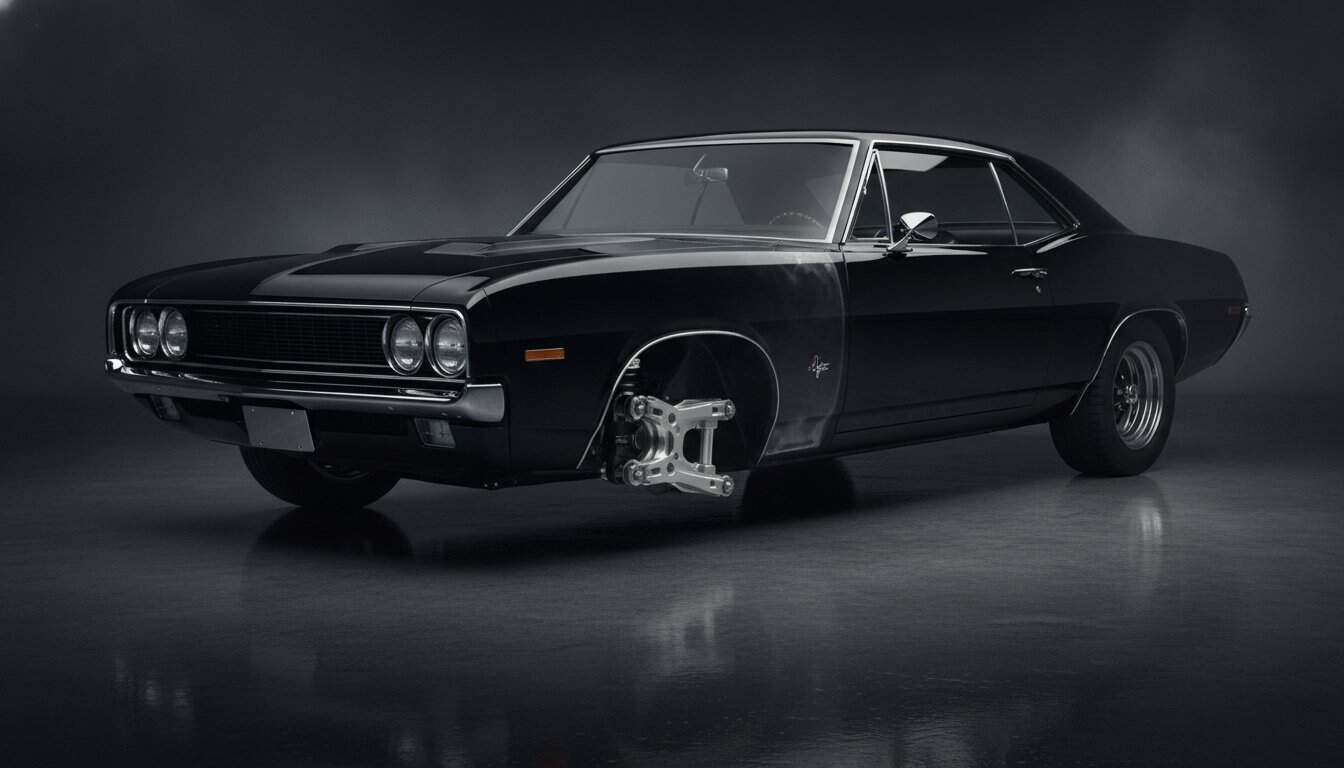
A classic car rack and pinion conversion is not just a simple part swap; it is a fundamental re-engineering of your vintage machine’s front-end geometry to meet modern safety standards. You likely know the exhaustion of constant course correction on the highway or the frustration of a massive dead spot in the center of your steering wheel. It’s a common hurdle for enthusiasts who want to enjoy their heritage steel without the vague, heavy feel of a leaking original steering box. By transitioning to a modern rack, you can shed up to 25 pounds of bulky iron and finally gain the road feedback your car deserves.
I understand the hesitation that comes with modifying a classic, but the rewards of precision handling far outweigh the nostalgia of a wandering front end. In this 2026 guide, I will show you how to eliminate steering play and transform your handling with the right conversion kit. We will break down the differences between manual, hydraulic, and the latest electric power assisted systems. You’ll learn how to select a setup that provides better header clearance for engine swaps and ensures your project is both safe and exhilarating to drive.
Key Takeaways
- Understand why replacing a vague recirculating ball system is the single most effective way to restore driver confidence and eliminate highway wander.
- Master the mechanics of a classic car rack and pinion conversion to achieve a direct, linear steering feel that mirrors the precision of a modern performance machine.
- Evaluate the distinct advantages of manual, hydraulic, and modern electric systems to find the perfect balance of road feedback and driver comfort for your specific build.
- Follow a methodical roadmap for dismantling original components and preparing your chassis for a secure, professional-grade rack installation.
- Learn how to synchronize your new steering system with suspension and braking upgrades to create a cohesive and safe high-performance restomod.
Beyond the Vague: Why a Classic Car Rack and Pinion Conversion is Essential
The sensation of driving a vintage muscle car often starts with a frantic dance at the steering wheel. You’re cruising at highway speeds, yet the car seems to have a mind of its own, wandering between lane markers while you struggle to find the center. This disconnected feeling stems from the antiquated recirculating ball steering box. By opting for a classic car rack and pinion conversion, you replace a complex network of worn joints with a streamlined, modern mechanism. A rack and pinion system provides a direct mechanical link between your hands and the asphalt, turning every small input into immediate direction.
To better understand how this mechanical transition improves your drive, watch this helpful video:
Beyond the tactile feedback, there is a significant safety argument for this upgrade. In an emergency swerve, the lag time of an old steering box can be the difference between a close call and a collision. Modern racks offer the precision needed for high-speed stability. Additionally, removing the bulky steering box and its associated linkages can shed up to 25 pounds from your front end. This weight reduction improves weight distribution, while the smaller footprint of the rack opens up vital space in the engine bay. If you are planning an LS engine swap, this extra clearance for headers is often a necessity rather than a luxury.
The Death of the Steering Box: Wear and Vague Feedback
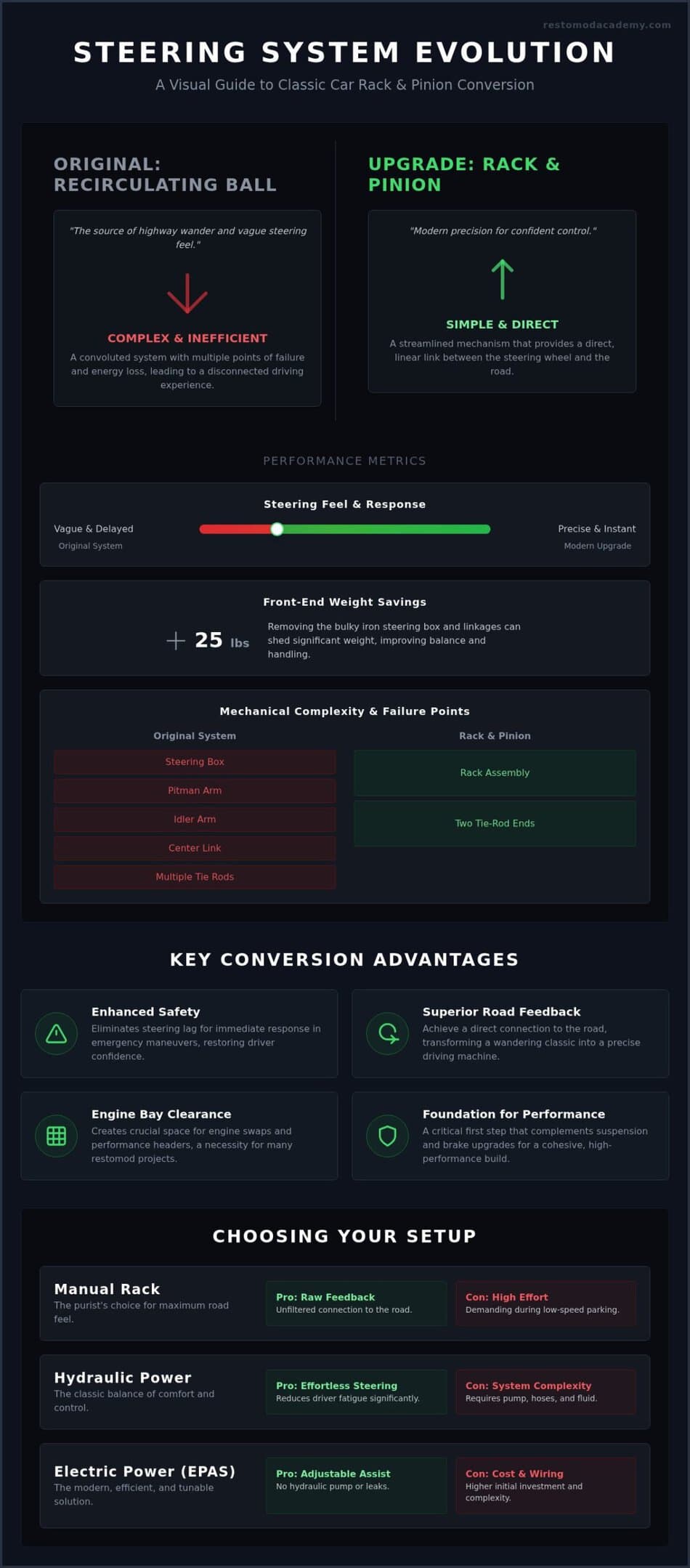
Original steering boxes rely on a series of ball bearings moving through a worm gear. Over decades, these components develop flat spots and internal play that manifest as a “dead spot” in your steering wheel. This isn’t just about the box itself. The original linkage is a crowded assembly of pitman arms, idler arms, and center links. Each of these pivot points represents a potential source of steering slop and vibration. When you perform a classic car rack and pinion conversion, you eliminate these variables, replacing a dozen failure points with two simple tie-rod ends.
Precision and Ratios: The Modern Driving Experience
Vintage steering boxes often feature slow ratios that require several full rotations of the wheel just to navigate a parking lot. Modern rack units offer quicker ratios, allowing for a more responsive and athletic driving experience. This shift transforms the psychological burden of driving. Instead of wrestling with a heavy, unpredictable machine, you gain effortless steering control and rock-solid highway stability. This precision is the essential foundation for any daily-driver restomod project, ensuring the car remains a joy to drive rather than a chore to manage.
The Mechanical Shift: How Rack and Pinion Differs from Original Systems
To understand the brilliance of a classic car rack and pinion conversion, you first need to look at the elegant simplicity of its design. While your original system likely relies on a heavy cast iron box filled with recirculating ball bearings, a rack and pinion consists of three primary components: the pinion gear, the rack bar, and the tie rods. The pinion gear sits at the end of your steering column and meshes directly with the teeth on the rack bar. When you turn the wheel, the pinion moves the bar left or right. It’s a closed, efficient loop that replaces the convoluted “Z” pattern of original linkages.
This shift from rotational motion to direct linear motion is where the magic happens. In a traditional setup, the steering box turns a pitman arm, which moves a center link, which eventually moves the wheels. Each transition is an opportunity for energy loss and mechanical slop. As highlighted in the SAE International technical paper Improvements in Rack and Pinion Steering Gears, this design drastically reduces internal friction. By eliminating the mechanical middleman, you gain a level of responsiveness that makes your vintage machine feel decades younger.
When planning your build, pay close attention to your chassis configuration. You will encounter either front-steer setups, where the rack sits ahead of the front axle, or rear-steer configurations, where it sits behind. Matching the rack to your specific spindle geometry is critical to avoiding the dreaded bump steer. Most high-quality kits are designed to work with original spindles, but they truly excel when paired with modern tubular control arms. If you’re feeling overwhelmed by these technical choices, our Restomod Consulting Services can help you map out the perfect geometry for your specific frame.
Linear Precision: Eliminating the Middleman
The beauty of the pinion gear acting directly on the rack is the instant feedback. You aren’t waiting for four or five ball joints to take up their slack before the wheels move. However, keep in mind that rack length is a vital variable. A rack that is too short or too long for your specific track width can negatively impact your turning radius, making U-turns a multi-point ordeal. Precision is the goal here, and getting the dimensions right ensures your car handles as well in a parking lot as it does on the open road.
Weight and Space: Clearing Path for Modern Engines
Performing a classic car rack and pinion conversion is often a prerequisite for a successful LS engine swap. The slim profile of a rack provides the necessary clearance for high-performance headers and custom exhaust routing that a bulky steering box would block. By swapping cast iron for aluminum, you can shed up to 25 pounds from your front end. You aren’t just improving the feel; you’re creating a cleaner, more serviceable engine bay that accommodates modern powerplants with ease.
Choosing Your Setup: Power, Manual, and the Electric Revolution
Decide on your steering architecture before you turn a single bolt. Your choice between manual, hydraulic, or electric assistance defines the very character of your build. For some, the raw feedback of a manual rack is the only way to feel truly connected to the machine. Others prioritize the effortless glide of power assistance. As we move into 2026, the standard for high-end builds has shifted toward electric power steering (EPS). This technology offers the best of both worlds: modern precision without the clutter of hydraulic hoses. To get a foundational grasp on the mechanics, you can read about How Car Steering Works before diving into the specific upgrades.
A classic car rack and pinion conversion typically involves a financial commitment ranging from roughly $1,100 for a basic manual kit to over $3,500 for high-end power systems. While manual setups are the most affordable and easiest to install, they demand more physical effort at low speeds. Power systems, whether hydraulic or electric, add complexity but reward you with a car that handles modern traffic with grace. Choosing the right path depends entirely on your intended use, whether that is a weekend cruiser, a dedicated track car, or a daily driven restomod.
Hydraulic vs. Electric: The Modern Dilemma
Traditional hydraulic power steering relies on a belt-driven pump that saps a small amount of engine power. It’s a proven system, but it introduces the risk of leaks and requires high-pressure hoses that can clutter a clean engine bay. In contrast, EPS uses a 12V motor to provide assistance. These systems are incredibly efficient, with some drawing as little as 9 amps only when the wheel is turning. This allows you to keep the engine bay focused on the powerplant itself, free from the spiderweb of hydraulic plumbing. Many modern EPS kits even allow for adjustable steering feel, giving you the ability to dial in the perfect amount of resistance for your driving style.
Manual Racks: When Less is More
Manual racks are the preferred choice for purists and drag racers who value weight distribution and simplicity above all else. By removing the pump, brackets, and fluid, you shed unnecessary pounds and gain a direct mechanical feel that is unmatched by assisted systems. However, be cautious with vehicle weight. A heavy big-block car with a manual rack can be a significant workout during low-speed maneuvers. If you choose this path, ensure your classic car rack and pinion conversion kit uses a steering ratio specifically designed for manual use to keep the car manageable on the street.
The Installation Roadmap: Overcoming Common Steering Conversion Hurdles
Transitioning from a theoretical plan to the actual labor of a classic car rack and pinion conversion requires a methodical approach. Begin by clearing the stage. You must remove the entire original steering assembly, including the pitman arm, idler arm, center link, and that heavy, often greasy steering box. Once the frame rails are exposed, inspect them for any signs of fatigue or previous damage. Chassis preparation is the foundation of your build. If your kit uses a bolt-on cradle, ensure the mounting surfaces are perfectly flat and free of debris. For custom applications that require welding, take the time to measure three times before making a single tack weld. Precision here prevents headaches later.
After the rack is securely mounted, you must address the critical connection to your steering column. This involves measuring for the correct length of steering shaft and selecting the appropriate U-joints. Once the mechanical assembly is complete, finish the job with a professional alignment. If you’ve chosen a hydraulic setup, you will need to bleed the system. Jack up the front end and turn the wheel slowly from lock to lock with the engine running to purge any trapped air. This ensures a smooth, silent operation from the very first drive.
The Geometry Trap: Understanding and Fixing Bump Steer
Bump steer is the most common reason enthusiasts end up disappointed with their handling. It occurs when your suspension travels through its arc and forces the wheels to turn slightly without you moving the steering wheel. This creates a darting sensation over uneven pavement. To achieve a professional result, use a bump steer gauge to verify your tie rod angles. Your goal is to keep the tie rods on the same plane as your control arms throughout their travel. You can often correct minor geometry errors by adjusting the rack height or using specialized shims at the tie rod ends to achieve near-zero toe change.
The U-Joint Puzzle: Connecting the Column to the Rack
Connecting your existing column to a modern rack often requires a series of U-joints and intermediate shafts. Pay close attention to spline counts. A 1960s Ford column will have a different diameter and tooth count than a modern rack. Safety is paramount when setting these angles. Never exceed a 30 degree angle on any single U-joint, as this can lead to binding or a notched feeling in the steering. If your routing requires three joints to navigate around headers, you must install a support bearing on the center shaft to prevent the assembly from flopping. For a detailed roadmap on managing these complex mechanical intersections, consult our Premium Project Blueprints to ensure your build is engineered for safety.
Integrating Your Steering Upgrade into a Complete Restomod Build
Your journey with a classic car rack and pinion conversion is more than a single mechanical victory; it is a vital chapter in the evolution of your vehicle. To truly transform how your car feels, you must view the steering system as one component of a larger handling ecosystem. Precision at the wheel loses its value if the chassis remains hindered by soft, factory-style springs or outdated drum brakes. By planning your steering alongside other front-end modifications, you ensure that every part works in harmony to deliver a crisp, predictable driving experience.
Consider the relationship between steering and high-performance braking. When you dive into a corner, the weight of the car shifts forward, putting immense load on the front tires. A modern rack allows you to feel exactly where those tires are through the steering wheel, giving you the confidence to apply the brakes later and harder. This level of synchronization is what separates a collection of parts from a professional-grade build. To achieve this, many builders rely on our Premium Project Blueprints to verify component compatibility before they ever pick up a wrench.
Suspension Synergy: The Foundation of Handling
For the best results, your new steering rack should be paired with comprehensive suspension upgrades for cars. While a rack eliminates play, a coilover conversion provides the adjustable dampening and ride height needed to maximize that newfound precision. Don’t overlook the smaller details like bushings and ball joints. Replacing original rubber with polyurethane or delrin bushings will prevent the control arms from shifting under load, which preserves the alignment you worked so hard to achieve. This holistic approach ensures your car doesn’t just turn better, but it holds its line with unwavering stability.
Your Next Milestone: Mastering the Build
Once your steering is dialed in, you are perfectly positioned to tackle the next phase of your project. Completing a classic car rack and pinion conversion is often the first step toward a total modernization of your vintage machine. Many enthusiasts find that the extra clearance provided by a rack is the ideal catalyst for a classic car modern engine swap guide. Whether you are following the definitive guide to an ls engine swap or dropping in a modern Coyote, success depends on the meticulous restomod project planning phase where you map out your goals and budget. If you find yourself at a crossroads with custom chassis applications, I invite you to explore our Restomod Consulting Services. Whether you need a guiding hand or a master plan like The Ultimate Restomod Guide, we are here to help you transition from a passive admirer to an active creator of performance art.
Reclaim Your Connection to the Road
Mastering a classic car rack and pinion conversion is one of the most rewarding mechanical victories you can achieve in your workshop. By replacing a vague, aging steering box with a precise modern rack, you’ve done more than just fix a dead spot. You’ve fundamentally re-engineered your car for the demands of 2026 traffic and high-speed stability. Success lies in the details. Whether you chose a manual rack for its raw feedback or a modern electric system for a clean engine bay, your focus on geometry and safety ensures a professional result.
Your vintage steel deserves the reliability of contemporary technology without sacrificing its heritage soul. To ensure every component in your build works in perfect harmony, Download the Ultimate Restomod Guide to plan your steering upgrade. With authoritative guidance from enthusiast Brook Walsh and our Premium Project Blueprints, you can move forward with the confidence of an expert. The road ahead is much smoother when you have a master plan in hand. Grab your tools, trust the process, and get ready to experience your car with a level of precision you never thought possible.
Frequently Asked Questions
Can I install a rack and pinion kit myself in my home garage?
Yes, you can install many of these kits in a well-equipped home garage using standard hand tools. Most modern manufacturers design their systems as bolt-on units that require no welding or permanent frame alterations. However, you must be confident in your ability to dismantle suspension components and perform a basic alignment once the job is done. If you’re working on a complex custom chassis, consulting with a mentor ensures your mounting points are structurally sound and safe for the road.
How much does a typical classic car rack and pinion conversion cost?
A classic car rack and pinion conversion typically costs between $1,088 for a basic manual kit and over $4,000 for high-end power steering systems. For example, a 1967 Mustang manual rack is priced at approximately $1,088, while more comprehensive power kits for the same vehicle can exceed $3,200. If you opt for Electric Power Assisted Steering, kits for popular models like the 1968-1970 Mustang are often available for under $1,500, while BMW 2002 kits range from $1,060 to $1,360.
Will adding a rack and pinion kit give me more room for my LS swap headers?
Yes, a rack and pinion conversion provides significantly more clearance for LS swap headers by removing the bulky factory steering box. The original cast iron box often sits exactly where high-performance exhaust manifolds need to go. By swapping to a slim rack, you open up the engine bay, making it much easier to route large primary tubes. This extra room is a major reason why steering upgrades are a prerequisite for many modern engine swaps.
Do I need to change my steering column when I convert to a rack?
You don’t always need to replace your entire steering column, but you will almost certainly need to modify it or use a new intermediate shaft with U-joints. Most original columns are a single piece that connects directly to the steering box. To integrate a rack, you must often cut the column tube and install a lower bearing to support a new shaft. Many enthusiasts choose to upgrade to a modern tilt column at this stage to simplify the connection process and improve ergonomics.
What is bump steer and will a conversion kit cause it?
Bump steer is a change in toe angle caused by suspension movement, and while a conversion kit can cause it if improperly installed, a well-engineered kit is designed to minimize it. It happens when the tie rod and control arm don’t travel in the same arc. You must verify your tie rod angles during the installation. Using a bump steer gauge helps you adjust the rack height or tie rod ends to ensure your car tracks straight over every dip in the road.
Is a manual rack and pinion too hard to turn for a daily driver?
A manual rack can be perfectly suitable for a daily driver if your car is relatively lightweight and you use a correct steering ratio. If you’re driving a small-block coupe, the 25-pound weight savings and direct feedback make for an engaging experience. However, a heavy big-block car can be difficult to turn in parking lots without power assist. Consider your physical comfort and the car’s front-end weight before deciding to ditch the power steering pump for a manual setup.
Can I use my original power steering pump with a new rack?
You can often use your original hydraulic pump, but you must verify that its pressure output matches the requirements of the new rack. Most vintage pumps produce higher pressure than a modern rack needs, which can lead to twitchy steering or seal failure. You might need to install a pressure-reducing valve or a shim kit in the pump’s flow control valve. Alternatively, switching to a modern remote-reservoir pump or an electric system eliminates these compatibility hurdles entirely.
Does a rack and pinion conversion increase the resale value of my classic?
A high-quality steering conversion generally increases the resale value of a restomod by making the car more approachable and safer for modern drivers. Most buyers prioritize the precision of a classic car rack and pinion conversion over the vague feel of a 60-year-old steering box. While it may not appeal to a concourse purist who demands 100 percent originality, it significantly broadens the market for enthusiasts who want a vintage aesthetic combined with modern performance and reliability.
A classic car rack and pinion conversion is not just a simple part swap; it is a fundamental re-engineering of your vintage machine’s front-end geometry to meet modern safety standards. You likely know the exhaustion of constant course correction on the highway or the frustration of a massive dead spot in the center of your steering wheel. It’s a common hurdle for enthusiasts who want to enjoy their heritage steel without the vague, heavy feel of a leaking original steering box. By transitioning to a modern rack, you can shed up to 25 pounds of bulky iron and finally gain the road feedback your car deserves.
I understand the hesitation that comes with modifying a classic, but the rewards of precision handling far outweigh the nostalgia of a wandering front end. In this 2026 guide, I will show you how to eliminate steering play and transform your handling with the right conversion kit. We will break down the differences between manual, hydraulic, and the latest electric power assisted systems. You’ll learn how to select a setup that provides better header clearance for engine swaps and ensures your project is both safe and exhilarating to drive.
Key Takeaways
- Understand why replacing a vague recirculating ball system is the single most effective way to restore driver confidence and eliminate highway wander.
- Master the mechanics of a classic car rack and pinion conversion to achieve a direct, linear steering feel that mirrors the precision of a modern performance machine.
- Evaluate the distinct advantages of manual, hydraulic, and modern electric systems to find the perfect balance of road feedback and driver comfort for your specific build.
- Follow a methodical roadmap for dismantling original components and preparing your chassis for a secure, professional-grade rack installation.
- Learn how to synchronize your new steering system with suspension and braking upgrades to create a cohesive and safe high-performance restomod.
Beyond the Vague: Why a Classic Car Rack and Pinion Conversion is Essential
The sensation of driving a vintage muscle car often starts with a frantic dance at the steering wheel. You’re cruising at highway speeds, yet the car seems to have a mind of its own, wandering between lane markers while you struggle to find the center. This disconnected feeling stems from the antiquated recirculating ball steering box. By opting for a classic car rack and pinion conversion, you replace a complex network of worn joints with a streamlined, modern mechanism. A rack and pinion system provides a direct mechanical link between your hands and the asphalt, turning every small input into immediate direction.
To better understand how this mechanical transition improves your drive, watch this helpful video:
Beyond the tactile feedback, there is a significant safety argument for this upgrade. In an emergency swerve, the lag time of an old steering box can be the difference between a close call and a collision. Modern racks offer the precision needed for high-speed stability. Additionally, removing the bulky steering box and its associated linkages can shed up to 25 pounds from your front end. This weight reduction improves weight distribution, while the smaller footprint of the rack opens up vital space in the engine bay. If you are planning an LS engine swap, this extra clearance for headers is often a necessity rather than a luxury.
The Death of the Steering Box: Wear and Vague Feedback
Original steering boxes rely on a series of ball bearings moving through a worm gear. Over decades, these components develop flat spots and internal play that manifest as a “dead spot” in your steering wheel. This isn’t just about the box itself. The original linkage is a crowded assembly of pitman arms, idler arms, and center links. Each of these pivot points represents a potential source of steering slop and vibration. When you perform a classic car rack and pinion conversion, you eliminate these variables, replacing a dozen failure points with two simple tie-rod ends.
Precision and Ratios: The Modern Driving Experience
Vintage steering boxes often feature slow ratios that require several full rotations of the wheel just to navigate a parking lot. Modern rack units offer quicker ratios, allowing for a more responsive and athletic driving experience. This shift transforms the psychological burden of driving. Instead of wrestling with a heavy, unpredictable machine, you gain effortless steering control and rock-solid highway stability. This precision is the essential foundation for any daily-driver restomod project, ensuring the car remains a joy to drive rather than a chore to manage.
The Mechanical Shift: How Rack and Pinion Differs from Original Systems
To understand the brilliance of a classic car rack and pinion conversion, you first need to look at the elegant simplicity of its design. While your original system likely relies on a heavy cast iron box filled with recirculating ball bearings, a rack and pinion consists of three primary components: the pinion gear, the rack bar, and the tie rods. The pinion gear sits at the end of your steering column and meshes directly with the teeth on the rack bar. When you turn the wheel, the pinion moves the bar left or right. It’s a closed, efficient loop that replaces the convoluted “Z” pattern of original linkages.
This shift from rotational motion to direct linear motion is where the magic happens. In a traditional setup, the steering box turns a pitman arm, which moves a center link, which eventually moves the wheels. Each transition is an opportunity for energy loss and mechanical slop. As highlighted in the SAE International technical paper Improvements in Rack and Pinion Steering Gears, this design drastically reduces internal friction. By eliminating the mechanical middleman, you gain a level of responsiveness that makes your vintage machine feel decades younger.
When planning your build, pay close attention to your chassis configuration. You will encounter either front-steer setups, where the rack sits ahead of the front axle, or rear-steer configurations, where it sits behind. Matching the rack to your specific spindle geometry is critical to avoiding the dreaded bump steer. Most high-quality kits are designed to work with original spindles, but they truly excel when paired with modern tubular control arms. If you’re feeling overwhelmed by these technical choices, our Restomod Consulting Services can help you map out the perfect geometry for your specific frame.
Linear Precision: Eliminating the Middleman
The beauty of the pinion gear acting directly on the rack is the instant feedback. You aren’t waiting for four or five ball joints to take up their slack before the wheels move. However, keep in mind that rack length is a vital variable. A rack that is too short or too long for your specific track width can negatively impact your turning radius, making U-turns a multi-point ordeal. Precision is the goal here, and getting the dimensions right ensures your car handles as well in a parking lot as it does on the open road.
Weight and Space: Clearing Path for Modern Engines
Performing a classic car rack and pinion conversion is often a prerequisite for a successful LS engine swap. The slim profile of a rack provides the necessary clearance for high-performance headers and custom exhaust routing that a bulky steering box would block. By swapping cast iron for aluminum, you can shed up to 25 pounds from your front end. You aren’t just improving the feel; you’re creating a cleaner, more serviceable engine bay that accommodates modern powerplants with ease.
Choosing Your Setup: Power, Manual, and the Electric Revolution
Decide on your steering architecture before you turn a single bolt. Your choice between manual, hydraulic, or electric assistance defines the very character of your build. For some, the raw feedback of a manual rack is the only way to feel truly connected to the machine. Others prioritize the effortless glide of power assistance. As we move into 2026, the standard for high-end builds has shifted toward electric power steering (EPS). This technology offers the best of both worlds: modern precision without the clutter of hydraulic hoses. To get a foundational grasp on the mechanics, you can read about How Car Steering Works before diving into the specific upgrades.
A classic car rack and pinion conversion typically involves a financial commitment ranging from roughly $1,100 for a basic manual kit to over $3,500 for high-end power systems. While manual setups are the most affordable and easiest to install, they demand more physical effort at low speeds. Power systems, whether hydraulic or electric, add complexity but reward you with a car that handles modern traffic with grace. Choosing the right path depends entirely on your intended use, whether that is a weekend cruiser, a dedicated track car, or a daily driven restomod.
Hydraulic vs. Electric: The Modern Dilemma
Traditional hydraulic power steering relies on a belt-driven pump that saps a small amount of engine power. It’s a proven system, but it introduces the risk of leaks and requires high-pressure hoses that can clutter a clean engine bay. In contrast, EPS uses a 12V motor to provide assistance. These systems are incredibly efficient, with some drawing as little as 9 amps only when the wheel is turning. This allows you to keep the engine bay focused on the powerplant itself, free from the spiderweb of hydraulic plumbing. Many modern EPS kits even allow for adjustable steering feel, giving you the ability to dial in the perfect amount of resistance for your driving style.
Manual Racks: When Less is More
Manual racks are the preferred choice for purists and drag racers who value weight distribution and simplicity above all else. By removing the pump, brackets, and fluid, you shed unnecessary pounds and gain a direct mechanical feel that is unmatched by assisted systems. However, be cautious with vehicle weight. A heavy big-block car with a manual rack can be a significant workout during low-speed maneuvers. If you choose this path, ensure your classic car rack and pinion conversion kit uses a steering ratio specifically designed for manual use to keep the car manageable on the street.
The Installation Roadmap: Overcoming Common Steering Conversion Hurdles
Transitioning from a theoretical plan to the actual labor of a classic car rack and pinion conversion requires a methodical approach. Begin by clearing the stage. You must remove the entire original steering assembly, including the pitman arm, idler arm, center link, and that heavy, often greasy steering box. Once the frame rails are exposed, inspect them for any signs of fatigue or previous damage. Chassis preparation is the foundation of your build. If your kit uses a bolt-on cradle, ensure the mounting surfaces are perfectly flat and free of debris. For custom applications that require welding, take the time to measure three times before making a single tack weld. Precision here prevents headaches later.
After the rack is securely mounted, you must address the critical connection to your steering column. This involves measuring for the correct length of steering shaft and selecting the appropriate U-joints. Once the mechanical assembly is complete, finish the job with a professional alignment. If you’ve chosen a hydraulic setup, you will need to bleed the system. Jack up the front end and turn the wheel slowly from lock to lock with the engine running to purge any trapped air. This ensures a smooth, silent operation from the very first drive.
The Geometry Trap: Understanding and Fixing Bump Steer
Bump steer is the most common reason enthusiasts end up disappointed with their handling. It occurs when your suspension travels through its arc and forces the wheels to turn slightly without you moving the steering wheel. This creates a darting sensation over uneven pavement. To achieve a professional result, use a bump steer gauge to verify your tie rod angles. Your goal is to keep the tie rods on the same plane as your control arms throughout their travel. You can often correct minor geometry errors by adjusting the rack height or using specialized shims at the tie rod ends to achieve near-zero toe change.
The U-Joint Puzzle: Connecting the Column to the Rack
Connecting your existing column to a modern rack often requires a series of U-joints and intermediate shafts. Pay close attention to spline counts. A 1960s Ford column will have a different diameter and tooth count than a modern rack. Safety is paramount when setting these angles. Never exceed a 30 degree angle on any single U-joint, as this can lead to binding or a notched feeling in the steering. If your routing requires three joints to navigate around headers, you must install a support bearing on the center shaft to prevent the assembly from flopping. For a detailed roadmap on managing these complex mechanical intersections, consult our Premium Project Blueprints to ensure your build is engineered for safety.
Integrating Your Steering Upgrade into a Complete Restomod Build
Your journey with a classic car rack and pinion conversion is more than a single mechanical victory; it is a vital chapter in the evolution of your vehicle. To truly transform how your car feels, you must view the steering system as one component of a larger handling ecosystem. Precision at the wheel loses its value if the chassis remains hindered by soft, factory-style springs or outdated drum brakes. By planning your steering alongside other front-end modifications, you ensure that every part works in harmony to deliver a crisp, predictable driving experience.
Consider the relationship between steering and high-performance braking. When you dive into a corner, the weight of the car shifts forward, putting immense load on the front tires. A modern rack allows you to feel exactly where those tires are through the steering wheel, giving you the confidence to apply the brakes later and harder. This level of synchronization is what separates a collection of parts from a professional-grade build. To achieve this, many builders rely on our Premium Project Blueprints to verify component compatibility before they ever pick up a wrench.
Suspension Synergy: The Foundation of Handling
For the best results, your new steering rack should be paired with comprehensive suspension upgrades for cars. While a rack eliminates play, a coilover conversion provides the adjustable dampening and ride height needed to maximize that newfound precision. Don’t overlook the smaller details like bushings and ball joints. Replacing original rubber with polyurethane or delrin bushings will prevent the control arms from shifting under load, which preserves the alignment you worked so hard to achieve. This holistic approach ensures your car doesn’t just turn better, but it holds its line with unwavering stability.
Your Next Milestone: Mastering the Build
Once your steering is dialed in, you are perfectly positioned to tackle the next phase of your project. Completing a classic car rack and pinion conversion is often the first step toward a total modernization of your vintage machine. Many enthusiasts find that the extra clearance provided by a rack is the ideal catalyst for a classic car modern engine swap guide. Whether you are following the definitive guide to an ls engine swap or dropping in a modern Coyote, success depends on the meticulous restomod project planning phase where you map out your goals and budget. If you find yourself at a crossroads with custom chassis applications, I invite you to explore our Restomod Consulting Services. Whether you need a guiding hand or a master plan like The Ultimate Restomod Guide, we are here to help you transition from a passive admirer to an active creator of performance art.
Reclaim Your Connection to the Road
Mastering a classic car rack and pinion conversion is one of the most rewarding mechanical victories you can achieve in your workshop. By replacing a vague, aging steering box with a precise modern rack, you’ve done more than just fix a dead spot. You’ve fundamentally re-engineered your car for the demands of 2026 traffic and high-speed stability. Success lies in the details. Whether you chose a manual rack for its raw feedback or a modern electric system for a clean engine bay, your focus on geometry and safety ensures a professional result.
Your vintage steel deserves the reliability of contemporary technology without sacrificing its heritage soul. To ensure every component in your build works in perfect harmony, Download the Ultimate Restomod Guide to plan your steering upgrade. With authoritative guidance from enthusiast Brook Walsh and our Premium Project Blueprints, you can move forward with the confidence of an expert. The road ahead is much smoother when you have a master plan in hand. Grab your tools, trust the process, and get ready to experience your car with a level of precision you never thought possible.
Frequently Asked Questions
Can I install a rack and pinion kit myself in my home garage?
Yes, you can install many of these kits in a well-equipped home garage using standard hand tools. Most modern manufacturers design their systems as bolt-on units that require no welding or permanent frame alterations. However, you must be confident in your ability to dismantle suspension components and perform a basic alignment once the job is done. If you’re working on a complex custom chassis, consulting with a mentor ensures your mounting points are structurally sound and safe for the road.
How much does a typical classic car rack and pinion conversion cost?
A classic car rack and pinion conversion typically costs between $1,088 for a basic manual kit and over $4,000 for high-end power steering systems. For example, a 1967 Mustang manual rack is priced at approximately $1,088, while more comprehensive power kits for the same vehicle can exceed $3,200. If you opt for Electric Power Assisted Steering, kits for popular models like the 1968-1970 Mustang are often available for under $1,500, while BMW 2002 kits range from $1,060 to $1,360.
Will adding a rack and pinion kit give me more room for my LS swap headers?
Yes, a rack and pinion conversion provides significantly more clearance for LS swap headers by removing the bulky factory steering box. The original cast iron box often sits exactly where high-performance exhaust manifolds need to go. By swapping to a slim rack, you open up the engine bay, making it much easier to route large primary tubes. This extra room is a major reason why steering upgrades are a prerequisite for many modern engine swaps.
Do I need to change my steering column when I convert to a rack?
You don’t always need to replace your entire steering column, but you will almost certainly need to modify it or use a new intermediate shaft with U-joints. Most original columns are a single piece that connects directly to the steering box. To integrate a rack, you must often cut the column tube and install a lower bearing to support a new shaft. Many enthusiasts choose to upgrade to a modern tilt column at this stage to simplify the connection process and improve ergonomics.
What is bump steer and will a conversion kit cause it?
Bump steer is a change in toe angle caused by suspension movement, and while a conversion kit can cause it if improperly installed, a well-engineered kit is designed to minimize it. It happens when the tie rod and control arm don’t travel in the same arc. You must verify your tie rod angles during the installation. Using a bump steer gauge helps you adjust the rack height or tie rod ends to ensure your car tracks straight over every dip in the road.
Is a manual rack and pinion too hard to turn for a daily driver?
A manual rack can be perfectly suitable for a daily driver if your car is relatively lightweight and you use a correct steering ratio. If you’re driving a small-block coupe, the 25-pound weight savings and direct feedback make for an engaging experience. However, a heavy big-block car can be difficult to turn in parking lots without power assist. Consider your physical comfort and the car’s front-end weight before deciding to ditch the power steering pump for a manual setup.
Can I use my original power steering pump with a new rack?
You can often use your original hydraulic pump, but you must verify that its pressure output matches the requirements of the new rack. Most vintage pumps produce higher pressure than a modern rack needs, which can lead to twitchy steering or seal failure. You might need to install a pressure-reducing valve or a shim kit in the pump’s flow control valve. Alternatively, switching to a modern remote-reservoir pump or an electric system eliminates these compatibility hurdles entirely.
Does a rack and pinion conversion increase the resale value of my classic?
A high-quality steering conversion generally increases the resale value of a restomod by making the car more approachable and safer for modern drivers. Most buyers prioritize the precision of a classic car rack and pinion conversion over the vague feel of a 60-year-old steering box. While it may not appeal to a concourse purist who demands 100 percent originality, it significantly broadens the market for enthusiasts who want a vintage aesthetic combined with modern performance and reliability.